Yamazaki Hiroshi and light

When last August I attended the Image Forum Festival in Tokyo, one of my regrets was not having the time to be at a special focus dedicated to photographer and filmmaker Yamazaki Hiroshi. As I wrote in my report, one of the good points of the festival is that it is touring, although with a downsized program, in other parts of the country. When I saw the schedule of the screenings in Nagoya in September, I seized the opportunity and spend an afternoon immersing myself in the experimental films of Yamazaki.

Born in Nagano Prefecture in 1946 Yamazaki Hiroshi became a freelancer photographer after dropping out from Nihon University where he studied at the Department of Arts. Parallel with his career in photography, for which he is known in Japan and at an international level, some of his works are displayed at MoMa, Yamazaki developed a passion for the moving image and in 1972 started to shoot short movies in 8mm and 16mm. His experimental short films are a natural continuation of his work in photography, albeit there’s an obvious difference in tone between the two. Moving freely back and forth from still photography to moving images, Yamazaki’s central preoccupation throughout his career has remained the same: the role light and time play in creating images through the mechanical apparatus. His photos are thus not about depicting human beings, situations or even landscapes, they’re more on the verge of creating and conveying something new, something that is dormant in the everyday reality and must be brought to the surface to be seen. Almost like an artist playing with the relativity theory, by distorting time Yamazaki is modifying the shape of light and thus the reality he presents in his works. Often, and rightly so, defined as conceptual photographer, his works are more akin to the paintings of Klee, Pollock or other artists who were shifting the limits between natural representation and abstract art, that to the works made by his contemporary colleagues.
Yamazaki got his first big recognition in 1983 for a series of time-exposed photographs of the sun over the sea, one of the themes that he has been pursuing and investigating throughout his entire career, and a theme very present in all the works screened at the event.

Eighteen works were screened, some in their original format (8mm, 16mm), some others digitally, and they were divided into two sections. The last film screened, The Seas of Yamazki Hiroshi, was an homage to Yamazaki as an artist, friend and peer by photographer Hagiwara Sakumi. Planned and organised by the festival as a special screening to honour and remember an important Japanese photographer and filmmaker, it was for me a special occasion to experience, in one sitting, the attempts and experiments of an artist I didn’t know in a new medium. Here the works screened:

FIX YAMAZAKI Hiroshi / 16mm / 5min. / 1972 / Japan
FIXED-NIGHT YAMAZAKI Hiroshi / 16mm / 6min. / 1972 / Japan
FIXED STAR YAMAZAKI Hiroshi / 16mm / 7min. / 1973 / Japan
A STORY YAMAZAKI Hiroshi / 16mm / 6min. / 1973 / Japan
60 YAMAZAKI Hiroshi / 16mm / 1 min. / 1973 / Japan
NOON YAMAZAKI Hiroshi / 16mm / 3min. / 1976 / Japan
Observation YAMAZAKI Hiroshi / 16mm / 10min. / 1975 / Japan
epilogue YAMAZAKI Hiroshi / 16mm / 1 min. / 1976 / Japan
MOTION YAMAZAKI Hiroshi / 16mm / 10min. / 1980 / Japan
GEOGRAPHY YAMAZAKI Hiroshi / 16mm / 7min. / 1981 / Japan
[kei] 1991 YAMAZAKI Hiroshi / video / 13min. / 1991 / Japan

VISION TAKE 1 YAMAZAKI Hiroshi / 8mm / 3min. / 1973 / Japan
VISION TAKE 3 YAMAZAKI Hiroshi / 16mm / 3min. / 1978 / Japan
HELIOGRAPHY YAMAZAKI Hiroshi / 16mm / 6min. / 1979 / Japan
WALKING WORKS YAMAZAKI Hiroshi / 16mm / 5min. / 1983 / Japan
3・・・ YAMAZAKI Hiroshi / 16mm / 5min. / 1984 / Japan
WINDS YAMAZAKI Hiroshi / 16mm / 6min. / 1985 / Japan
Sakura YAMAZAKI Hiroshi / video / 19min. / 1989 / Japan
The Seas of YAMAZAKI Hiroshi HAGIWARA Sakumi / digital / 20min. / 2018 / Japan.

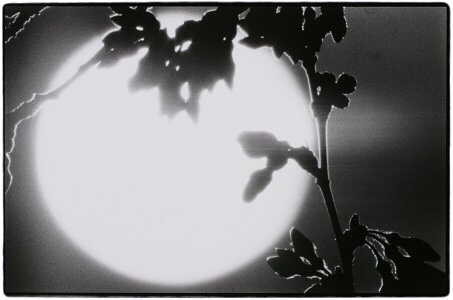
Among these works, three stood out for me. Observation (1975) is a ten-minute film, shot in 16mm, in which he created the illusion of twenty-eight suns arching over the sky in his neighborhood, and Sakura/Flowers in Space, shot on video in 1989, is a reflection on film of the ideas he captured in a series of photos towards the end of his career. Cherry blossoms are here depicted against the Sun, thus losing all the color and beauty they are usually associated with, and mutating instead into black shapeless figure of almost phantasmatic solitude.

But the absolute highlight was Heliography, a continuation but also a variation of what Yamazaki had being doing for more than 10 years with his photos, resulting in one of his most well known series, Heliography, released in 1974. In this series of photos of stunning visual impact Yamazaki subtracts all the unnecessary elements that usually are linked to a beautiful costal landscape, focusing primarily on the sun and the sea, captured here through very long exposures.
Seeing Heliography was for me almost a transcendental experience, and for a variety of different reasons. First of all because it came after an hour of seeing his short experiments in 8mm and 16mm, most of them interesting from a photographic point of view and in tracing a path in his oeuvre, but almost forgettable as stand alone works. Heliography arrived also as a natural progression of his experiments on film, but at the same time as a deviation and something completely new as well. It is visually and conceptually one of the most compelling films I have seen this year, six minutes of pure bliss. Like in La Région centrale, the oblique images of the Sun over the sea and the eye of the camera fixed and fixated on the star with everything else moving around, unanchor the viewers from the Earth, liberating and disengaging the vision from the human eye and re-centering it around the drifting Sun in what becomes in the end an astral landscape.

To add one more layer to the experience, I really believe that had I watched all the works at home on a TV, non matter how big, Heliography would not have retained the same majestic power, I know I’m stating the obvious here for most cinephiles, but certain type of experimental cinema should be absolutely seen in theater.

So I Can Be Alright : Cocco’s Endless Journey 大丈夫であるように-Cocco 終らない旅 (Kore’eda Hirokazu, 2008)

In 2007, just before making one of his best movies, Still Walking, Kore’eda Hirokazu started to film the Japanese singer Cocco and her concerts throughout Japan. The result was So I Can Be Alright : Cocco’s Endless Journey 大丈夫であるように-Cocco 終らない旅, a movie released theatrically in Japan the following year. It wasn’t a new encounter between the two, Cocco had collaborated before with Kore’eda when he directed two music videos for her, in 2002 Mizukagami, and in 2006 Hi no teri nagara ame no furu.
Cocco is probably more known outside Japan, especially among cinephiles, for her intense interpretation in Tsukamoto Shin’ya’s Kotoko, in my opinion, one of the best Japanese movies of the decade. The role she played in the movie had some affinities with her persona, a complex, delicate and troubled artist (at least she was so at the time of the shooting). Cocco’s eating disorders and self-harm tendencies are not a secret, when her diaphanous and skinny figure, not hiding the self-inflicted cuts on her wrists, appeared on the cover of the magazine Papyrus in October 2009, it caused quite a stir in the media.

It’s probably Cocco’s exceptional figure and personality, together with her uniqueness in Japanese show business world, that might have convinced Kore’eda to direct a documentary after more than five years from his previous one. As it is now well known, Kore’eda started his career in documentary, mainly for TV, when he joined the independent production company TV Man Union. However (1991) about the Minamata Disease and the legal struggles of the victims for compensation, was his debut, followed by Lesson from a Calf (1991) and I wanted to Be Japanese… (1992), the latter about the rights of second and third generation Koreans born and resident in Japan. In 1994 he directed August Without Him, a film that documents the fights of an AIDS patient and the relationship with his friends and with Kore’eda himself. From 1995 onwards, after his exceptional feature debut Maborosi/Maboroshi, Kore’eda then shifted towards fiction, but never really abandoned documentaries, a passion that he kept alive on the background of his main career. In 1996 for instance he was behind the camera for Without Memory, an indictment of medical malpractice and reflection on memory and loss, themes that feature prominently in all his fiction films. The most recent documentary-like work he directed was Ishibumi in 2015, a remake of a TV program made in 1969 about the tragedy of Hiroshima. While his commitment to documentary is still present, it is also obvious that his main career as a director has now moved away from it. Yet many of the qualities he developed as a documentarist are still very present in many of his feature films: the ability to improvise and capture the rawness of the moment, working with non-professional actors and children, and the use of natural light, for instance.

Cocco’s Endless Journey follows the Okinawa-born artist in an important period in her life and career, during her Kira-Kira Live Tour between 2007 and the beginning of 2008. The tour marked the 10th anniversary from her solo debut, and also a time when her insecurities as an artist and as a human being clashed, deteriorating her physical and mental condition.
The film moves pretty smoothly and ordinarily for most of its 110 minutes, performances by Cocco are alternated with the artist speaking with her staff or going back to Okinawa for a family reunion. But it’s in the last 20 minutes or so that the movie becomes a remarkable and fascinating watching. From a musical documentary following an artist, her concerts and her preoccupations with civil and environmental battles—Cocco’s tour touches Rokkasho, a town with a huge nuclear reprocessing plant in Aomori, and Okinawa with all the problems related to the presence of American bases, one of which being the extinction of the Okinawa dugong—the movie becomes something totally different. Cocco insecurities, her death drive and her fragile physical and psychological condition slowly come to the surface. It was something that was present before of course, we see her crying many times before or during the performances, but a long conversation with Kore’eda towards the end of the movie pushes the documentary to a different and somehow uncomfortable place. The long scene has a direct-cinema touch and works almost like a confession. On a hill facing the beautiful sea of Okinawa, Kore’eda, off camera, listens to Cocco talking about the difficulty of staying alive and about her suffering, but also the novelty brought to her life by the birth of her son (if I’m not wrong he was 7 at the time).

For instance, she explains the difference between watching Miyazaki’s Princess Mononoke by herself, disappointed by the hopefulness of the ending, and together with her son, when on the contrary she was relieved and glad for the happy end. The very last scene takes place on a beach at night, here after digging a hole in the sand, Cocco and her staff starts to fill it with the fan letters she received and read and a lock of her hair, a cleansing fire that ends the movie.
Before the ending roll we’re informed by intertitles about all the recent developments that occurred in Okinawa and Rokkasho after the shooting of the movie, and that in April of the same year, 2008, Cocco was hospitalised for treating her anorexia.

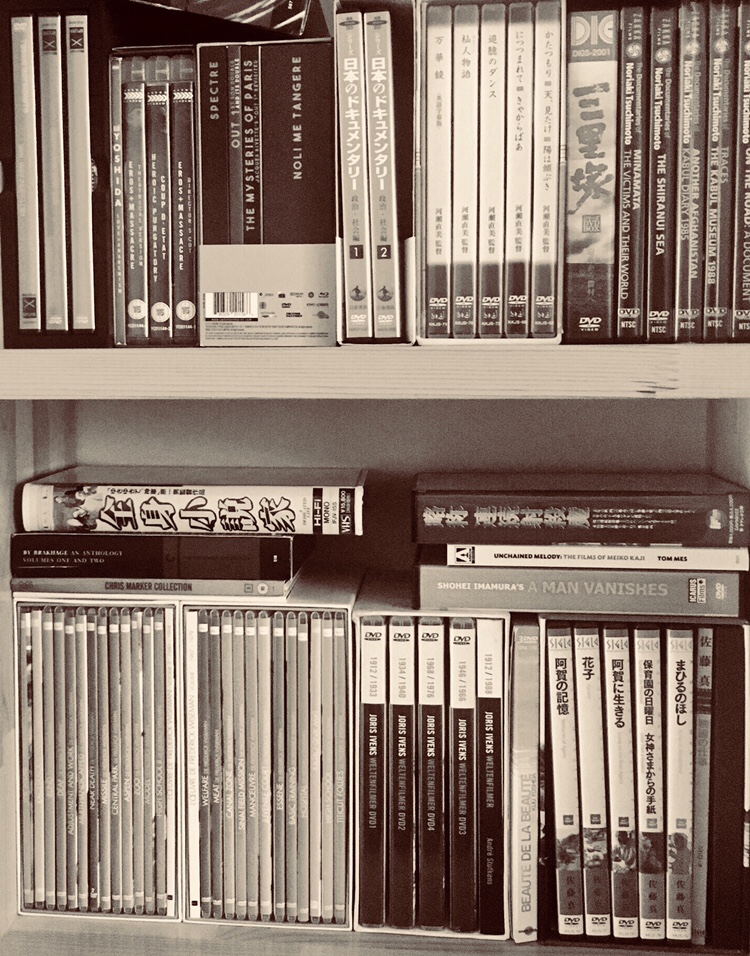
Physical media (DVDs and Blu-rays)

You can find this page on the menu above (I’ll post it here just to get more visibility):

This is a page where I’ll try to list all the Southeast and East Asian documentaries that have been released on DVD or Blu-ray (no VHS o laser discs…yet), both those still available and those currently out of print. For now, since I’m writing in English, I’ve decided to include only the home releases subtitled in English, but there’s a lot out there with French subs (Yoshida Kijū or Wang Bing for instance)…

There are a couple of fundamental reasons why I’ve decided to embark in this task:

We can talk and write at length about a certain movie or a certain director, but if we don’t have the means to see the films in question, unless you have the money to attend all the festivals dedicated to documentary around the world, it’s like talking about ghosts, and sometimes absence creates myths…

Another reason, and maybe the more dear to me, is that in recent years I’ve become fascinated by the history and development of home video distribution and its circulation around the world.

Moreover, as always with lists, this catalogue might also work as a special way to discover new titles, authors and filmographies.

Since I’m based in Japan and the documentary scene here has been vibrant since the beginnings of cinema, most of the titles are Japanese. I’m sure there are many Chinese, Taiwanese or Filipino non-fiction movies subtitled and on DVD, if you know any of them, please let me know, you can leave a comment or contact me through Twitter (the column on the right).

The order is chronological, that is, old movies at the top and more recent ones at the bottom. I’ve used this format:

English title (if not available I’ve kept the original) – name of the director – year of production – format- DVD or BD company’s name – year of the home video release when available.

As usual, feel free to contribute, I’m also open to suggestions regarding the layout of the page (should I divide the list by country? by author, etc.)

You can navigate through the movies on the list I created on Letterboxd (although some titles are missing, but I’m slowly fixing it)

Yamamoto Senji kokubetsushiki / The Funeral of Yamamoto Senji (Proletarian Film League of Japan, 1929) DVD Rikka Press, in Prokino sakuhin-shū, 2013.

Yamasen Watamasa rōnōsō / Yamamoto Senji Watanabe Masanosuke Worker-Farmer Funeral (Proletarian Film League of Japan, 1929) DVD Rikka Press, in Prokino sakuhin-shū, 2013.

Tochi / The Land (Proletarian Film League of Japan, 1931) DVD Rikka Press, in Prokino sakuhin-shū, 2013.

Dai jyūsankai no Tōkyō Mē Dē / The Thirteen Tokyo May Day (Proletarian Film League of Japan, 1931) DVD Rikka Press, in Prokino sakuhin-shū, 2013.

Sports (Proletarian Film League of Japan, 1932) DVD Rikka Press, in Prokino sakuhin-shū, 2013.

Zensen / The Front Lines (Proletarian Film League of Japan, 1932) DVD Rikka Press, in Prokino sakuhin-shū, 2013.

Hokusai (Teshigahara Hiroshi, 1953) DVD Criterion Collection, in Three Films by Hiroshi Teshigahara, 2007.

Ikebana (Teshigahara Hiroshi, 1956) DVD Criterion Collection, in Three Films by Hiroshi Teshigahara, 2007.

Tokyo 1958 (Teshigahara Hiroshi, 1958) DVD Criterion Collection, in Three Films by Hiroshi Teshigahara, 2007.

The Weavers of Nishijin (Matsumoto Toshio, 1961) Blu-ray Cinelicious Pics, in Funeral Parade of Roses, 2017.

The Song of Stone (Matsumoto Toshio, 1963) Blu-ray Blu-ray Cinelicious Pics, in Funeral Parade of Roses, 2017.

Tokyo Olympiad (Ichikawa Kon, 1965)
a) DVD Criterion Collection, 2002.
b) DVD/Blu-ray in 100 Years of Olympic Films: 1912–2012, Criterion Collection, 2017.

On The Road – A Document (Noriaki Tsuchimoto, 1964) DVD Zakka Films, 2011.

In Search of the Unreturned Soldiers in Malaysia (Imamura Shōhei, 1971) DVD Icarus Films, in A Man Vanishes, 2012.

In Search of the Unreturned Soldiers in Thailand (Imamura Shōhei, 1971) DVD Icarus Films, in A Man Vanishes, 2012.

Minamata: The Victims and Their World (Tsuchimoto Noriaki, 1971) DVD Zakka Films, 2011.

The Pirates of Bubuan (Imamura Shōhei, 1972) DVD Icarus Films, in A Man Vanishes, 2012.

Sapporo Winter Olympics (Shinoda Masahiro, 1972) DVD/Blu-ray in 100 Years of Olympic Films: 1912–2012, Criterion Collection, 2017.

Goodbye CP (Hara Kazuo, 1972) DVD Facets, 2007.

Outlaw-Matsu Returns Home (Imamura Shōhei, 1973) DVD Icarus Films, in A Man Vanishes, 2012.

Extreme Private Eros – Live Song 1974 (Hara Kazuo, 1974) DVD Facets, 2007.

Karayuki-san, The Making of a Prostitute (Imamura Shōhei, 1975) DVD Icarus Films, in A Man Vanishes, 2012.

Kenji Mizoguchi: The Life Of A Film Director (Shindō Kaneto, 1975)
a) DVD Asmik Ace, 2001.
b) DVD/Blu-ray Criterion Collection, in Ugetsu, 2017.

The Shiranui Sea (Noriaki Tsuchimoto, 1975) DVD Zakka Films, 2011.

Turumba (Kidlat Tahimik, 1981) DVD Flower Films, 2005.

Antonio Gaudí (Teshigahara Hiroshi, 1984) DVD Criterion Collection, 2008.

The Emperor’s Naked Army Marches on (Hara Kazuo, 1987) DVD Facets, 2007.

Seoul 1988 (Lee Kwang-soo, 1989) DVD/Blu-ray in 100 Years of Olympic Films: 1912–2012, Criterion Collection, 2017.

Hand in Hand (Im Kwon-taek, 1989) DVD/Blu-ray in 100 Years of Olympic Films: 1912–2012, Criterion Collection, 2017.

Beyond All Barriers (Lee Ji-won, 1989) DVD/Blu-ray in 100 Years of Olympic Films: 1912–2012, Criterion Collection, 2017.

Living on the River Agano (Satō Makoto, 1992) DVD Siglo, in Satō Makoto’s Complete Works box-set, 2008.

Embracing (Kawase Naomi, 1992) DVD Kinokuniya Shoten, in Kawase Naomi Documentary DVD Box, 2008.

A Dedicated Life (Hara Kazuo, 1994) DVD Facets, 2007.

Katatsumori (Kawase Naomi, 1994) DVD Kinokuniya Shoten, in Kawase Naomi Documentary DVD Box, 2008.

See Heaven (Kawase Naomi, 1995) DVD Kinokuniya Shoten, in Kawase Naomi Documentary DVD Box, 2008.

Hi-Wa-Katabuki (Kawase Naomi, 1996) DVD Kinokuniya Shoten, in Kawase Naomi Documentary DVD Box, 2008.

The Weald (Kawase Naomi, 1997) DVD Kinokuniya Shoten, in Kawase Naomi Documentary DVD Box, 2008.

A (Mori Tatsuya, 1998)
a) DVD Maxam, 2003.
b) DVD Facets, 2006.

Artists in Wonderland (Satō Makoto, 1998)
a) DVD Siglo, in Satō Makoto’s Complete Works box-set, 2008.
b) DVD Zakka Films.

Mangekyo/Kaleidoscope (Kawase Naomi, 1999) DVD Kinokuniya Shoten, in Kawase Naomi Documentary DVD Box, 2008.

Self and Others (Satō Makoto, 2000) DVD Siglo, in Satō Makoto’s Complete Works box-set, 2008.

Hanako (Satō Makoto, 2001) DVD Siglo, in Satō Makoto’s Complete Works box-set, 2008.

Sky, Wind, Fire, Water, Earth (Kawase Naomi, 2001) DVD Kinokuniya Shoten, in Kawase Naomi Documentary DVD Box, 2008.

Letter from a Yellow Cherry Blossom (Kawase Naomi, 2002) DVD Kinokuniya Shoten, in Kawase Naomi Documentary DVD Box, 2008.

A2 (Mori Tatsuya, 2002)
a)DVD Maxam, 2003.
b)DVD Facets, 2006.

Tie Xi Qu: West of the Tracks (Wang Bing, 2003) DVD Tiger Releases.

S21 The Khmer Rouge Killing Machine (Rithy Panh, 2003) DVD First Run Features, 2005.

Another Afghanistan: Kabul Diary 1985 (Noriaki Tsuchimoto, 2003 ) DVD Zakka Films, 2011.

Traces: The Kabul Museum 1988 (Noriaki Tsuchimoto, 2003) DVD Zakka Films, 2011.

Mamories of Agano (Satō Makoto, 2004) DVD Siglo, in Satō Makoto’s Complete Works box-set, 2008.

Haruko (Nozawa Kazuyuki, 2004) DVD Fuji Television、2004.

Rokkasho Rhapsody (Kamanaka Hitomi, 2006) DVD Zakka Films.

Echoes from the Miike Mine (Kumagai Hiroko, 2006) DVD Zakka Films.

Bing’ai (Feng Yan, 2007) DVD Zakka Films.

Three Sisters (Wang Bing, 2007) DVD Icarus Films.

Campaign (Soda Kazuhiro, 2007) DVD Kinokuniya Shoten, 2007.

Mapping the Future Nishinari (Tanaka Yukio, Yamada Tetsuo, 2007) DVD Zakka Films.

Mental (Soda Kazuhiro, 2008) DVD Kinokuniya Shoten, 2010.

Flowers and Troops (Matsubayashi Yōju, 2009) DVD Zakka Films.

Breaking the Silence (Toshikuni Doi, 2009) DVD Zakka Films.

Holy Island (Hanabusa Aya, 2010) DVD Zakka Films.

The Everlasting Flame (dir. Gu Jun , 2010) DVD/Blu-ray in 100 Years of Olympic Films: 1912–2012, Criterion Collection, 2017.

Ashes to Honey —Toward a Sustainable Future (Kamanaka Hitomi, 2010) DVD Zakka Films.

Peace (Soda Kazuhiro, 2010) DVD Kinokuniya Shoten, 2012.

Barefoot Gen’s Hiroshima (Ishida Yuko, 2011) DVD Zakka Films.

Duch, Master of the Forges of Hell (Rithy Panh, 2011) DVD First Run Features, 2013.

Living the Silent Spring (Sakata Masako, 2011) DVD Zakka Films.

Fukushima: Memories of a Lost Landscape (Matsubayashi Yōju, 2012) DVD Zakka Films.

Theatre 1 & 2 (Soda Kazuhiro, 2012) DVD Kinokuniya Shoten, 2013.

The Missing Picture (Rithy Panh, 2013)
a) Blu-ray New Wave Films, 2014.
b) DVD Strand Releasing, 2014.
c) DVD Edko Films, 2016.

Campaign 2 (Soda Kazuhiro, 2013) DVD Kinokuniya Shoten, 2015.

The Horses of Fukushima (Matsubayashi Yōju, 2013) DVD Zakka Films.

Flowers of Taipei – Taiwan New Cinema (Hsieh Chin Lin, 2014) DVD Edko Films, 2017.

The Last Geisha: Madame Minako (Yasuhara Makoto, 2014) DVD Zakka Films.

Ishibumi (Kore’eda Hirokazu, 2015) DVD/Blu-ray Vap, 2017.

Little Voices from Fukushima (Kamanaka Hitomi, 2015) DVD Zakka Films.

A Room of Her Own: Rei Naito and Light (Nakamura Yūko, 2015) DVD DIG, 2017.

We Shall Overcome (Mikami Chie, 2015) DVD Zakka Films.

Le Moulin (Huang Ya Li, 2016) Blu-ray/DVD Fisfisa Media, 2017.

Fake (Mori Tatsuya, 2016) DVD Happinet, 2016.
Anthropology and cinema: The Song of Akamata (Kitamura Minao, 1973)

I’m reposting something I wrote almost 4 years ago about Kitamura Minao and visual anthropology in Japan

Visual anthropology, ethnographic cinema, visual folklore and ethnographic film are all definitions floating around the same concept, a point of intersection between cinema, film or the visual arts on the one side and ethnology, anthropology or ethnographic field work on the other. Although all these definitions don’t exactly signify the same thing, I personally like the term “visual anthropology” the best, for no special reason.

I came to be interested in visual anthropology through the works of Jean Rouch, author and co-author of some of the most outstanding works in the history of documentary (Chronicle of a Summer, Moi, un noir, etc.) who was also a very well respected anthropologist who spend most of his life working in the African continent. Driven by this interest a couple of years ago I started to look for something or someone similar in Japan, and by pure chance one morning at Nagoya Cinemaskhole, I came across and discovered the works of Kitamura Minao.
Kitamura is one of the most respected visual anthropologist (I don’t know if he’d agree to be called so) working today in Japan, the founder of Visual Folkrore Inc. and, besides his works for TV (mainly for NHK), he’s also the author of some very compelling and inspiring theatrical documentaries. For instance, Kitamura is the director of one of my favourite films of 2012,

ほかいびと 伊那の井月 Hokaibito: Ina no Seigetsu (2012) about the life of Inoue Seigetsu, a poet and wanderer who lived the last part of his life (he died in 1887) shifting through the land of Ina, now located in Nagano prefecture, between the Edo and Meiji period, a time of dramatic changes that transformed and shaped Japan as a modern nation.

seigetsu_no_ina

Hokaibito: Ina no Seigetsu is a very unique documentary constructed by merging poems, written by Seigetsu himself and visualized on screen by nice handwritten strokes, with reconstructions of the life of the poet, played here by the legendary dancer Tanaka Min.
I haven’t seen so many of Kitamura’s works, especially those commissioned by museums or NHK, but a couple of years ago at the Kobe Planet Film Archive I had the chance to see two of his works made around 30 years ago: The Horse of Kaberu (1969) and The Song Of Akamata:
Life Histories of the Islanders of Iriomote Okinawa (1971).
The former in particular impressed me for its compelling topic: the failed attempt to film a sacred festival in Komi (filming the rituals in the remote island remains a taboo) that nonetheless turned out into a meaningful portrait of the people living or returning to the small land, and a revealing study of their deep relationship with traditions and religion practices of the island.
What follows is an introduction to the movie by Kitamura himself, given on the occasion of a symposium, “Expanding the horizon of Area Studies through film presentation The New Generation of Anthropological Cinema” held in Kyoto in 2006:

akamata

THE SONG OF AKAMATA:
LIFE HISTORIES OF THE ISLANDERS, IRIOMOTE, OKINAWA

KITAMURA Minao

There are two sacred festivals in the Okinawan Islands that, although they continue today, have not yet been filmed or documented: Uyagan-Sai of Ogami Island, Miyako; and Akamata of the Yaeyama Islands, which I attempted, on one notable occasion, to film with an Arriflex camera. The result is this rather peculiar work that did not actually achieve its main objective.
Once a year, during June of the lunar calendar, wearing a wild red wooden mask and covered in leaves and vines, Akamata appears from the sacred cave known as Nabindo. He visits the village founder’s house in Komi to bless the villagers and promise a good harvest for the coming season.
In July of 1972, I arrived at Komi with my filming crew, having traveled by Sabani, a kind of small fishing boat. Although 73 families had occupied the village in 1960, only 17 families remained. Most of the young people had left for Tokyo or Kawasaki, and each year an additional few families had also emigrated to Ishigaki Island or Naha. With such a small village population, I was doubtful that Akamata would be held.
At midnight of the first day of the festival, I was called outside, where I was surrounded by several young men with sickles. They returned to me a bottle of sake I had presented them with in honor of the festival, and then threatened me, shouting, “We never gonna let you shoot Akamata. Never! If you do, you’ll be found murdered.” Their parting shot, “If we ever allow your filming, it’s the end of the village,” made me even more curious about why Akamata made them so excited and energetic. What magnetic force made people come back to the island to join Akamata?
Due to these developments, instead of filming Akamata, I decided to document the life histories of the villagers and the ways of life of the people who had emigrated from Komi. I rallied my frightened crew and began a daytime visit to a family by asking them to let us take a souvenir photo. They liked our request, even though the camera was my 16mm Arriflex. We also voluntarily joined in the work of the village community, drank together, and sang together, with the camera and recorder turned on.
Before completing souvenir photos of all 17 families, I began to understand the fairly complicated relationships among the villagers. For instance, there were conflicts between native and newly introduced religions. After the photos had all been taken, we visited ex-islanders live in Ishigaki and Naha in order to ask why they had left their native island. I found that these ex-islanders living in the cities maintained the same values they had cherished in their native village. It seems that Akamata still lives in their minds.
The sacred masked Akamata, covered by leaves and vines, does not appear at all in “The Song of Akamata.” Nonetheless, this film succeeded in documenting and unmasking the real lives of the islanders.
Duration: 82 mins, Medium: DV, Year: 1973, 2006 (revised), Production: Yugyoki Location: Komi, Iriomote, Okinawa, Japan

Here the original

Slow Motion, Stop Motion スローモーション、ストップモーション (Kurihara Mie, 2018)

Slow Motion, Stop Motion スローモーション、ストップモーション by Kurihara Mie was awarded with the Grand Prize and the Audience Award at the 32nd edition of the Image Forum Festival. Shot in Laos, Myanmar and Thailand in the course of 4 years, as far as I know the director usually stays in the regions for at least a couple of months a year, the movie is a funny and poetic telling, through the mode of the personal documentary, of her experiences and encounters in those countries. On the surface thus Slow Motion, Stop Motion is a diary film and a record of her meetings and interactions with the people she meets and befriends, but on a different level it’s also a glimpse into their life and daily struggle to survive. Avoiding shots of turistic places, beautiful postcard-like landscapes, and disengaging completely from a moralistic and exploitative use of the poorest areas of the countries, the film excels in creating a vivid and vital potrait of the people Kurihara meets. The images captured by the Japanese, but often she gives the camera to children and other people to freely film whatever and however they want, feel thus very authentic. Moreover the home movie-quality that permeates the entire work is functional to what seems to be one of Kurihara goals, that is capturing glances of ordinary life in South East Asia.

An important element of the film is the narration. Done by Kurihara herself it’s infused with a dry sense of humor, the words spoke n not only are funny and represent a commentary a posteriori on what is depicted on screen, but they often reflect and indirectly criticize the act of filming itself and the fetishism towards technology that visual artists very often succumb to. In one of the funniest parts, the director buys a cheap version of a Go-pro and tries to film underwater scenes and pigeons, there were no seagulls on the beach, like in the beloved Leviathan by Lucien Castaing-Taylor and Verena Paravel.

The humorous parts are intertwined with few poetic and melancholic scenes, when Kurihara reflects on the sad mood that permeated the day of her departure for instance, or in a long scene without comment or narration, almost ethnographic in style, where an old man kills, plucks, cleans and cooks a rooster for his family.

The film has neither the stylish and polished aesthetics so in demand in the current international festival circuit, nor the political and activist approach that often drives people to documentaries. I really hope that despite the lack of these qualities the movie won’t fall under the radar, because as a hybrid experiment that uses the diary and personal documentary style as a point of departure, it subtly touches very crucial themes such as post-colonial representation and representation of marginal areas in contemporary visual culture.

Image Forum Festival 2018 イメージフォーラムフェスティバル 2018

The 32nd Image Forum Festival ended last Sunday in Tokyo. The nine-day-long event, hosted at two different locations in the Japanese capital, the Theatre Image Forum and the Spiral Hall, screened in total more than 80 films, including 23 in the East Asian Experimental Film Competition, the main section. Established in its present form in 1987, the festival succeeded and replaced an experimental film festival that was held, in various phases and different shapes, in the capital from 1973 to 1986.

To this day the festival continue to embody the mission and the legacy of its predecessors. Primarily dedicated to experimental cinema and video, the event provides a special opportunity for the viewers to experience on a big screen a mix of feature films, home cinema, documentary and experimental animation.
After Tokyo, the festival will move to Kyoto, Yokohama and Nagoya, with slightly different contents, there will be special sections dedicated to artists of each city. This is a right and welcomed decision, since too often Tokyo ends up cannibalizing the cultural and artistic events taking place in the archipelago.

This slideshow requires JavaScript.

This year’s special retrospectives were dedicated to the provocative films of Christoph Schlingensief, German director who expanded his works beyond cinema to touch theater, television and public happenings, Kurt Kren, Austrian artist associated with Viennese Actionism, but also author of structural films, and the experiments on celluloid by Japanese photographer Yamazaki Hiroshi. I wasn’t aware of the films of Schlingensief, and I have to say that it was at the same time a discovery and a delusion. While I really liked 100 Years of Adolf Hitler (1989), claustrophobic and parodic reconstruction of the last hours of the dictator and comrades in his bunker, I couldn’t digest the other two movies of the so called German Trilogy. German Chainsaw Massacre (1990) and especially Terror 2000 (1992) are too much of a mess and stylistically all over the place , and probably too bound to the events of the time, the Fall of the Berlin Wall and the consequent unification of the two Germanies, for me to decipher them.

Unfortunately I wasn’t able to check the works of Yamazaki, but I’m planning to see them at the end of September, when the festival will come to Nagoya. As with his conceptual photos, the shorts made during his entire life explore the relationship between time and light, a topic I’m very attracted to.
I also missed the screening of Caniba (2017) by Lucien Castaing-Taylor and Véréna Paravel, about the “cannibal” Sagawa Issei, if I’m not wrong, this was the Japanese premiere of the film, and the special focus Experimenta India, a collection of visual art from the Asian country.
Interesting was to catch Matangi/Maya/M.I.A. (Steve Loveridge, 2018), about the famous ex-refugee of Tamil origin, now a pop icon and singer, an artist I was completely unaware of. The documentary is based on more than 20 years of footage filmed by herself and her friends in Sr Lanka and London. While I didn’t connect with the first part of the movie, too self-indulgent for my taste, the film gets much better in the last 30-40 minutes when, albeit briefly, touches on complex and fascinating topics such as immigration and art, fame, and social awareness in the show business.

The East Asia Experimental competition was pretty solid, besides several short films coming from a variety of areas like South Korea, China, Hong Kong, Taiwan and naturally Japan, two were the long documentaries screened. A Yangtze Landscape (Xu Xin, 2017), a visual exploration of the social and geographical landscape along the longest river in Asia (you can read my review here), and Slow Motion, Stop Motion (Kurihara Mie, 2018) a movie that positively surprised me and won both the Grand Prize and the Audience Award. A review is coming soon, stay tuned.

Asia is One アジアはひとつ (NDU, 1973) edited

I’m reposting an edited version of my piece on NDU’s Asia is One, an article I wrote two years ago.

NDU (Nihon Documentary Union) was a Japanese collective founded in 1968 by a group of Waseda University students who would eventually drop out to dedicate their lives to filmmaking and political struggle. From 1968 to 1973, when the group disbanded, this group of activists, who saw themselves first and foremost as a collective of activists, made four documentaries, moving from the streets of Tokyo – the first work was Onikko – A Record of the Struggle of Youth Labourers – to the distant islands of Micronesia, passing through Okinawa, the archipelago where they made two of their most important documentaries.

Motoshinkakarannu (1971) was made in and about Okinawa, before the archipelago was ‘returned’ to Japan. The group went to the island in 1971 and captured on film a society in transition. The film shows and focuses on the fringes of society, with illegal prostitution and life in the red districts, while also highlighting the historical and social fractures that have run through the area: anti-establishment and anti-American riots, the Black Panthers’ visit to Okinawa, water pollution and much more. I voted Motoshinkakarannu one of my favourite Japanese documentaries in a poll I organised a year ago, but today I’d like to turn my attention to the second film made by the collective in Okinawa (and beyond): Asia is One アジアはひとつ (1973, 16mm, 96′), a work that I hadn’t seen at the time of the poll and that would have certainly made my list along with Motoshinkakarannu.

Asia is One was screened on June 26th at Kyoto Kambaikan, as part of the AAS in Asia, and it was screen with English subtitles for the first time, the movie was shelved for many many years, forgotten, and was (re)discovered only in 2005 when was screened at the Yamagata International Documentary Film Festival. The screening in Kyoto was followed by a fascinating Q&A with the only surviving member of NDU, Inoue Osamu. Nunokawa Tetsurō, who after the dismantling of the collective made other interesting solo documentaries in Palestine and US, passed away in 2012. As described by Roland Domenig (1), with Asia is One

NDU further explored the margins of Okinawan society and continued to break through borders by focusing on the Taiwanese minority. The film portrays Taiwanese migrant workers on the main island of Okinawa who substitute the Okinawa laborers who in turn are employed as migrant workers on Japan’s main islands. It traces the history of Taiwanese coal miners on Iriomote Island, follows legal and illegal workers to the westernmost island of Yonaguni and finally lands in Taiwan in a village of he Atayal tribe of Taiwanese aborigines, where still the Japanese naval anthem is played every noon.

Formally the documentary is composed of landscapes and interviews, all of them out of sync, possibly due to the equipment used or maybe the lack of it. The uncanny space created by this displacement, but also by the use of music from radio broadcasts and kids voices, thrown here and there during the movie, gives the work a peculiar aesthetic tone, a type of non-fiction cinema that I like to call “chaos cinema”. (2)
To explain and understand the “chaotic” trait of Asia is One, and Motoshinkakarannu as well, we have to delve deeper in the philosophy that laid at the core of NDU’s approach. What the collective has tried to convey through their cinema is extremely fascinating, in their writings (3), mainly published in the magazine Eiga Hihyo, the group was explicitly pushing towards a cinema/activism of anonymity, trying to reach an “impersonal space” and rejecting even the term “work” (sakuhin) because it was seen as the product of a single person in command and as a result of a dominating power structure. In this regard famous was their criticism of Ogawa Production, a collective that bore the name of a single person and that was basically structured hierarchically (4). To this kind of collectivism NDU tried to oppose a more fluid idea of group activism, where the structure was a flat and horizontal one, and in doing so, promoting a cinema made by amateurs (5) and not by professionals. “Everybody can push the button and shoot with a 16mm camera” said Inoue, and this is even more true today since the advent of the digital revolution. Whether this approach was successful or not, and more importantly, whether this horizontal structure and “amateur cinema” is possible at all, are questions without answers that are haunting scholars to this day.
Going back to Asia is One, the part of the movie the resonated more with me was the last one, when the film moves to the Atayal village in Taiwan. There’s a quality in the close-ups of the tribe people, beautiful and ancient faces, that is extremely fascinating, also because it is in these scenes that the political discourse on identity, or the negation of it, reach its peak. From the 17th Century onward The Atayal people, like the rest of the tribes inhabiting the island, were forced to face the colonization of the Dutch first, the Spanish and the Chinese later, and eventually that of the Japanese Empire (1895 – 1945), which called them “barbarians” and tried to assimilate and annihilate their culture (6). That being said, the words spoken by the member of the tribe provide more context and add layers of complexity to the situation. “Japan conquered us and abolished many of our ancient traditions and customs”, but at the same time “we were drafted and went to war with pride and ready to die” and also “luckily the Japanese abolished some of our ancestral traditions like beheading”. Asia is One ends with the militaristic song If I Go to Sea against an everyday scene with the aboriginal Taiwanese people isolated in the mountains singing “We want to go to war again.”

Of course there is oppression and violence, physical and cultural, in every colonization, but things here are deeper than what they seem. In the process of cultural and historical coring that the movie conveys with its images and words, from Okinawa to Taiwan, I believe that two significant elements emerge. The first is the crisis of the identity concept, often a forced cultural and national superstructure imposed by the stronger and more powerful part on a “highly fluid space of human life” (6), as Inoue explained “identity was one of the most hated words inside the NDU, identity is a choking concept”. The second point that struck me is the recurrence of a power and social structure that exploits the margins, the outsiders and the weakest people. In mainland Okinawa the illegal prostitutes and worst jobs are done by people from Miyako island, and in Miyako and other small islands the lower part of society is occupied by Koreans, Taiwanese and aboriginal people. This perpetuating exploitation is possible only as long as a certain part of society is described as different and inferior, and only when and where the concept of border is a monolitic divide used to create the “other”, the “foreigner” and the “stranger”. NDU’s documentaries are an antidote against all this poisonous discourse, and an invitation to break through the borders, those in the world outside us, but also those inside ourselves.
A final note on the title, the movie as a product of a collective that was thriving towards anonymity, has not film credits, nor it had originally a title, Asia is One was attached to it only later, and it’s a kind of a joke because as Inoue himself said “we all know that Asia is not one!”

notes:

1 Faraway, yet so close by Roland Domenig, in The Legendary Filmmaking Collective NDU and Nunokawa Tetsurō ed. Yasui Yoshio, Tanaka Noriko, Kobe Documentary Film Festival Committee, 2012.

2 This might not be the best way to describe the movie, but aesthetically it reminded me, maybe because of the out of sync, of Imamura Shōhei’s documentaries shot in South East Asia during the 70s.

3 Some of the writings are translated in The Legendary Filmmaking Collective NDU and Nunokawa Tetsurō, op. cit.

4 You can find more in Forest of Pressure: Ogawa Shinsuke and Postwar Japanese Documentary, Abé Markus Nornes, Visible Evidence 2007.

5 Some interesting insights on amateurism in cinema can be found in The Flash of Capital: Film and Geopolitics in Japan, Eric Cazdyn, Duke University Press 2002.

6 In 1930 the village was the site of an anti-Japanese uprising, the so called Musha Incident, an event portrayed in Warriors of the Rainbow: Seediq Bale (Wei Te-Sheng, 2011)

7 Nunokawa Tetsurō in YIDFF 2005 Special Program, Borders Within – What it means to live in Japan.

“Contemporary documentary in Taiwan: memory, identity, flux”

I’m very pleased to announce that a paper I’ve been working on in the past several months, has finally been published. It’s been included in the latest number of Cinergie (2018, n. 13), an open-access, peer-reviewed journal about cinema and cinema related studies.

Titled “Contemporary documentary in Taiwan: Memory, Identity, Flux“, the article is an expansion and re-elaboration of some of the short takes on documentary in contemporary Taiwan I’ve been posting on this blog in the past two years.

The movies I’ve wrote about are: Le Moulin (Huang Ya-li, 2015), Wansei Painter – Tetsuomi Tateishi (Kuo Liang-yin and Fujita Shūhei,2016), Letter #69 (Lin Hsin-i, 2016) and 3 Islands (Lin Hsin-i, 2015).

You can read the paper here

P.S. Another movie that would have fit perfecty in the discourse I’ve tried to articulate in the essay is MATA-The island’s Gaze (2017, Cheng Li-Ming), but unfortunately I watched too late.

MATA-The island’s Gaze (2017, Cheng Li-Ming)

Taiwan experimental-documentary scene, whatever meaning you want to attach to the term, is one of the most intriguing and vibrant in contemporary cinema, particularly when the themes tackled are going deep into decolonisation, negotiating identity, and the complex history of the island. I’ve written on the subject here, here and here, and a longer and deeper analysis is coming soon.

In MATA-The island’s Gaze filmmaker Cheng Li-Ming focuses his attention on the gaze of Scottish photographer John Thomson, who visited Taiwan in 1871, and his relationship with some members of the Siraya tribe – one of the several that inhabited Taiwan before the arrival of the Dutch and the Han— originally settled in the southern part of the island, near Tainan. Here the synopsis:

Scottish photographer John Thomson’s trip to Taiwan in 1871 is an important historical event. In this film we selected a hunter photo to re-interpret that event and visit the Siraya tribe to find an Elder, who talks and sings well, bringing us back to the past through his plucking of strings.

Then we saw the vigorous hunters holding their breath, staying very still in front of that weird machine for a long time, with a boy and a dog squatted at their feet. The director grabbed the view of this moment and invites the audience to watch with curious eyes.

On both sides of the river of time, he repeatedly speculates and watches the past, the future, and the influence of images on this island.

Elliptical in its constructon, the work is centered around the concept of gazing: the mechanical gaze of the camera of the outsider/colonizer on the one hand, and that of the two Siraya people captured in a photo by the Scottish himself, on the other. As the director himself explains “I created a pair of characters out of a photo with a boy and a dog squatted at the corner, through their curious stare at the vigorous tribal hunters and their encounter with the ‘image hunter’, witnessing a duel of old and new world”.

Words of a descendant of the Siraya and his reflections on language and the importance of words in creating a common history and reality are intertwined with an imaginative reconstruction of the encounter between the photographer and the two hunters. Here again the director’s own words:

This film is a sequel to “Looking for Siraya”, and this time starts with a photo of hunters holding shotguns to continue the act of taking back our souls. The stereo camera that John Thomson carried happened to inspire me creating a stereo composition. Through dramatic imitation of John Thomson’s journey as well as recording of Siraya who stays beautifully in primary image in photos yet actually is fading at present, we try to imagine how our Formosa’s “Mata(s)” treat this “mechanical eye” that intruded into the island.

You can watch MATA-The island’s Gaze on Vimeo:

MATA-The island’s Gaze from Li-Ming Cheng on Vimeo.

Ogawa Production retrospective at Cinéma du réel (March 23-April 28)

This year Cinéma du réel, one of the most prestigious documentary film festivals, will kick off its 40th edition this coming Friday, among the more anticipated events of the Parisian festival there will be a special focus on Ogawa Shinsuke and Ogawa Production, a huge retrospective dedicated to the documentary collective that from the 1960s onward changed and impacted the landscape of non-fiction cinema in Japan and Asia. Part of the events celebrating and reflecting on the civil unrest and protests that shook the world in 1968, from March 23rd to April 28th, the festival and the city of Paris will showcase seven movies made by the group in the 1960s:

Sea of Youth – Four Correspondence Course Students (1966)

Forest of Oppression – A Record of the Struggle at Takasaki City University of Economics (1967)

Report from Haneda (1967)

The Battle Front for the Liberation of Japan – Summer in Sanrizuka (1968)

Prehistory of the Partisans (1969, directed by Tsuchimoto Noriaki)

At the end of Cinéma du réel, the retrospective will then move to the Galerie nationale du Jeu de Paume where will continue its focus on the Sanrizuka Series, movies documenting the struggle and resistance of the peasants and the students, united against the land expropriation perpetrated by the government in order to build Narita airport. The retrospective will last until April 27th presenting also the movies made by Ogawa Pro in its third phase, when the group moved to Magino village in Yamagata prefecture. The collective disbanded in 1992 with the untimely death of its founder Ogawa Shinsuke, a passing that also revealed the dark side of such a unique cinematic endeavor, Ogawa himself left a huge debt made during the years to support the collective and their films.

One member of the collective, Iizuka Toshio, will be in Paris to introduce the Magino films, and discuss his own movies and his relationship with Ogawa Shinsuke and the group. Curated by Ricardo Matos Cabo, whom I had the pleasure of meeting last October in Yamagata, the retrospective will also include other documentaries about the group, Devotion: A Film About Ogawa Productions (2000) by Barbara Hammer, A Visit to Ogawa Productions (1981) with Oshima Nagisa, Filmmaking and the Way to the Village (1973) by Fukuda Katsuhiko, and Kashima Paradise (1973) a French documentary about the struggle in Narita. An important part of the event will be the presence of scholar Abè Markus Nornes who will give a master class on Ogawa and lectures on militant film in Japan and Sanrizuka: Heta Village (1973).

If you’re in Paris, don’t miss this opportunity, experiencing Ogawa Pro’s documentaries on a big screen, in the proper contest and with proper introductions, is one of the best cinematic experiences I had in my life. Here the schedule of the screenings and lectures at Jeu de Paume :

April 3 (Tue), 18:30 Sanrizuka – Heta Village (1973)

April 4 (Wed), 18:00 Winter in Sanrizuka (1970)

April 6 (Fri) 16:30 Sanrizuka — the Three Day War (1970)
18:00 Sanrizuka – Peasants of the Second Fortress (1971)

April 7 (Sat) 11:30 Sanrizuka – The Construction of Iwayama Tower (1971)
14:30 Sanrizuka – Heta Village (1973)
18:00  Filmmaking and the Way to the Village (1973)

April 10 (Tue) 18:30 Dokkoi! Songs from the Bottom (1975)

April 17 (Tue) 16:00 Devotion: A Film About Ogawa Productions (2000)
18:00 The Magino Village Story – Pass (1977)
The Magino Village Story – Raising Silkworms (1977)

April 20 (Fri) 18:00 « Nippon » : Furuyashiki Village (1982)

April 21 (Sat) 11:30 Encounter with Toshio Iizuka
14:30 The Sundial Carved with a Thousand Years of Notches – The Magino Village Tale (1986)

April 24 (Tue) 19:00 The Magino Village Story – Pass (1977)
A Visit to Ogawa Productions (1981, directed by Oshige Jun’ichiro)

April 28 (Sat) 14:30 Kashima Paradise (1973, directed by Yann
Le Masson and Bénie Deswarte)
17:00 Sanrizuka – The Construction of Iwayama Tower (1971)