Yamagata International Documentary Film Festival 2023. Noda Shinkichi, Trinh T. Minh-ha, Miko Revereza, and more

After the special online edition of 2021 (the in-person event was canceled due to the pandemic), starting from today the Yamagata International Documentary Film Festival is back in its regular format. For a week, October 5-12, the city in Northern Japan will be the capital of non-fiction cinema, with screenings, events, workshops, and meetings on and around the varied landscape of international documentary, with a special focus on Asia. If you want to have a look at the program, check the official page of the festival.

This will be my 5th edition (6th counting the online one), and the main focus for me will be following, as much as possible—but as usual everything changes during the festival—the huge retrospective on the works of Noda Shinkichi (1913-1993). A poet, filmmaker, film theorist, and an important figure to understand the different evolutions and developments of documentary filmmaking in the archipelago during the 20th century. Some of his works (industrial, science, and folklore films) are available on the NPO Science Film Museum‘s official homepage for free; or for rental, on the platform Ethnos Cinema.

この雪の下に Country Life Under Snow (1956), for instance, is a fascinating depiction of the harsh life in a rural area in Yamagata prefecture, while オリンピックを運ぶ Transporting the Olympics (1964), co-directed with Matsumoto Toshio, focuses on the logistics and the behind the scene of the 1964 Tokyo Olympics. How things (boats, yachts, traffic cones, film reels, etc.) and animals (horses, pigeons) were transported from and to the capital.

One of the most relatively known works by Noda is マリン・スノー-石油の起源-Marine Snow – The Origin of Oil, co-directed by Ōnuma Tetsurō, a celebrated science film produced by Tokyo Cinema, sponsored by Maruzen Oil Co., and filmed using Eastmancolor. The short film describes the vertiginous span of time (millennia) in which sea plankton, through decomposition, turns into natural gas and oil. Commissioned by an oil company, and thus partly celebrating the petroleum industry— directly only in its last 5 minutes though—Marine Snow remains a visually astounding piece of science film, flawed by its own design and origin, but astounding nonetheless.
You can watch here the version with an English narration (I prefer the Japanese one, for what it’s worth).

These films are just a fraction of what will be shown in Yamagata, in total the Noda’s retrospective includes 38 works, produced between 1941 and 1991. A Japanese/English flyer with summaries for each film is available here.

I really look forward to learn more about this towering figure in Japanese documentary, also because his contribution to the art of cinema does not stop with filmmaking, but it encompasses also books on the subject. One I’m particularly interested in is 日本ドキュメンタリー映画全史 Nihon dokyumentarii eigashi (1984), a history compiled by listing and analyzing the individuals involved in making documentary films in Japan, from the beginning of cinema to the mid-1980s. Having leafed through the volume, I could see names I had never heard before. I’m excited to discover more.

If I’m not mistaken, this retrospective in Yamagata originates from a special program organized in 2020 at the National Museum of Art in Osaka, an event that was unfortunately canceled because of the pandemic. One of the positive outcomes of this phantom retrospective was the publication online of a series of essays (in Japanese) exploring Noda’s filmmaking and his role in Japanese non-fiction cinema.

Naturally, many more works will be screened in Yamagata, the international competition, for instance, will present Self-Portrait: 47 KM 2020 (2023) by Zhang Mengqi, a friend of the festival who is bringing the newest entry of her ongoing film series shot in her hometown, and What About China? (2022) by theorist and filmmaker Trinh T. Minh-ha. One of my most anticipated works of the festival, the film was assembled using Hi8 video footage shot by the artist about 30 years ago.

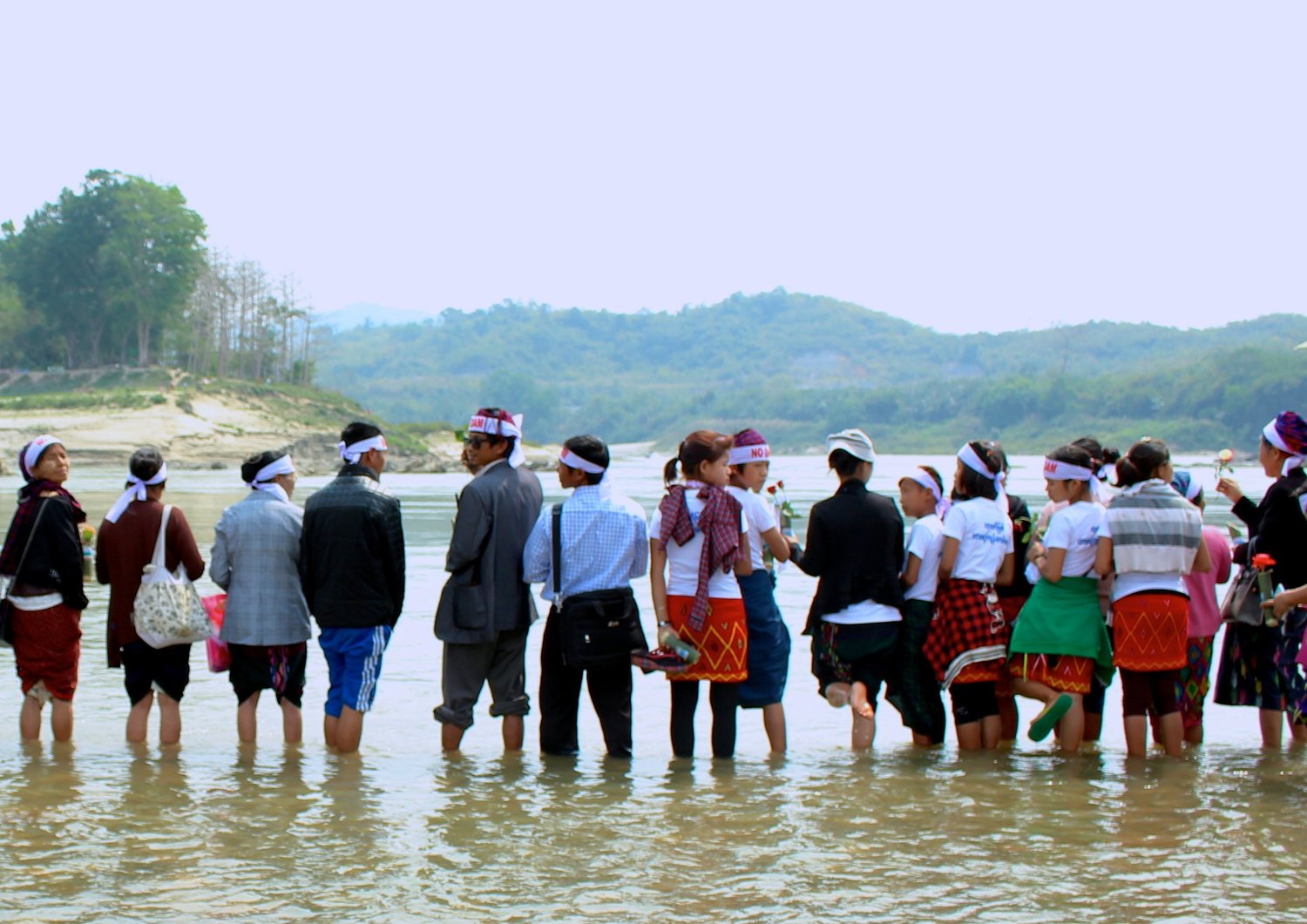
New Asian Currents is usually a section that does not disappoint, and in past editions, it was a chance for me to make some big discoveries. This year, one of the threads of the program seems to be a special attention towards Myanmar and the ongoing resistance to the current political situation in the country. Losing Ground (anonymous, 2023), Journey of a Bird (anonymous, 2021), and Above and Below the Ground (Emily Hong, 2023) are some of the titles dealing with the subject. Also in New Asian Currents, Gama by Oda Kaori (I’ve written about it here), and the always interesting Miko Revereza with Nowhere Near (2023).

Other programs of this year festival are Yamagata and Film, Cinema with Us 2023, Film Letter to the Future, Perspectives Japan, Double Shadows 3, and View People View Cities—The World of UNESCO Creative Cities.

Usually the most impactful viewings I had at the festival in the past—at any festival, to be honest—are those that came at me unexpected and that I discovered by chance or by word of mouth. Hopefully it will be the same this year.

Tanaka Min, 名付けようのない踊りThe Unnameable Dance (Inudō Isshin, 2022)

Tanaka Min is one of the contemporary Japanese artists I admire the most, both for his past as a butoh performer—a definition he has openly and vehemently refused to used in recent years—and for his connection with Gilles Deleuze and especially Felix Guattari, an encounter that resulted, in 1985, in the volume 光速と禅炎 Agencement ’85. Last but not least, I’ve always been fascinated by the turn that Tanaka’s career took around two decades ago, a change that made him a movie actor appreciated for his powerful and magnetic presence on screen. Not only a performing body in service of documentaries with an experimental touch, such as the beautiful ほかいびと 伊那の井月 Hokaibito: Ina no Seigetsu (Kitamura Minao, 2012), and the delirious piece of performance that is 始まりも終わりもない No Beginning, No End, directed in 2013 by Itō Shunya of 女囚701号/さそりFemale Prisoner #701: Scorpion fame. But also for his presence in more mainstream movies, and his work in voice acting for feature animations.

名付けようのない踊りThe Unnameable Dance (2022) is a documentary that retells, using Tanaka’s own narration and words, and in an episodic and at times syncopated way, some of the events and encounters that guided his life as a performer. Tanaka recalls, for instance, his meeting with Hijikata Tatsumi and the discovery of his revolutionary performances in the early 1970s. Or dancing in Paris in 1978, a trip that de facto launched his career, not only internationally but also in Japan. During one of his trips to France, Tanaka had also the chance to meet Roger Caillois, a writer and philosopher he strongly admired, and for whom he insisted to dance. The title of the movie, The Unnameable Dance, is, as a matter of fact, taken from a sentence Caillois used to describe Tanaka’s performance.

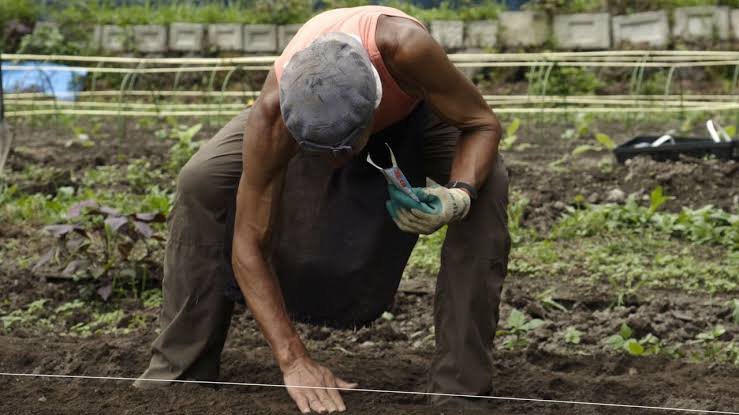
The documentary, directed by Inudō Isshin, covers also Tanaka’s debut as an actor in Yamada Yōji’s Twilight Samurai, an event that kicked off, at age 57, his career on the big, and small, screen. A part of the documentary is also dedicated to Tanaka’s work as a farmer, an activity very important for his philosophy, because, as he famously stated, “In agriculture one can find the anti-modern coming from the past. There you find the concreteness of the present.”

The recalling of all these experiences is interspersed with some of his more recent performances, always awe-inspiring, even when mediated through the camera. These performances were recorded in Japan and abroad, Paris and Portugal play a big role in the work, the latter is not only the place where the documentary begins and ends, but its music (Fado?) accompanies the whole documentary.
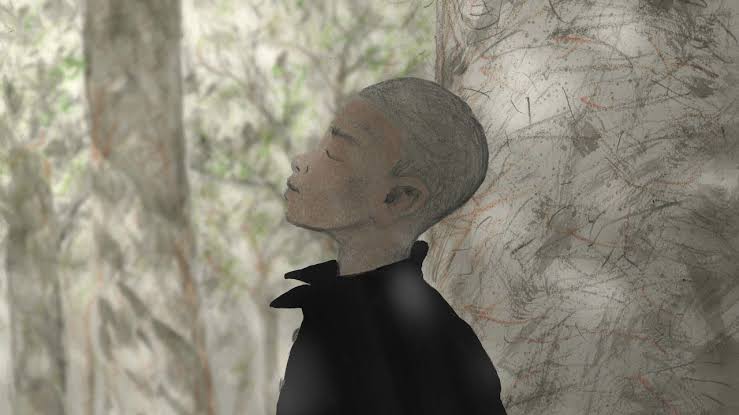
Another fascinating quality of the film is that the performances and scenes with Tanaka on screen are interspersed with Yamamura Kōji ‘s beautiful and effective animation, used mainly to depict Tanaka’s memories and dreams as a child.
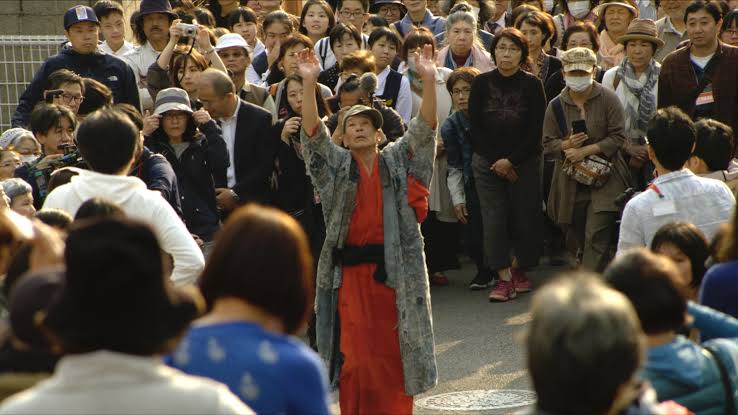
Particularly significant is also how the documentary includes purposely the audience, their faces and their reactions, when filming Tanaka’s performances in public spaces. There’s not attempt to hide or cut out the people watching and taking videos and photos with their smartphones, since for the Japanese performer “dance cannot be owned; dance is born in the space between; the viewers become dancers too”.

On Yamazaki Hiroshi, Heliography, Magino Village, and Ātman

I’ve been fascinated and captivated by Yamazaki Hiroshi’s works, both still and moving images, since the first time I discovered them in 2018, at the Image Forum Festival.

Reading about his approach to photography in the catalogue of one of his exhibitions, and finding ‘Ugoku shashin! tomaru eiga!‘(Moving photos! Still movies!), the book where he recounts part of his life and career, made me appreciate his artistic output even more.

Moreover, it a was a revelation to discover (how did I miss it!?) that Yamazaki was behind the time-lapse sequences shot for Magino Village – A Tale / The Sundial Carved with a Thousand Years of Notches (1986) by Ogawa Production, and that he worked as a cameraman in Matsumoto Toshio’s Ātman (1975).

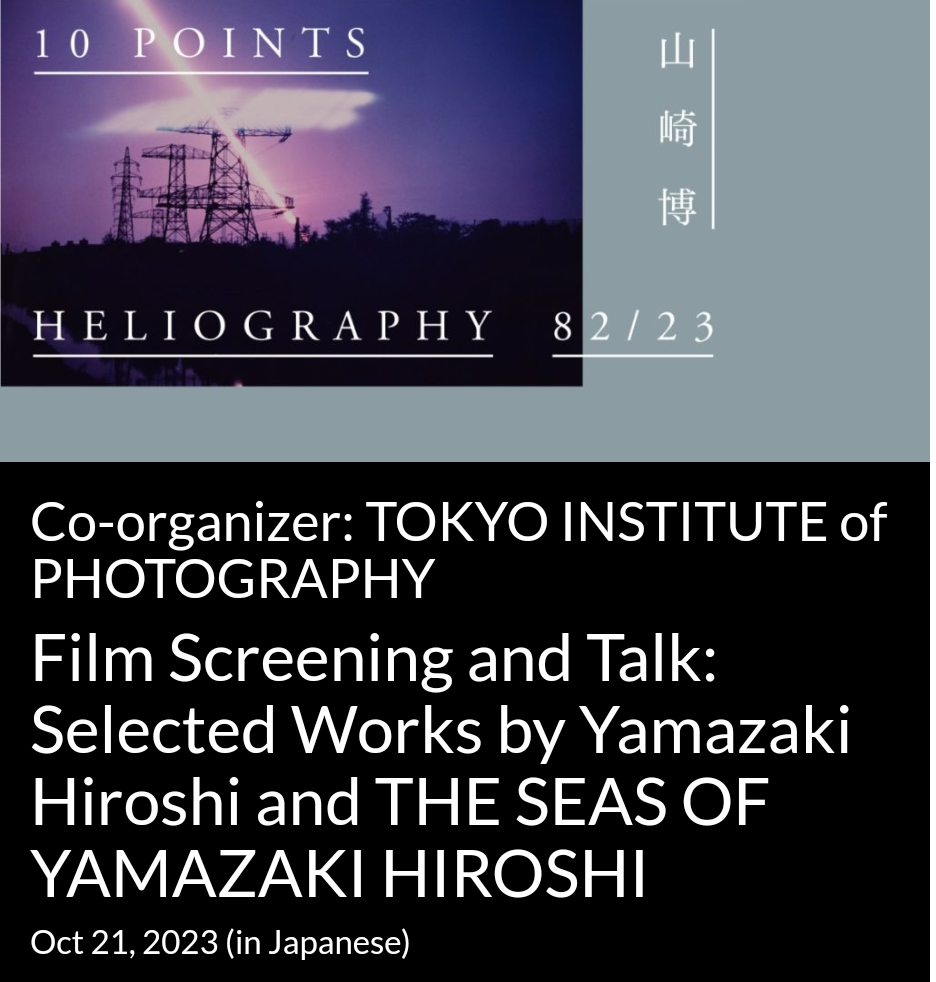
Chute, an experimental film cooperative based in Istanbul and The Hague, offered me the chance to gather my thoughts on Yamazaki, Heliography (1979), and what I’ve called “the solar connection”.

The piece is available here.

In the article I’ve only scratched the surface of what could, and frankly should, be written about Yamazaki. His engagement with moving images, the relation between his films and his work in photography, his method, and his position in the history of experimental cinema in Japan.

Soon after the article was posted, more thoughts started to coagulate in my head, and I was also told that Matsumoto wrote a piece on some pre-Heliography experimental films by Yamazaki. The journey has just started.

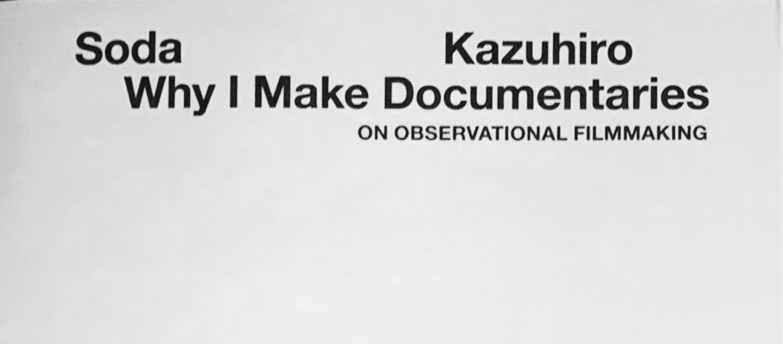
Sōda Kazuhiro – Why I Make Documentaries (Viaindustriae, Milan 2023, translated by Matt Schley).

Sōda Kazuhiro has become, in the last decades, one of the most distinct voices working in the contemporary documentary scene. Based in New York, a city where he moved for studying and eventually work for the Japanese public broadcasting NHK in the second half of the 1990s, Sōda has been directing, shooting, and editing (with his wife Kashiwagi Kiyoko as a producer) his independent documentaries for almost two decades. Sōda has also been writing, in Japanese, about filming, and social and political issues for quite some time, on his blog, but also in articles and in books.
なぜ僕はドキュメンタリーを撮るのか Naze boku wa dokyumentarii wo toru no ka is a volume published in 2011 dealing with the process, issues, theory, and discoveries of making non-fiction movies, and was recently translated into English as Sōda Kazuhiro – Why I Make Documentaries (208 pages, Viaindustriae, Milan 2023, edited by Silvio Grasselli, translated by Matt Schley).

This publication is a reflexive diary on his own work in pursuit of answers to many crucial questions which have arisen along his extensive research path. It is the first curated English version of Kazuhiro’s most enlightening and complete writings, enriched with a new iconographic apparatus derived from his films and an updated introduction by the author himself. Discover why seeking answers to such basic things as ‘What is a documentary?’ and ‘Why do I make documentaries?’ turns out to be essential practice for one of the most prominent Japanese filmmakers today.

As written above, the volume originally was published in Japan in 2011, after the Tōhoku earthquake and tsunami, a tragedy that almost pushed Sōda to halt and cancel the project, and it is structured around Peace (2010), the third documentary directed independently by the Japanese. In the book Sōda recalls how the film came into existence, through the invitation to make a short movie by the DMZ International Documentary Film Festival in South Korea, but also the unexpected encounters while filming, and the difficulties in shaping a work centered around a community of people and cats in Okayama city, Japan. Describing the process of making Peace is for Sōda a chance to reflect on his working method, his belief in what documentary cinema can do, and other important issues related to the ethics and philosophy of filming. Famously, Sōda describes his method and style as observational filmmaking, and when making independent documentaries always tries to follow a series of rules he has himself established:

1 No research.

2 No scripts.

3 No meetings with subjects.

4 Roll the camera yourself.

5 Shoot for as long as possible.

6 Cover small areas deeply.

7 Do not set up a theme or goal before editing.

8 No narration, superimposed titles, or music.

9 Use long takes.

10 Pay for the production yourself.

The volume covers a lot of fascinating themes and topics significant for those who are interested in nonfiction filmmaking. First of all, citing also the writings of Satō Makoto, the power and responsibility that holding and pointing a camera at someone entails. “A documentary camera (especially in the hands of a skilled filmmaker) mercilessly gouges out and lays bare its subject’s subconscious; their inner soul, or what I call people’s ‘soft spots’” writes Sōda. “Depending on how things go, it can leave a subject deeply hurt. In that sense, there’s a possibility for a documentarist to become an assailant, and a very real risk for the camera to become a tool of violence.”

Some beautiful pages are also dedicated to the filmmakers Sōda considers his main influences, the American direct cinema of the 1960s, and especially Frederick Wiseman, who remains for the Japanese author to this day a guiding star in the world of documentary. As the technical innovations helped to shape nonfiction cinema at the end of the 1950s and beginning of the 1960s, so did the digital revolution that occurred at the beginning of this century. “The biggest impact this technology had was in freeing documentaries from the production and exhibition format of film” writes Sōda, “Up until then, if you wanted to exhibit your work on a big screen with any semblance of quality, you had no choice but to shoot, edit and project on either 16 or 35mm film. But using this new camera and the DV format allowed you to shoot on digital, edit on a computer, and even show your film using a digital projector. It opened up a whole new path.”

These new tools allowed Sōda to embark in a career of independent filmmaking, a path that was also kindled and forged in contrast to what he had experienced in the world of documentaries made for TV during the 1990s. There are strong echoes here with what Kore’eda Hirokazu has to say about working for TV, although with some major differences, Kore’eda was lucky to work in a different period, with more freedom, and with some enlightened colleagues and producers, Sasaki Shōichirō in primis. Everything on TV, according to Sōda, is often scripted, and once the director or the producers set a theme or a goal for the program, the reality captured is distorted, biased, and without anything left to chance, the latter being one of the most powerful elements in a documentary. As an example of this modus operandi, Sōda brings his personal experience of working with NHK after the terrorist attacks on 9/11 2001. In the aftermath of the tragedy, the Japanese broadcaster was looking for images of tears and cooperation, while Sōda often witnessed in New York scenes of normal daily life and quarrels.
Being open to chance and randomness is a key point for Sōda’s approach to documentary, and it is fascinating to read that he was influenced and inspired in this by the art and the creative method used by Jackson Pollock, and by the way dance was conceptualised by Merce Cunningham, a performer Sōda was able to know and meet through his wife, a professional trained dancer.

Some of the most inspiring pages are the ones dedicated to the art of editing, and a paragraph titled “Changing Yourself Through Observation”, where Soda associated the act of observing through documentary with vipassana meditation, a subject he ended up writing a book about in 2021.
“Many people may think of ‘observation’ as something done in a cool and distant way. But that couldn’t be further from the truth. The act of observation is almost always accompanied by a change in the observer’s way of seeing the world. One loses one’s sense of tranquility, and, before long, is compelled to observe one’s own self as well.”

In conclusion, it is fair to say that beyond the pleasure of reading the reflections of one of the most prominent documentarians working today, this volume is also important in that it is an essential addition to expanding literature, available in English, on film theory produced in Asia.

The book is available for purchase here.

Night and Fog in Zona (Jung Sung-il, 2015)

I’m reposting a slightly edited version of a piece I wrote 8 years ago, an article about Night and Fog in Zona, directed by South Korean film critic, Jung Sung-il.

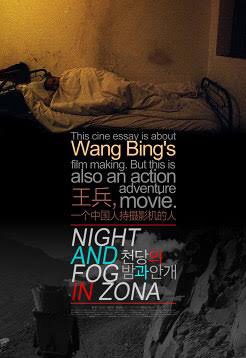
It’s always fascinating when cinema reflects on cinema, and even more so when a documentary’s subject is director Wang Bing filming one of his movies. Night and Fog in Zona is a documentary, or better yet a cine-essay as it is called by its author: South Korean critic turned director Jeong Sung-il, who follows the renowned Chinese filmmaker throughout a whole winter while working on two of his projects, ‘Til Madness Do Us Part and a sequel to his Three Sisters.

The “coming” of Wang Bing has been, and still is, one of the most important events that occurred in the world of cinema in the last 15 years: not only did he contribute asserting the aesthetic value of digital filmmaking, but with his documentaries he also brought an auroral and liberating gaze upon the world.
Jung Sung-il had the same kind of dawning experience watching West of the Tracks in 2001.

“When I was at the Rotterdam Film Festival I bought a ticket for a movie 9 hours and 10 minutes long, I was surprised by its length but went anyway. It begins with a train in movement and it reminded me of the first movie ever made by the Lumière brothers in 1895. Watching Wang Bing’s work I had the feeling of witnessing the cinema of 21st Century just like the audience in 1895 witnessed its birth.”

There’s no narration in Night and Fog in Zona, everything is explained with intertitles: geographical coordinates, places where Wang Bing is headed to, his plans. Sometimes these intertitles also work as a poetic comment to the following scene.
The only time when Wang speaks directly to the camera is in an interview-like fashion at the very beginning of the film, a sequence that works as a brief introduction to his world and his filmmaking style. A few minutes where, among other things, he talks about his filmmaking process, truth in cinema, the impossibility of conveying the totality, his projects, Chinese history and peasants, and the similar cultural background his generation shares with Andrei Tarkovsky.

In 235 minutes Night and Fog in Zona illuminates a great deal about Wang Bing’s approach to filmmaking. Among other things, we learn about his habit of taking photos of the people he films, his relationship with them, and, most fascinating of all, about his “interview technique”: it’s compelling to see how he is able to seamlessly switch from “chatting with” to “shooting at” his subjects, as if there was no real break between the two actions.
It’s also interesting to witness how “Wang searches for the ‘strategic point’, the single position from which all of the actions in the scene can be recorded”. This is a fundamental feature of his filmmaking, as the relationship between the camera and the people and things around it determines both the movie’s sense of space and how space itself is conveyed in his works. And space, together with time/duration, is one of the most crucial elements of his cinema.
Another revelation of Night and Fog in Zona is to discover how Wang Bing is a director whose involvement with the subjects of his movies is deeper than we might think from just watching his works: when the camera is off, he’s often seen giving practical help and advices to his “protagonists”.

Particularly fascinating, from a movie making point of view, is a scene where the director and his two collaborators have an evening meeting to watch the footage shot during the day at the Asylum — footage that would eventually become ‘Til Madness Do Us Part. A few but meaningful minutes where he explains the reasons behind his use of long takes, why avoiding telephoto lens, and other rules to follow while shooting, so that the final work can gain a certain consistency, a certain style.
However, the best quality of Night and Fog in Zona is that it’s not only a documentary about Wang Bing shooting his movies, but it’s also shot and conceived — with all the due differences – just like one of Wang’s documentaries. In terms of style, it mirrors Wang Bing’s filmmaking: long takes, no narration, abstract landscapes and experimental music, everything put together to explore his filmmaking and, in a broader sense, contemporary China, a country gazed upon, as in most of Wang Bing’s works themselves, from a peripheral and rural point of view.
One of the best examples of this mirroring process is to be found towards the beginning of the film, when the Chinese director and his collaborators move to the Yunnan province.

A very long sequence shot from the car everyone is on, that shows us streets, mountains, plains, lights and tunnels almost melting together. A scene almost 10 minute long, matched with a hypnotic and minimalistic music interacting with the abstract landscape captured by the camera.
We encounter these sort of sequences a couple of times during the movie: another powerful one, shown in slow motion, is inside the asylum. Bing is sleeping and ten or so patients are sitting and moving around him. What gives Night and Fog in Zona a further experimental and even meta-filmic touch are two scenes, placed at the beginning and at the end of the movie, that show a Korean girl dressed in red sitting in a theater and making a phone call.
The only flaws to be found in this documentary, an otherwise almost perfect work, are some editing choices, in some cases too abrupt, and the pace of the intertitles, definitely too fast. But that’s just splitting hairs, Night and Fog in Zona is definitely one of the best non-fiction movies seen this year, not only for its fascinating subject, but also for its ability to resonate with Wang Bing’s own style at a deep and aesthetic level.

Report: screening of Gama (Oda Kaori, 2023) in Toyonaka

At the end of last January, I had the pleasure of attending a special screening of Gama, the latest project by Oda Kaori, a talented filmmaker and artist whose previous works I covered in the past for this blog, and for various other outlets (review of Aragane, interview with Oda, review of Cenote).

The work was screened in the city of Toyonaka on January 27th, and was commissioned by the Toyonaka Arts Project 2022. From Oda’s perspective Gama is also a second chapter of sorts, or a “trace” so to speak, of an ongoing project, a movie that will come out next year, Oda is developing about underground areas in Japan, underground both in its literal and figurative sense. The first chapter of this project is a visual installation produced by the Sapporo Cultural Arts Community Center, and projected on an ultra-wide horizontal screen in a underground pedestrian passageway in the city of Sapporo, Hokkaido. The work, also titled Underground, is being screened until the end of March, alternated with works by artists such as Apichatpong Weerasethakul (The Longing Field) or Rika Noguchi (Insects/ Leaves/ Songs of Birds), as part of a project called Nishi 2-Chome Chikahodo Video Creation. Here the official description of Oda’s installation:

Kaori Oda “Underground”
2022 | 09’37”
Kaori Oda consistently seeks for human memories―Where are we coming from and where are we going to―. In this piece, she dives into the underground paths in Sapporo beneath its enormous landscape aboveground. She projects everyday lives and sound footages of Sapporo in the past decades, as well as repetitive caves and holes, or images of the universe. The locations where she projects these moving images are normally closed to public. This film shot in 16mm considers layers of the time lived by the people, redefining them as multi-track timeframe. It invites us to imagine the space where we exist now as well as the very beginning of time.

Back to Gama, the work screened in Toyonaka. The film takes place entirely in Okinawa, and the connection between Toyonaka, a city located in Osaka prefecture, and the Ryūkyū archipelago has a history that goes back after the war, when in 1964 the city of Koza, now Okinawa city, started to send sacred stones and hibiscus flowers to the families, living in Toyonaka, of people who died during the war in Okinawa. The film is shot mainly in natural caves (gama), where civilians took shelter during the early stages of the Battle of Okinawa (April-June, 1945). One of these though, the so-called Chibichiri Gama, tragically ended up becoming the site of a mass suicide, when people were told that American soldiers would eventually kill them all. If I’m not wrong, there’s another cave also mentioned in Gama, one where the Okinawans who took refuge surrendered, because they were told by people who lived in Hawaii that U.S. Army would spare civilians.  

I think it is fair to say that Gama is, formally, a slight departure from Oda’s previous works, at least the feature-length documentaries, and for a couple of different reasons. The first and major one is that the movie has a strong performative element to it, one that was almost absent in Aragane, Cenote or Towards a Common Tenderness. In the film, the caves are used as a set for the stories told by a local guide, who specializes in the history and stories connected to the caves, and who is very passionate about his “job” to the extent he considers it a mission. Engulfed in the darkness of the cave, with just some blades of light cutting the frame, these tragic stories about women, children and old people fearing for their life are declaimed as in a recital. There’s a certain singsong rhythm to the way the man tells his stories, that gives the movie almost a hypnotic sonic quality. On the visual aspect, the play between darkness and light—it is worth mentioning that the work was shot on film—and the balance/imbalance of artificial and natural elements in the frame, make the movie fascinating to look at, and at times looking like a painting. Going back to the performative element, an important and central part of the work is the presence of Yoshigai Nao, a dancer and filmmaker (Grand Bouquet, Shari) who, according to what was said in the talk after the screening by herself and Oda, is for the movie not only an actor or a performer serving the director, but more a member of the staff, she actively participated in some filming decisions as well. Interesting and connected to what we wrote above about Gama being a work that signals a divergence from her previous modus operandi, is also the fact that the movie is the first work Oda did not film herself, it was shot by another female filmmaker and cinematographer, Takano Yoshiko, she was, among other things, the cinematographer for Saudade by Tomita Katsuya (2011).     

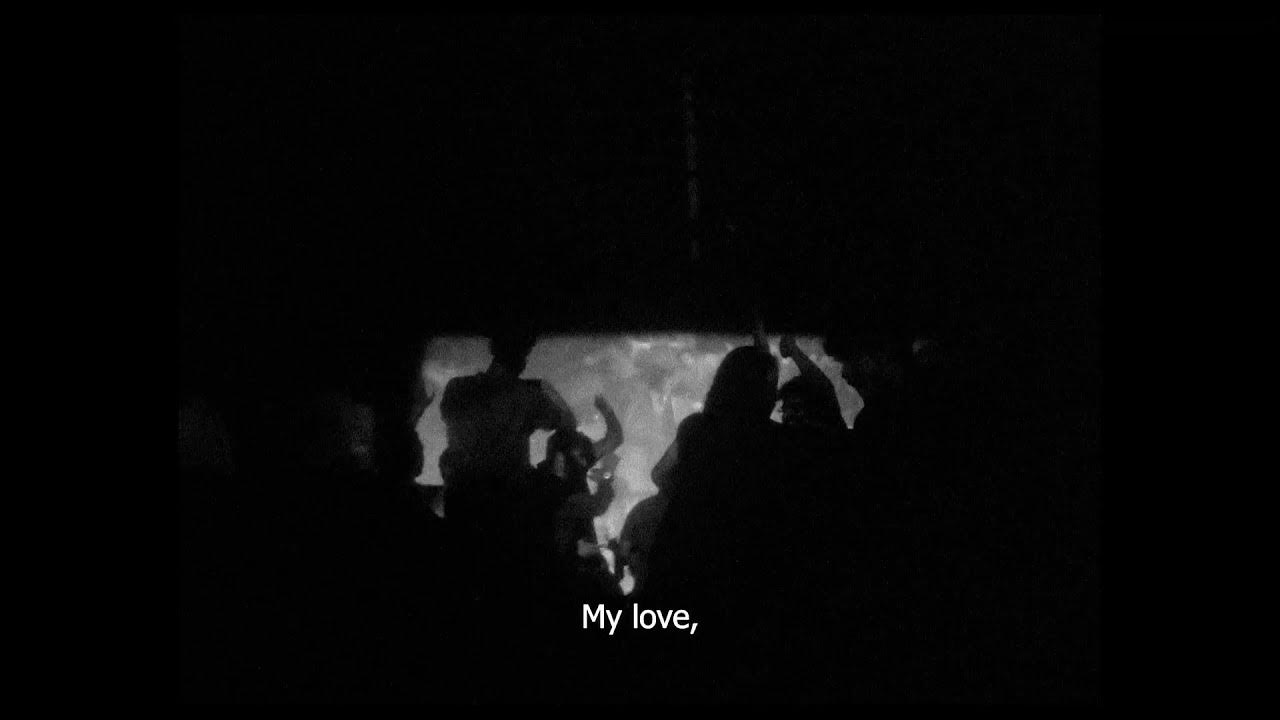
While the guide is reciting his stories, Yoshigai, in the film dressed in blue, moves, crawls, and almost dances throughout the cave, a phantasmatic figure, she plays the role, in Oda’s own words, of the “shadow”, possibly conveying presences from the past, human or non-human. The compresence of human histories, in this case tragic war memories, with the geologic time, millennia that here shaped the caves, while not directly expressed, is one of the themes that lies at the core of Gama (and is prominent in Cenote as well). The cave has at its bottom, and is itself composed of, layers of minerals, micro-organisms, animals’ bones, and human bones. Traces of historical and geologic time that are here overlapping.  “Traces” is an important concept for approaching Gama and more broadly Oda’s works, not only because of what we just wrote, but also because of a certain scene in the movie. While the guide is telling his stories, the screen goes completely black, Oda explained that she just turned off all the lights leaving the cave in its natural darkness with the man speaking. As an after effects—this was discussed in the talk after the screening and Oda said she did not notice it at first—the shape of the man and the outlines of the rocks stay for a couple of second on the black screen, giving a sense of a phantasmatic presence, of something that manifest itself while not being there. As a common thread running through her films, it is fascinating to notice how Cenote explores something similar, not formally, but thematically, the presence of the dead both in the sinkholes, and in the Maya ceremonies shot in 8mm.

One of the formal choices that have become a sort of signature of Oda’s style, an abrupt cut from darkness to light and from noise to silence, moves the focus of Gama from the cave, where the guide and his group are searching for and separating human and animal bones, to the outside, where the screen is filled with the blue of the sea and the sky, and the white of the coral beach. Here Yoshigai is playing with pieces of coral, themselves remnants of past lives, making a light and soothing sound with them. The peace of the scene is interrupted, by pure chance according to the director, when the deafening sound of an American aircraft passing nearby transforms the scene into a scream, reminding us, the viewers not the people of Okinawa, about the reality of the physically oppressive presence of the American Army in the archipelago.

As in her previous works, but in Gama is something more prominent, the underground space with its darkness and depth seems to be the perfect locus solus where different times, and different (hi)stories intermingle and intersect. It will be fascinating to see how Oda will be able to organize and infuse these ideas in her next feature-length work.

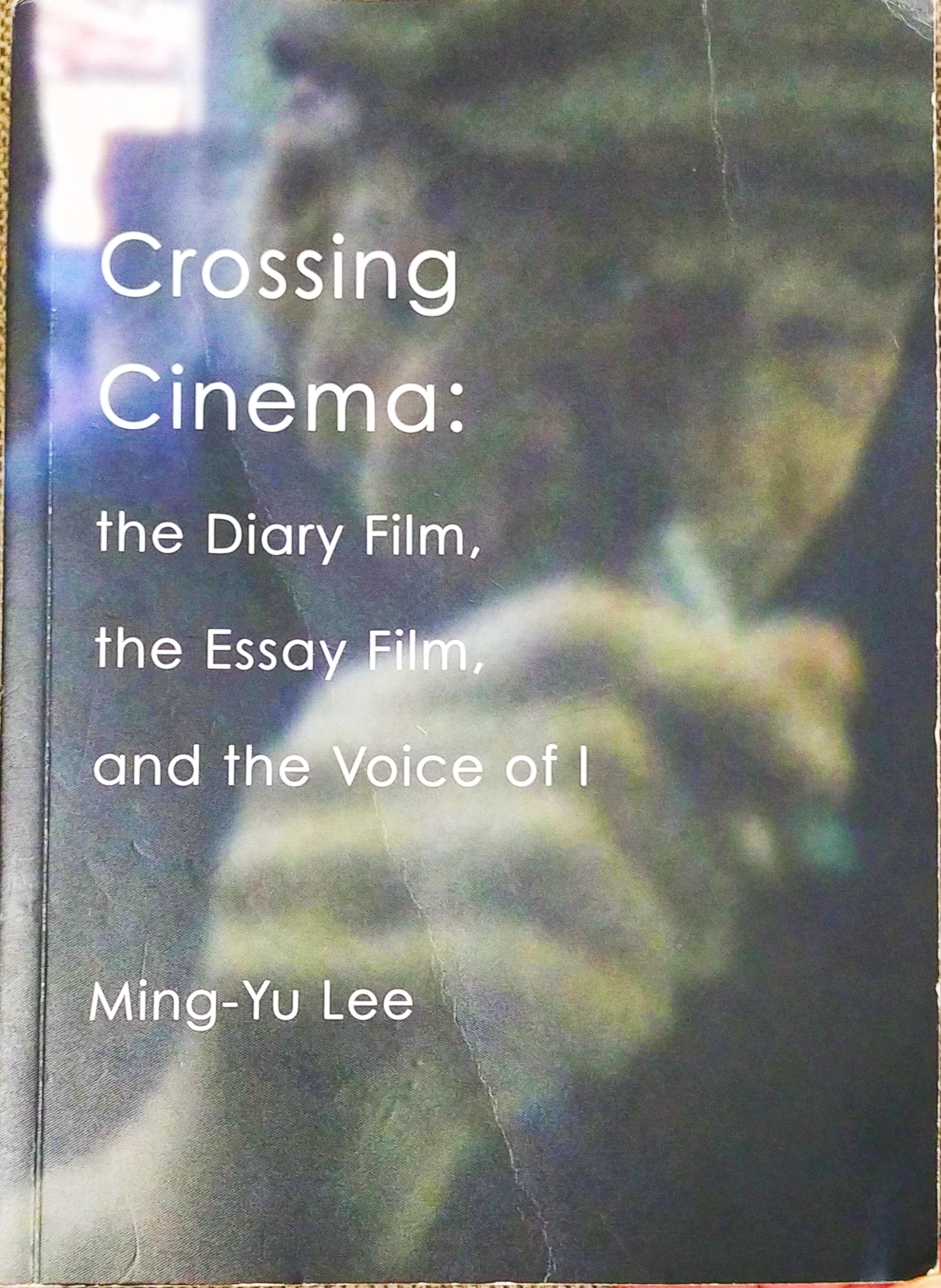
“Crossing Cinema: the Diary Film, the Essay Film, and the Voice of I” by Ming-Yu Lee

Crossing Cinema: the Diary Film, the Essay Film, and the Voice of I is a volume published by Bookman Books in 2022, and written by Taiwanese scholar and filmmaker Lee Ming-Yu on the possibilities and aesthetics of essay and diary films. I came to the author through my interest towards Taiwanese filmmaker Liu Na’Ou (discovering The Man Who Has a Camera was a revelation for me), to whom the first insightful essay in the volume is dedicated, but I discovered through the book a far richer cinematic landscape, one that explores the possibilities of the visual diary and the essay film. As stated by the author on the back cover:

This book focuses on the unique forms of expression of diary film and essay film, especially how authorship of filmmakers can be integrated in the voice-over as a narrative strategy in first-person cinema. The book is divided into two sections: the first section “essays” contains three chapters, and in these chapters I use films of Liu Na’Ou, Hollis Frampton, Jonas Mekas, and José Luis Guerín as cases for filmic textual analyses, to discuss the issues of authorial presence, the voice-over narration, and audiovisual structure. In the second section “interviews”, four important researchers and filmmakers contribute their thoughts and reflections on how the essay film and the diary film can be approached and understood.

The first part of the volume is very interesting and rich with insights, but here I’d like to focus more on the second section. The first conversation, a correspondence between Lee and scholar and professor Laura Rascaroli was the one that resonated with me the most. Rascaroli is known, among other things, for her research and publications on personal cinema and the essay film, reflections that are here mirrored in the style used, an exchange of emails she had with Lee over three months, between May and July 2016.  What I found particularly fascinating in their exchange is the parallel drawn between diary films and the practice of microhistory, as Rascaroli writes:

Diary-making is a form of history from below, of microhistory: and this is so needed at a time when history from above continues to rewrite our everyday stories as a function of a political goal. Brexit, which you evoked at the end of your last entry, is a case in point, an abrupt and divisive contestation of just this kind of appropriation. I love the diary film not least because it is a channel through which our microhistory can interconnect and so too be a part of a living social fabric in a wider world.

The open-endedness of the diary form is also a remark I found very poignant:

As Lejeune says, ‘autobiography turns towards the past’, while the diary moves along, heading towards the future, which is unknown to anyone. (Lee)

Epistolarity is, like the diary, a form that is always open to the next ‘entry’. As Raymond Bellour has written, ‘The letter goes on and on. If it is a real letter, it never stops saying, wanting, wanting to say more’ (Rascaroli) 

It goes without saying that the interview with Jonas Mekas is also a chest of treasures. Here on the use of voice-over in his works:

Lee:

When you record your voice-over…

Mekas:

It’s not really…maybe, I don’t know if I would call it voice-over. It’s just part of the film. It has the same function as images, which is not a voice-over, it’s just another element. Voice- over is like you make comments about the images that you see. I don’t make comments about the images. I add another level of content. So it’s not a comment, not a voice-over. You could say that the image-over, sometimes the sound is more important, sometimes images. Images illustrate the sound.

and about diary films and cinéma vérité:

Lee: Does the diary film have something to do with Cinéma vérité?

Mekas: No, no. Cinéma vérité was a variation of the documentary film. The documentary has forms, scripts. It is a scripted gene of cinema. Illustrated with footage. Scripted documentary film, they write a script and they find the footage to illustrate the script, Cinema vérité try to get rid of script scenario, the outcome [wasn’t] determined, there was always a different subject they chose or the theme was different. It was not scripted. They were collecting materials from real life, to illustrate a certain idea. The technique was more open, more real. (…) The diaristic kind of cinema does not have any idea, no predetermined scripts, because you cannot plan life…

To summarize, these are the chapters of the book:

Part one: Essays

1.Re-Discovering Liu Na’Ou and His Man with a Camera: Authorial I. Written Diary, and Cinematic Writing.

2.The Parenthetical Voice-over: Dialectical Audiovisual Structure in Hollis Frampton’s (nostalgia) and Jonas Mekas’s The Song of Avila

3. Film-Letter: The Beginning, Exchanging, and Narration in Jonas Mekas and José Luis Guerín’s Correspondence

Part two: Interviews

4. Correspondence: Ming-Yu Lee/Laura Rascaroli

5. Jonas Mekas: To My Dear Friends

7. Joseph Morder: I’d Like to Share This with Someone

6. Roger Odin: Home Movie. The Diary Film, and P-Cinema

Ming-Yu Lee (李明宇) is a filmmaker and Assistant Professor of Radio, Television and Film at Shih Hsin University (Taipei, Taiwan). Research Interests include the Diary Film, Experimental Film, Essay Film, First-Person Cinema, and Film-making. Independent Filmmaker, photographer and film editor having directed several experimental shorts including Time Variations, Going Home, Home Not Yet Arrived, Four Years of Miller. Works deal with the relationship between diary film, home movies, experimental film and questions of identity.

The book can be purchased here.

Documentary discoveries of 2022

No best documentaries list for me this year, unfortunately I have not seen, or liked, enough films to make one. Instead, I have compiled a list of the best documentary discoveries I had in the past 12 months (the first two are actually movies released in 2022). As usual, the films are listed in no particular order.


名付けようのない踊りThe Unnameable Dance (2022) by Inudo Isshin is the portrait of dancer and performer Tanaka Min, one of the most fascinating Japanese artists alive. The documentary retraces some of the events and encounters that guided his life as a dancer and actor, such as meeting Hijikata Tatsumi in the 1960s, and dancing in Paris in 1978, a trip that de facto launched Tanaka’s career, and a place where he met Roger Caillois, a writer Tanaka strongly admired (the title of the movie is taken from a sentence the French writer used to describe Tanaka’s dance). The documentary, using Tanaka’s own narration, continues by retelling his debut as an actor in Yamada Yōji’s Twilight Samurai (2002), an event that kicked off, at the age of 57, his career in cinema, and focuses also on his work as a farmer, an important part of his life, as he famously stated “In agriculture one can find the anti-modern coming from the past. There you find the concreteness of the present.”
The retelling of all these experiences is interspersed with some of his recent performances, always awe-inspiring, even when mediated by the camera. Performances that were recorded in Japan, but also abroad, in Paris, and especially in Portugal, a country where the documentary begins and ends. The film is an enthralling viewing experience also because it is constructed by interweaving Tanaka’s performances with Yamamura Kōji ‘s beautiful and affective animation, used here mainly to depict Tanaka’s memories and dreams as a child.
Particularly significant is also how the documentary includes purposely the audience, their faces and their reactions when filming Tanaka’s performances in public spaces, since dance is, for the artist, born between dancer, place, and audience.

In Fire of Love (2022)American documentarian Sara Dosa crafted a fascinating work assembling images and films shot around the world in the course of their life by two French volcanologists, Katia and Maurice Krafft. Dosa interweaves these images with other videos about them, and wrapped up everything with the narration of actress, filmmaker and artist Miranda July. I would have preferred a movie made entirely of their films without narration, while July’s voice is very affective, but it is nonetheless a powerful viewing experience. Not only because of the spectacular images, but also because the documentary is very good at delving into the obsession and raison d’etre that guided the life, and ultimately the death, of the couple.

Origin of Cosmos (Lothar Baumgarten) was for me the cinematic experience of 2022, I had the chance to see the movie at the Aichi Triennale, where is was screened in a loop in a very dark room as an installation. Shot between 1973–1977 and finished in 1982, Origin od Cosmos is based on a myth of the Tupi people, a South America’s indigenous group, and while conceptually it is a film about the rain forest, it was filmed in its entirety along the Rhine near Düsseldorf Airport. It is a sensorial experience, as people nowadays say, that envelops the viewers with images and especially with the cacophonous soundscape. Animate and inanimate life is displayed and amassed on screen like a Pollock’s painting: stones, insects, trees, soil, mud, plastic, branches, spiders, eyes, the moon, the sky…
It has to be seen in darkness, because in some of its parts the shapes emerging from the pitch black background are very subtle. I definitely need to do more research on the movie, its production history, filming, and on director Lothar Baumgarten himself.

東京‘69 – 青いクレヨンのいつかは . . . Tokyo ’69 – one day blue crayons . . . (1969) and 治安出動草稿 お昼の戒厳令 Public Order Project: Martial Law at Noon (1981) are two recently discovered works made by the collective NDU (Nihon Documentary Union). I wrote about them here.

死者よ来たりて我が退路を断て Dead, Come and Cut Off my Retreat (1969) is a documentary chronicling the resistance of the students at Nihon University (College of Art) in 1968-69 made by a group of activists called グループびじょん Group Vision, people working at the time at Nippon Eiga Shinsha.
Besides being a powerful documentary about a certain type of resistance at a crucial time in Japan, what I found extremely compelling is how the film is also a profound exploration of places and spaces. It is an interesting documentary also because it gives voice, not much, but more than usual in these kind of contexts in Japan, to women on screen, but also off screen. Among the members of the group, there were at least two women in important positions: Kitamura Takako was one of directors, and Sasaki Michiko one of the cameraman.
Group Vision was also involved in the production of Ogawa Shinsuke’s A Report from Haneda, and Dead, Come and Cut Off My Retreat (the English title is unofficial) has definitely a similar tone. Apparently Jōnouchi Motoharu was also affiliated for a period of time with the group, but I cannot confirm. The group has uploaded the movie on YouTube:

Autour de Jeanne Dielman( Sami Frey, 1975) is a touching document of the filming of Jeanne Dielman, 23, quai du Commerce, 1080 Bruxelles, a window open to the fascinating working relationship between Chantal Akerman and Delphine Seyrig, and to the making of a masterpiece. The movie is available through Another Screen, here.

Before the Flood (Yifan Li, Yu Yan, 2005) chronicles the death of Fengjie, on the Yangtze River, a city and its people slowly being executed and reduced to rubbles by the state and “progress”, in order to make way for the new Three Gorges Dam that eventually ended up flooding the entire valley.

2H (Li Ying, 1999) is a compelling piece of documentary cinema about ageing, the Chinese diaspora, and a group of Chinese expatriates in Tokyo at the end of last century. Ma Jinsan is a 95 year-old former Kuomintang general who defected to Japan nearly 50 years earlier, shortly after the Communist revolution, who has a strong connection with Xiong Wenyun, a young avant-garde artist.
Through the DV camcorder’s aesthetics, used here to its full potential, everything is hugely impactful in 2H, from the staged scenes of Xiong and her lover, to the portrait of Ma, from the dialogic relationship between the camera/director Li and all the people filmed, to the touching finale with Tokyo covered in snow.

Incident at Restigouche (Alanis Obomsawin, 1984) is a documentary chronicling two raids on the Listuguj Mi’gmaq First Nation (Restigouche) by the Sûreté du Québec in 1981, as part of the efforts of the Quebec government to impose new restrictions on Native salmon fishermen. The film, constructed through interviews, photos, and original footage, explores the history behind the Quebec Provincial Police (QPP) raids and the reasons of the protests. The Quebec government had decided to restrict salmon fishing, traditionally an important source of food and income for Micmac Indians. It’s a bless every time we can watch a movie from an author we have never seen anything of, and get blown away; a cinematic door opens in front of us presenting and offering a new landscape to explore. This was for me Incident at Restigouche, and I’m looking forward to watching more documentaries by Obomsavin this year.

Model (1981) Every time I watch a new (for me) film by Frederick Wiseman it is a discovery, this one was glorious, one of his most entertaining, and at the same time, ça va sans dire, deep works. A pivotal film in his career, where something new started to surface. Perhaps the first documentary where he started to use extensively the “pillow shots”. Listen to the excellent Wiseman Podcast, a perfect companion to his documentaries, if you decide to delve in his filmography.

C’etait un Rendezvous (Claude Lelouch, 1976), eight adrenalinic minutes of high-speed drive through the street of Paris.

Kobe Discovery Film Festival 2022 – dispatch 3: Koike Teruo’s screen memorial

Third and final dispatch from this year’s Kobe Discovery Film Festival (first and second here and here)

My last day at the festival coincided with the screening of four programs: the state of film preservation today, actor Hayakawa Sessue, the 100th anniversary of Pathé Baby, and a selection of works by Koike Teruo, experimental filmmaker who passed away last March.

Film, the Living Record of Our Memory (2021) is a documentary directed by Inés Toharia, where film archivists, curators, technicians and filmmakers reflect on the current state of film preservation, why it is a vital part of our culture, and how film archives in different countries are facing a set of very different problems. The second screening of the day was Where Lights Are Low, a silent drama directed by Colin Campbell in 1921, with protagonist the Japanese Hollywood star Hayakawa Sessue. I had already watched the movie before, on the streaming edition of the Pordenone Silent Film Festival during the pandemic I believe, but to experience it on the big screen with a live accompaniment was a delight. 2022 marks the 100th birthday of Pathé Baby, to celebrate it, a group of people, lead by Anna Briggs, Michele Manzolini, and Mirco Santi, in conjunction with the association INEDITS Amateur Films / Memory of Europe, assembled a montage of amateur films shot in 9.5mm from around the globe, 9 1⁄2 the title. The work is a visual symphony of everyday life, as it is called in the introduction, that, for its moments of unexpected poetry, reminded me of Liu Na’ou’s The Man Who Has a Camera.

Experimental filmmaker and visual artist Koike Teruo passed away on March 18th, KDFF 2022 dedicated to the director a special program comprised of four of his works, three of which are part of his life-long series Ecosystem, which Koike himself described as something that “has grown as a sort of giant tree for me”: 生態系 -5- 微動石 (1988), 生態系 -20- ストーン (2013), and 生態系 -27- 密度1(2018). One of the four, 衝 (1995), is a short piece, a sort of documentary, shot in Kobe in the aftermath of the earthquake that hit the area on January 17th 1995. Besides the works themselves, a wave of materiality that inundates the viewer with their rhythm and editing speed, especially when experienced on a big screen, what turned out to be particularly interesting for me, was the talk after the screening. Researcher Tanaka Shimpei talked about the importance of Koike in establishing the experimental scene in the Kansai area through events and independent screenings (自主上映会). As Tanaka writes in the catalogue ECOSYSTEM Teruo Koike Visual Works 1974 – 2020:

The career of a prominent visual artist Teruo Koike must be reconsidered through not only his film making which includes collaborations with various modern dances and his improvisational music performances, but also his aggressive independent screening activities which have been maintained since as far back as around 1980’s. And not only should we look back on his rich filmography centering on the “Ecosystem” series, but also by reviewing Koike’s screening activities engaged around Kobe.

Born in Ichinomiya city, he graduated in Kobe, and after his experience in Iran at the end of the 1970s, where he worked in a petroleum complex, and where he experienced first hand the Iranian Revolution, Koike returned to Japan, started again to make films, and began to organize screening events. In 1980, together with Okuda Osamu founded Cosmic Caravan (1980-1982), a group engaged in showing and making experimental movies. After this experience, Koike and others, among whom Zeze Takahisa, formed Voyant Cinémathéque (1983-1996), a group active for more than a decade in Kyoto, Osaka, and Kobe, that promoted experimental cinema, and helped new artists by providing them venues for showing their work. Koike continued to be very active in showing and organizing events (installations, visual performances) in the new millennium as well, he learned to play the Japanese flute in the mid-1990s, and often accompanied the screenings of his works, not only with his live improvised performances, but also with professional dancers.

Image Forum Festival 2022: Silver Cave, Humoresque, A Short Story, and The Cleaning Lady After 100 Years: Spectre.

Yesterday I had the chance to attend one of the programs of this year Image Forum Festival, in Nagoya. Every year the event is held first in Tokyo, and later in the year, in a scale-down format, in other cities in Japan: Yokohama, Kyoto, and Nagoya.

In the past decade I went to the festival in Tokyo a couple of times, once in Kyoto if I remember correctly, and recently just in Nagoya, since it’s for me, a closer location. The event is dedicated mainly to experimental cinema and video, produced all over the world, with a particular attention of what is going on in Japan and Asia. The festival has been for me a source of wonderful discoveries, here I wrote about the 2018’s edition, here about Stop-Motion Slow-Motion, and here about Heliography by Yamazaki Hiroshi. Unfortunately this year I could just see a tiny fraction of what I planned and wanted to, just four works of the East Asian Experimental Film Competition.

Silver Cave

Silver Cave (2022) by Cai Caibei is an interesting piece that plays with surfaces, and the flat metallic substance that animates and “moves” for most of the work. For its focus on abstractions, rhythm, and its quasi meta-filmic quality, it reminded me of the works of some pioneer animators of the beginning of last century, such as Walter Ruttmann. Silver Cave won the Award for Excellence at the festival.

A Short Story

Filmmaker and artist Bi Gan’s latest work, A Short Story (2022) tells about a black cat that embarks on a bizarre journey to meet three curious characters. Presented in the short competition at Cannes last spring, the work is populated with dream-like images, visual inventiveness, and poetry, but I could not really connect with it.

ユーモレスクHumoresque

I was really looking forward to checking ユーモレスク Humoresque (2022) by Isobe Shinya, who in 2020 made 13, one of my favourite films of that year. I had already read that this work was something very different from what he had done before, Humoresque is 46 minutes long and was shot digitally, so I was somehow prepared. As the description in the official catalog reports the work is

an abrupt turn from “13”, this film employs the technique of home movies to tell the story of the lives of a mother and child across four seasons. Day after day, water drawn from a lake is filtered and bartered for food. One day, a man visits with a portable gramophone. The song it plays is Dvorak’s “Humoresque.” What does he think about this music?

and according to Isobe

I created a fictional world by converting and extending home movie shooting as a filmmaking technique. Many of the scenes in the film were inspired by their real-life counterparts. The small story in front of us, the big story far away, and the story that is no longer here. This film is an attempt to assimilate them in fiction and reality.

Some images are really mesmerising, the way sound is used is remarkable, and while very different from the time-lapse experiments Isobe is known for, Humoresque is still a movie about time, the thickness of it, and the passage of it. That being said, I definitely need to watch it again to give it a proper assessment. Humoresque was awarded the Grand Prize at the festival.

The Cleaning Lady After 100 Years: Spectre

The Cleaning Lady After 100 Years: Spectre (Shichiri Kei, 2022) is a reimagining of the filmmaker’s own multimedia stage drama The Cleaning Lady, where the ghost of her mother appears to an old woman. This was probably the most powerful work among the four I saw, in a completely digitised world the human presence is not even a memory, even the words uttered are just part of the cacophonous soundscape presented in the film. No straightforward meanings emerge from the work, but images and sounds slowly and aggressively point towards and put the viewer through a sensorial and exhilarating experience. The film loses part of this power towards the end when the spoken words try to enunciate philosophical ideas.

Leafing through the catalogue made me realised how many interesting and possibly wonderful works I missed: a retrospective on contemporary Chinese independent cinema, Qingnian Express: New Voices and Visions of Chinese Independent Cinema Today (curated by Tong Shan and Ma Ran), TUNOHAZU, the latest by Tezka Macoto, a retrospective on artist and graphic designer Tanaami Keiichi, and much more.