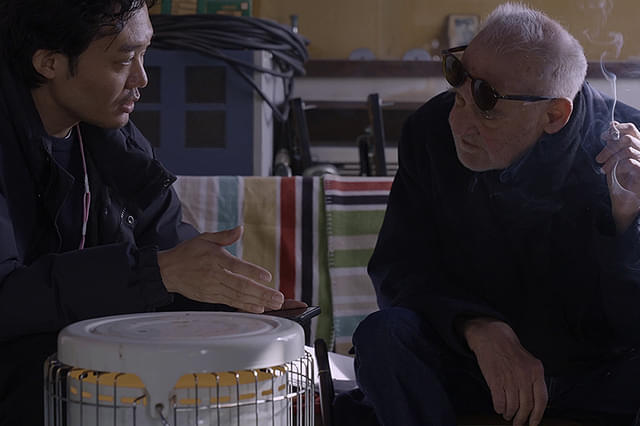
Fukushima with Béla Tarr documents a two-week workshop held by the Hungarian filmmaker in February 2024 in the Japanese area hit by the 2011 Tōhoku earthquake and tsunami. The documentary is directed by Oda Kaori, who studied with Tarr at film.factory, his film school in Sarajevo, more than a decade ago, a period that led to Oda’s debut film Aragane (2015).
I found Fukushima with Béla Tarr fascinating on so many levels, not least the director’s abrasive personality, which – as some reviewers have pointed out – at first seems almost like a caricature of the artistic persona he has developed over the years. What also struck me was his varied interactions with each filmmaker; there is a sense, at least from what we can gather from the documentary, that he likes some of the participants’ approach to filming more than others. Tarr’s comments, suggestions and conversations with the filmmakers also reveal how he sees cinema and the filmmaking process, at least in the limited conditions of the workshop: only two weeks, no familiarity with the area and the language for many of the participants. Perhaps it’s because of the limited time available that Tarr pushes everyone, sometimes almost aggressively, to visualise the ideas they have in mind in images, rather than just talking about them or explaining the context of what’s happening. Some of the most interesting technical tips he gives the workshop participants are also prime examples of his idea of cinema, such as holding a shot longer than one would normally do, it’s always possible to shorten it later, or how paying attention to the interplay of light and darkness enhances the visual impact and the meanings conveyed by the work.
The best quality of the documentary, in my opinion, is the time it spends and stays with the group of people involved in the workshop, allowing the camera to capture the distinctive personality of each filmmaker and how each of their projects progresses, or in some cases crumbles, towards the deadline. It is this familiarity with the subjects that makes the work more organic and meaningful as it unfolds, and leads the viewer to care about, or at least become more familiar with, all the people involved, not just the filmmakers and Tarr, but also the interpreters, drivers and ordinary people filmed here. All this takes place against the backdrop of the lives of the people of Fukushima affected by the triple disaster, the subject of the works produced in the workshop, of which we, the viewers, get only a glimpse. Among the most fascinating of these stories is that of a kamishibai performed by two women in an abandoned cow shed, now in ruins, and told from the animals’ point of view (Tale of Cows directed by Fukunaga Takeshi).
On a technical level, Oda’s decision to use mostly static shots with very little camera movement is very effective in creating a restrained cinematic space centred around the people portrayed and their interactions. But perhaps the Japanese filmmaker’s greatest effort, as is often the case with this type of documentary, was in the editing room, deciding what to include, how to include it, how to structure it, and what to leave on the cutting room floor.
The short films made by the 7 filmmakers have been compiled into an omnibus film, Letters From Fukushima. Below is the description of each short film (from the Tokyo International Film Festival’s webpage):
“Nappo” After 13 years of silence, the instruments are played again. Nappo gathers Fukushima children at Odaka Church. Singing and dancing, they breathe new life into the land. Director: Lin Po-Yu 2024/Color/9min/Japanese
“Wall” A man from Namie Town had to relocate his landscaping business after the disaster. One day, he begins working on a garden in the office, which has been untouched. Director: Ooura Miran 2024/Color/28min/Japanese
“Long Long Hair” In a Fukushima hair salon, daily interactions unveil personal stories, resilience, and the beauty of life after the Great East Japan Earthquake and the nuclear accident. Director: Iizuka Minami 2024/Color/23min/Japanese
“From F” Fukushima, Family, Female, and Future. A story about various Fs, starring 17-year-old-girl who wants to be a dancer while attending an evening school in Fukushima. Director: Shimizu Shumpei 2024/Color/10min/Japanese
“Letters from Fukushima” “Woman, Life, Freedom” is a social movement seeking gender equality. Through three scenes of Fukushima, the film honors the women who gave their lives for dignity. Director: Roya Eshraghi 2024/Color/27min/Japanese, Persian
“The Guests” After a nuclear radiation leak at the Fukushima power plant in 2011, a group of Southeast Asian auto mechanics is dispatched to work in this land… Director: Xu Zhien 2024/Color/28min/Filipino, Japanese
“Tale of Cows” Two women who survived the 2011 Tohoku Earthquake, perform a Kamishibai picturebook about the abandoned cows during the Fukushima nuclear power plant accident. Director: Fukunaga Takeshi 2024/Color/29min/Japanese
Underground spaces accumulate traces and memories of past presences, both non-human ones created over thousands of years by geological processes, and those left by human activity and histories. Over the past three years, Japanese artist and filmmaker Oda Kaori has explored and focused her attention on some of these underground places in Japan, seeking to capture and evoke past existences through images and sounds. The result of this research, which has also led to other productions in various media, is アンダーグラウンド Underground (2024), a sonic and visual experiment that was presented at the 37th edition of the Tokyo International Film Festival in the Nippon Cinema Now section last November.
At least three years in the making, Underground is her most experimental work to date, and a project that concludes a phase of Oda’s career dedicated to exploring subterranean spaces with Aragane (2015) and continued with the underwater world with Cenote (2019), but one that may also herald a new path, more experimental, for the artist. If you want to know more about Oda and her previous work, I’ve written a long essay about her first three works, or there’s also an interview I did with her – although it was almost ten years ago, at the beginning of her career.
The interest in the Japanese underground and in the past lives it evokes is thus a continuation of the path that the artist took with Aragane and Cenote, but here with a focus on the subterranean spaces of the archipelago. An early result of this exploration of Japan’s underground spaces was released last year, Gama (2023), a medium-length film that brings to light, almost literally, the stories of forced mass suicides of Okinawan people in gamas (natural caves), during the latter stages of the Pacific War. Much of the footage shot for Gama was reused in Underground and combined with images from another project, a nearly ten-minute installation created for the city of Sapporo in 2022. To complete Underground, Oda combined all this material with others shot in Yubari, Shimane, Saga, and Hyogo, although the locations are never specified in the film.
The biggest departure and difference from her previous works is Oda’s decision to use Yoshigai Nao as “shadow” in the film, an almost phantasmatic presence that moves freely throughout the work, connecting different places and different times, and the meaning of which is never explained. This addition brings a performative element to Underground that is almost absent from her other films. Yoshigai is a coreographer, dancer, and director herself, and has made some interesting works such as Grand Bouquet (2019) and Shari (2021); まさゆめ Masayume (2024), her latest – which I have unfortunately not seen – was produced as Cenote by the Aichi Arts Center and screened in Nagoya last November. Yoshigai also has a prominent role in Gama, as most of the images from the hybrid documentary released in 2023 are reused in Underground. This is probably the main problem I have with Oda’s latest film, the central part is a repetition of what was done and shown in Gama, and although I know that it is the other way round – Gama came out of the Underground project and not vice versa – I feel that the images of Okinawa could have been left out.
While Underground is perhaps less effective when it combines material that is too visually disparate – at least for me the film does not work when it weaves together Yoshigai’s performance with the more abstract images shot underground – it excels in the more visually and sonically experimental moments. In the director’s own words “the underground world is pitch black, and nothing can be seen unless light is shone on it. It is not reflected. The act of shining light on the darkness felt like an act of sculpting the space with light”. This play of light and darkness, the overlapping of the artificial and the natural – the use of film superimposition is first class – and the materiality of the images, which I understand were shot on film, find a magnificent parallel in the sound, a sonic tapestry that, in the most inspired moments, manages to elevate the whole film.
If I’m not mistaken, at the moment Oda is working on smaller projects, she will be screening one of her shorter works, shot digitally, about her mother, at the next Yebisu International Festival for Art & Alternative Visions between next February and March.
I’ve decided to publish here my essay on three films by Oda Kaori that was originally meant to be published in an international film magazine (things have stalled, unfortunately). I took the decision because in the meantime Oda’s career (the piece was written almost five years ago) has evolved significantly, with more exhibitions, art installations, political and social stances, and films (Gama, and the Underground project). It goes without saying that now I would write the piece quite differently, mainly in style but also regarding the content. Posting here this short essay does not preclude that in the future I might return to write on the subject; on the contrary, it gives me the chance and the peace of mind to turn the page and freshly reassess the filmography of one of the most fascinating artists working in Japan today.
Reassessing the human: three experimental documentaries by Oda Kaori
“The landscape thinks itself in me and I am its consciousness.”[1]
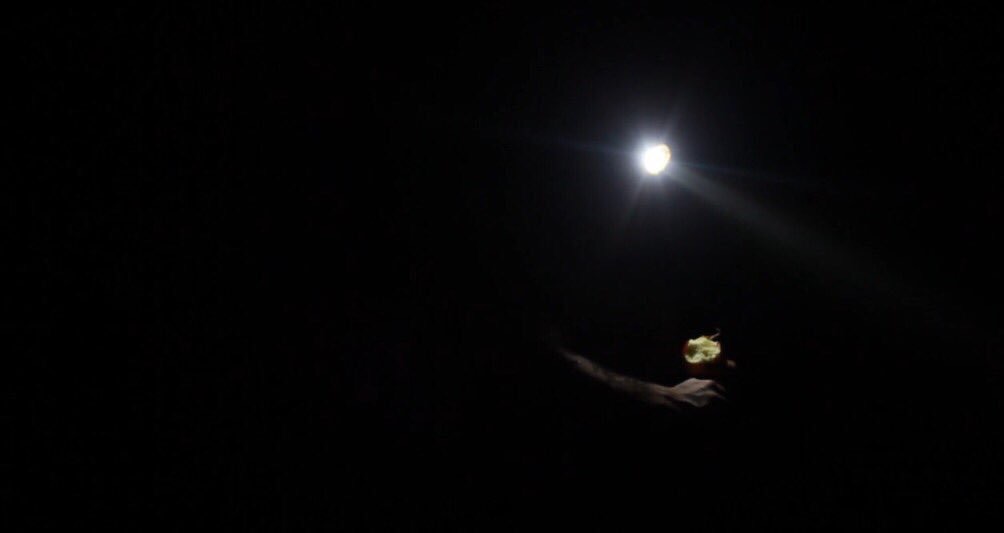
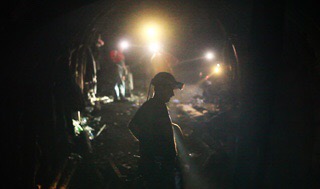
A worker sits down and takes a break. In the deep belly of a mine and enveloped in a pitch black surrounding, he bites a red apple. His helmet lamp provides the only few blades of light in a scene of almost Vermeer-like beauty. In the preceding scenes the noise from the machinery at work in the mine is so unbearable that the words are oftentimes superfluous or just a waste of energy. The life in the mine is only silence or cacophony: there is no middle ground. It is an alien landscape, both visual and sonic, where the human is just one element among several. The beauty of the moment derives from the interplay between darkness and light, from the silence after the wall of noise that precedes it, and from the empathy towards the man conveyed by the camera.
The scene is one of most significant and impressive passages in Aragane, a feature documentary shot, edited, sound-designed and directed by Oda Kaori in 2015. Oda made her debut in 2010 with the short Thus a Noise Speaks, a personal documentary that unflinchingly explored her coming out as gay and the subsequent reactions from her family, especially her mother. The experience of Thus a Noise Speaks, one where the camera is also used, in Oda’s own words, “as a weapon for revenge against my mother,” was a fundamental experience for the young Japanese director, who was 23 years old at the time: Not only because it was a way of expressing her true self, but also because it was a chance to grasp the incredible power that filmmaking can have, and to realize how harmful a camera pointed at someone can be.
Born in Japan, but partly educated in the U.S.[2] and with three formative years spent in Bosnia, Oda’s artistic arc began from a position of hybridity from the very beginning and afterward wandered around the globe in search of places and stories to explore. The sense of displacement experienced and expressed in her debut short, and her background as a so-called “halfie,”[3] opened the gates for a cinema conceived as a nomadic wandering, and an artistic path that in crossing borders, cultures, genres, and styles, explores what it means to be a subject in flux and always open, as the best ethnographers always are, to what the world has to offer[4]. Moving from one geographical area to the next, from Japan to Bosnia, back to Japan and then to Mexico—but a Mexico filtered through Mayan mythology—Oda’s filmography expresses the idea of a nomadic cinema not interested in broad and essentialist discourses about cultures, but more focused on specific places and the collective experiences and memories linked to such places.
Towards an alien phenomenology
The first (and to this day, most artistically accomplished) example of this approach arrived for Oda in 2015, when Aragane was presented at the Yamagata International Documentary Film Festival. A work, as previously mentioned, that she directed, photographed, edited, and sound-designed, but also a “product” of Bela Tarr’s film.factory, the short-lived film school based in Sarajevo and established by the Hungarian director in 2013, a place where Japanese director Oda studied for three years.
Aragane, meaning ore or small pieces of stone in Japanese, was shot in a Bosnian coal mine as a project for film.factory. An immersive and hypnotic sensorial experience, the movie starts, and thus sets the tone for the rest of the work, with a pounding noise and a close-up of a machine. The scene is followed by a short depiction of life on the surface, with workers preparing and completing various tasks before commencing the deep dive into the mine. Once in, we’re in a different kind of world, one where the only lights rippling and dancing in the total darkness are those of the headlights of the workers and of Oda herself, and one where the noise is so deafening and monotonous it turns into a sort of alien music.
Aragane is not a direct inquiry into the harsh conditions of the people working in the mine (although that is something that eventually and necessarily emerges) but more an attempt to convey on screen the time and space of the coal mine as experienced by the people working in it. Creating a sensory experience of the place, an experience constructed through the interplay of machines, darkness, head lamps and the miners, Oda hints at a different field of perception and at a different type of time. For most of the duration of the film, we don’t really know what’s going on and who is doing what: what is missing is a central orientation, a focal point around which the movie can organize itself in the usual sense.
“The darkness, no sunlight, no moonlight”
“timber dust floating”
“pump, electric saws”
“grey fog”
“steam evaporating from T-shirts”
“a flickering head lamp sways”
“A small universe within a universe”.
“I see because there is light”
“In this underground world people and machine carry the same weight”[5]
Once we get accustomed to the things, events and musicality of the noise presented on screen, though, everything slowly begins to make sense. What starts to surface from the images, sounds, tracking shots and slow and hypnotic camera movements, is the time and the materiality of the mine itself. When a long and dark scene towards the end of the movie, with the carts ascending to the surface of the earth, is brutally interrupted by a static image of the outside of the mine covered in snow, it is almost like a revelation. After an hour of darkness inside the bowels of the earth experiencing a different perception of time and space, the whiteness of the snow, the colors of the clothes and those of the equipment hanging are so sharp and bright that gazing upon them almost induces vertigo.
With the sensory and cacophonic descent into the alien landscape that is the life in the mine, Aragane is also an exploration of the relation between the people working inside and the place itself. This is a crucial point in understanding Oda’s works: her films are, for the most part, and especially on first viewing, an overwhelming visual and sensory experience that seem to focus more on the non-human elements of what is filmed. However, when fully absorbed, they reveal the true potential of what her cinema can do at its best: establish a cartography of non-human landscapes and, at the same time, reflect on the role and position of the human element in this “new world.” It is not by chance that the central part of the movie, the core and one of the most significant scenes in the entire documentary, is the beautiful scene that we have described at the very beginning of this essay.
“Tell me how I can touch a butterfly without breaking her wings”[6]
The preoccupation towards people is one of the central themes of Towards a Common Tenderness. Released in 2017, the movie is many things: a visual poem structured like a diary about the experience Oda had while filming her first and second works, but at the same time a reflection on the act of filming, and, as in Thus a Noise Speaks, the power the camera has when pointed at someone.
The movie starts with a beautiful murmur of voices and sounds, with Oda herself pronouncing lines from her memories and reading from Notes on Cinematography by Robert Bresson and Rosemary Menzies’ Poems for Bosnia. It then moves to a shot of her first movie (a shot of a shot) of her mother crying when Oda comes out. The movie is, in fact, structured as a long letter sent to Oda’s mother, in which the director speaks directly to her mother about her experiences with the camera and everything that happened to her after she decided to become a filmmaker. Toward a Common Tenderness uses a mixed visual style, with abstract and poetic images intertwined with shots recorded by Oda in Bosnia and Herzegovina during her period at Bela Tarr’s school, outtakes not used in Aragane, and other images from unfinished projects.
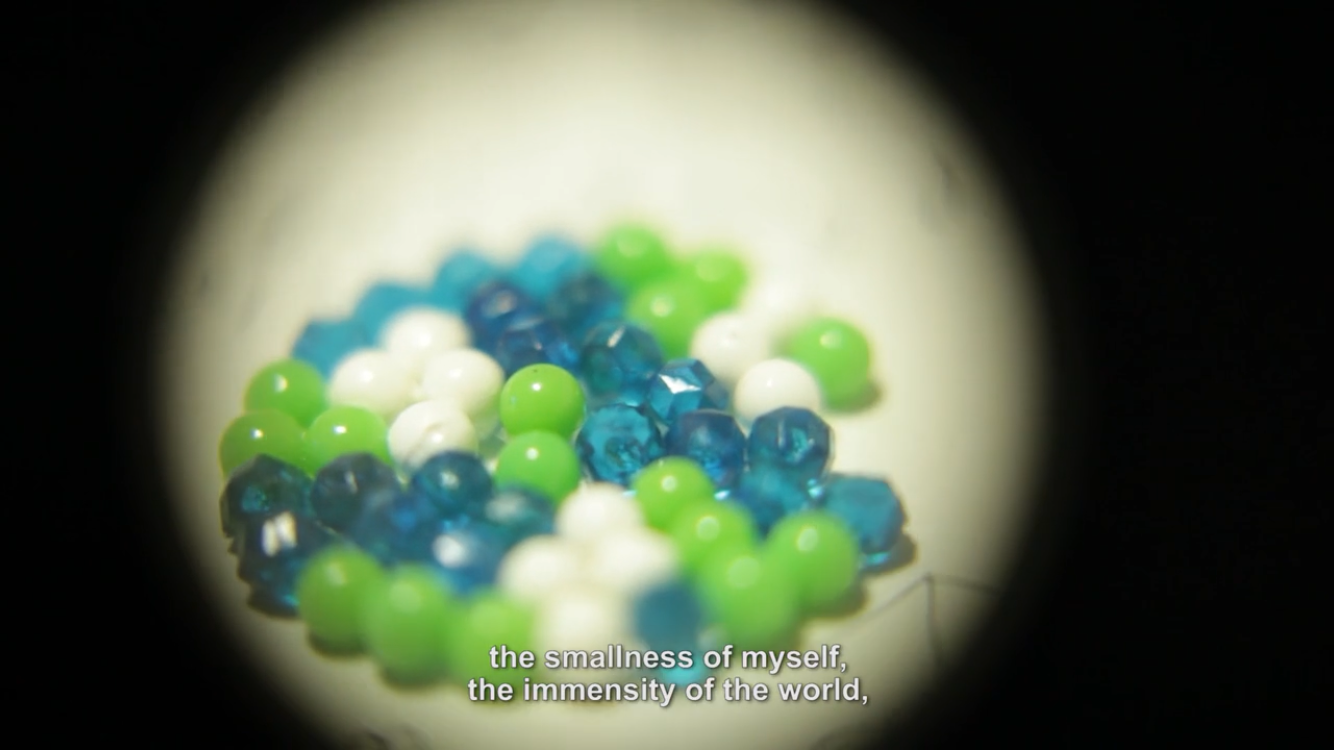
The central part of the documentary is when Oda was a guest at a family of Romani descent for a week. When talking about this experience, she recalls how she couldn’t finish filming the project because she could not stare at the old husband and go deeper inside him, depicting the loss and grief his family went through when one of their members passed away. Rosemary Menzies’s poem shown at the end of the movie through extreme close-ups of the printed page is exemplary of the conundrum that haunts and informs the whole movie. “Tell me how can I touch a butterfly without breaking her wings.” How can we gracefully depict the beauty of things without destroying it? How can we film reality without annihilating it or destroying the things and the people in it?
“…reveals the base of inhuman nature upon which man has installed himself”[7]
If Aragane is a movie revolving formally around darkness, slow movement, and repetition, and Towards a Common Tenderness a reflection on the riddle that is the act of filming, Cenote is a movie that combines the two approaches.
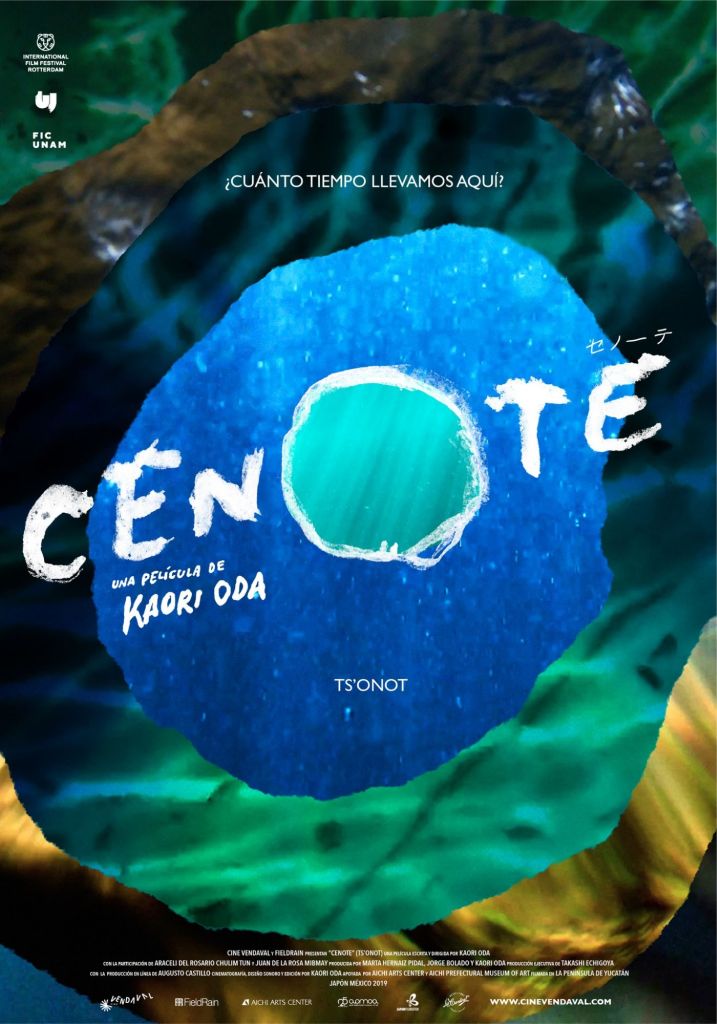
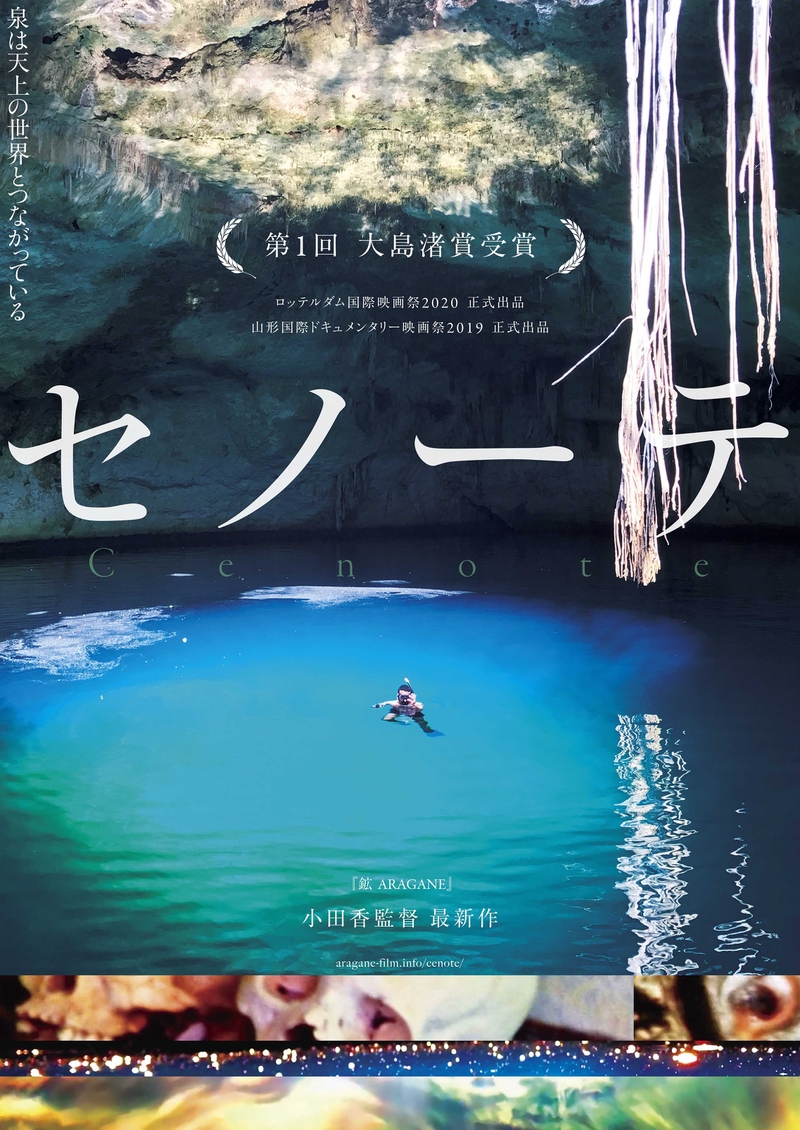
It is about water, light and their connection to the cosmos, but also about people and their collective memories. Cenotes, or ts’onot in a form of Mayan, are natural sinkholes found in the Yucatan Peninsula in Mexico, the only source of water for people living far away from rivers or lakes, and considered sacred places in ancient Mayan civilization.
Abstract images of the underwater world inside the cenotes intercut with people reciting, almost whispering, old Mayan poems, and other voices, in Spanish, recalling memories about life near these natural pits. Swimming in the water, the camera is enfolded in a reality that is perceived and created by the play of water and light. The first ten minutes, the more experimental part of the work, are in this sense an absolute bliss, an exhilarating and liberating artistic experience that brings us back to the womb of the earth, to the origin of life, or, as one of the quoted Mayan poems states, to the place where the sun sinks, disappears and reappears every day. Blotches and blades of colors flash on screen, drops of water dance like subatomic particles on the surface of water, and fish swim as peacefully as ancient deities. While this formal experimentation is noticeable in the path blazed by Aragane, a cinema of sensation that shifts the representation of humanity towards the periphery of reality, the non-human elements presented in Cenote expand further, reaching the spiritual and the mythical.
Another novelty that Cenote brings when compared to Aragane or even Towards a Common Tenderness is the presence, throughout the film, of a dialogic tension, both aesthetically and thematically, between words and noise, light and water, grainy images and digital sharpness, mythical time and geological time, and people and natural elements. Using 8mm film (Super8) and images shot underwater with an iPhone, Oda creates a difference and an aesthetic space, a poetic “ma” (間) that reflects and has a parallel in the space between the two worlds explored: the sensory experience taking place underwater, on the one hand, and the close-ups of faces and the voices of people on the other. Faces of people, but also animals, chicken, butterflies, dogs, cats, and local festivals are filmed in 8mm, while the world inside the cenotes is filmed with an iPhone. The dialog between these two types of images, the intercut between these two worlds, becomes the structural backbone around which the movie develops.
The sound and words spoken in the movie, folklore, mythical stories, memories of people who live near a cenote, and legends of children who drowned in them are all weaved together, recited and spoken in Yucatec Maya and Spanish. The stories told are important, of course, but the musicality of the words is an element that, paired with the underwater sounds and the distorted noise captured or created by the camera’s microphone, form a sonic tapestry of rare beauty. The soundscape used in Cenote, more than the one adopted in Aragane, where the human voices were relegated to very few words, hints at an idea of the cosmos in which humans are part of a larger dimension, both in time and space. The images confirm this larger scope on a geological scale: the sinkholes are a product of a celestial encounter between a shower of meteorites and the earth’s crust, but at the same time, a mythical place for ancient Mayan civilization, a portal and a threshold where, according to the Popol Vuh, this world and the afterlife touch each other. The connection between these two realms is an important part of Cenote, and, as a matter of fact, the movie also works as an exploration of collective memories and ancient mythologies, both still very present in the area and the villages around these sinkholes. The dead (via the poems), the women sacrificed in the pits, and all the legends and stories retold by the villagers, form a layer where the past, real or mythical, and the present coexist. This present-permeated-by-the-past has a phantasmic quality channeled into the movie by the images in 8mm, which always feel distant from the here and now, and by the voices in Spanish and Yucatec Maya, always out of sync and hovering above the images, as it were. The connection between the dead and the living is made more explicit in a brief and beautiful passage when the movie gazes, bathed in a frail and milky light, at funeral rituals in the area, when human bones and skulls are brushed, polished and collected with extreme care as remnants of past lives.
Conclusion
Like some of the works made at the Sensory Ethnography Lab[8], and to the cinema of Bela Tarr and Wang Bing, Oda’s filmmaking has, in the past years, built a unique trajectory in the film world: a brand of experimental documentary born at the intersection between visual anthropology and a cinema that prioritizes a pre-reflective engagement with the world. The result is an oeuvre that traces and establishes new connections between people, things, memories and the landscape they inhabit and from which they emerge. The human element is thus repositioned and reframed according to a different vision of reality, compared to one that often dominates the field of documentary, especially in contemporary Japan. This artistic approach is also traceable in her works as a painter: for instance, in a series of CD covers of Aragane’s soundtrack she painted by hand. Each cover is a thick impasto depiction of a scene from the movie, or a memory from her filming inside the mine. Another example is a series of portraits of women Oda made inspired by the story of the women who were thrown into the cenotes as ritual sacrifices. In these paintings, the faces of these women seem to resurface from the water like deities, made by the recollection of what Oda experienced while filming and swimming in these sinkholes.
Visual and sonic experimentation which engages with the world and creates a cinema that, while reassessing the human element and abandoning a human-centered perspective on reality, continues at the same time to show a deep care, affection and interest toward people. This is the biggest accomplishment of Oda’s artistic trajectory so far.
[1] Paul Cézanne, quoted in Cezanne’s Doubt, Maurice Merleau-Ponty, 1945. Later in Sense and Non-Sense, trans. by Hubert and Patricia Dreyfus (Evanston: Northwestern, 1964).
[2] She studied film at Hollins University in Virginia.
[3] “People whose national or cultural identity is mixed by virtue of migration, overseas education, or parentage” Lila Abu-Lughod, Writing Against Culture, in Fox, Richard G. Hg, Recapturing Anthropology: Working in the Present. Santa Fe, S. 137–162.
[4] More than fifty years before, a similar approach to documentary was proposed by Matsumoto Toshio: “Matsumoto’s avant-garde documentary theory focused instead on the revelation of the existential force of an object or the actual people filmed through the process of subjective film-making” Hata Ayumi, ‘Filling our empty hands’: Ogawa Productions and the politics of subjectivity in H. Fujiki, A. Phillips ed. The Japanese Cinema Book, Bloomsbury 2020.
At the end of last January, I had the pleasure of attending a special screening of Gama, the latest project by Oda Kaori, a talented filmmaker and artist whose previous works I covered in the past for this blog, and for various other outlets (review of Aragane, interview with Oda, review of Cenote).
The work was screened in the city of Toyonaka on January 27th, and was commissioned by the Toyonaka Arts Project 2022. From Oda’s perspective Gama is also a second chapter of sorts, or a “trace” so to speak, of an ongoing project, a movie that will come out next year, Oda is developing about underground areas in Japan, underground both in its literal and figurative sense. The first chapter of this project is a visual installation produced by the Sapporo Cultural Arts Community Center, and projected on an ultra-wide horizontal screen in a underground pedestrian passageway in the city of Sapporo, Hokkaido. The work, also titled Underground, is being screened until the end of March, alternated with works by artists such as Apichatpong Weerasethakul (The Longing Field) or Rika Noguchi (Insects/ Leaves/ Songs of Birds), as part of a project called Nishi 2-Chome Chikahodo Video Creation. Here the official description of Oda’s installation:
Kaori Oda “Underground” 2022 | 09’37” Kaori Oda consistently seeks for human memories―Where are we coming from and where are we going to―. In this piece, she dives into the underground paths in Sapporo beneath its enormous landscape aboveground. She projects everyday lives and sound footages of Sapporo in the past decades, as well as repetitive caves and holes, or images of the universe. The locations where she projects these moving images are normally closed to public. This film shot in 16mm considers layers of the time lived by the people, redefining them as multi-track timeframe. It invites us to imagine the space where we exist now as well as the very beginning of time.
Back to Gama, the work screened in Toyonaka. The film takes place entirely in Okinawa, and the connection between Toyonaka, a city located in Osaka prefecture, and the Ryūkyū archipelago has a history that goes back after the war, when in 1964 the city of Koza, now Okinawa city, started to send sacred stones and hibiscus flowers to the families, living in Toyonaka, of people who died during the war in Okinawa. The film is shot mainly in natural caves (gama), where civilians took shelter during the early stages of the Battle of Okinawa (April-June, 1945). One of these though, the so-called Chibichiri Gama, tragically ended up becoming the site of a mass suicide, when people were told that American soldiers would eventually kill them all. If I’m not wrong, there’s another cave also mentioned in Gama, one where the Okinawans who took refuge surrendered, because they were told by people who lived in Hawaii that U.S. Army would spare civilians.
I think it is fair to say that Gama is, formally, a slight departure from Oda’s previous works, at least the feature-length documentaries, and for a couple of different reasons. The first and major one is that the movie has a strong performative element to it, one that was almost absent in Aragane, Cenote or Towards a Common Tenderness. In the film, the caves are used as a set for the stories told by a local guide, who specializes in the history and stories connected to the caves, and who is very passionate about his “job” to the extent he considers it a mission. Engulfed in the darkness of the cave, with just some blades of light cutting the frame, these tragic stories about women, children and old people fearing for their life are declaimed as in a recital. There’s a certain singsong rhythm to the way the man tells his stories, that gives the movie almost a hypnotic sonic quality. On the visual aspect, the play between darkness and light—it is worth mentioning that the work was shot on film—and the balance/imbalance of artificial and natural elements in the frame, make the movie fascinating to look at, and at times looking like a painting. Going back to the performative element, an important and central part of the work is the presence of Yoshigai Nao, a dancer and filmmaker (Grand Bouquet, Shari) who, according to what was said in the talk after the screening by herself and Oda, is for the movie not only an actor or a performer serving the director, but more a member of the staff, she actively participated in some filming decisions as well. Interesting and connected to what we wrote above about Gama being a work that signals a divergence from her previous modus operandi, is also the fact that the movie is the first work Oda did not film herself, it was shot by another female filmmaker and cinematographer, Takano Yoshiko, she was, among other things, the cinematographer for Saudade by Tomita Katsuya (2011).
While the guide is reciting his stories, Yoshigai, in the film dressed in blue, moves, crawls, and almost dances throughout the cave, a phantasmatic figure, she plays the role, in Oda’s own words, of the “shadow”, possibly conveying presences from the past, human or non-human. The compresence of human histories, in this case tragic war memories, with the geologic time, millennia that here shaped the caves, while not directly expressed, is one of the themes that lies at the core of Gama (and is prominent in Cenote as well). The cave has at its bottom, and is itself composed of, layers of minerals, micro-organisms, animals’ bones, and human bones. Traces of historical and geologic time that are here overlapping. “Traces” is an important concept for approaching Gama and more broadly Oda’s works, not only because of what we just wrote, but also because of a certain scene in the movie. While the guide is telling his stories, the screen goes completely black, Oda explained that she just turned off all the lights leaving the cave in its natural darkness with the man speaking. As an after effects—this was discussed in the talk after the screening and Oda said she did not notice it at first—the shape of the man and the outlines of the rocks stay for a couple of second on the black screen, giving a sense of a phantasmatic presence, of something that manifest itself while not being there. As a common thread running through her films, it is fascinating to notice how Cenote explores something similar, not formally, but thematically, the presence of the dead both in the sinkholes, and in the Maya ceremonies shot in 8mm.
One of the formal choices that have become a sort of signature of Oda’s style, an abrupt cut from darkness to light and from noise to silence, moves the focus of Gama from the cave, where the guide and his group are searching for and separating human and animal bones, to the outside, where the screen is filled with the blue of the sea and the sky, and the white of the coral beach. Here Yoshigai is playing with pieces of coral, themselves remnants of past lives, making a light and soothing sound with them. The peace of the scene is interrupted, by pure chance according to the director, when the deafening sound of an American aircraft passing nearby transforms the scene into a scream, reminding us, the viewers not the people of Okinawa, about the reality of the physically oppressive presence of the American Army in the archipelago.
As in her previous works, but in Gama is something more prominent, the underground space with its darkness and depth seems to be the perfect locus solus where different times, and different (hi)stories intermingle and intersect. It will be fascinating to see how Oda will be able to organize and infuse these ideas in her next feature-length work.
I wrote a longer and in-depth piece on Cenote, Aragane, Towards a Common Tenderness, and Oda’s filmmaking more in general for a film publication (hopefully out next year), so what follows are just some of my thoughts on the movie, and my experience with Cenote after multiple viewings. My interview with Oda, and my piece on Aragane.
The past and present of those living around the cenotes coalesce in this mysterious place. Long-lost memories echo in hallucinatory turquoise underwater footage, an entrancing game of light and dark. Swimming in these sinkholes, director Oda Kaori encounters intriguing shapes and beams of light, the water heaves, drops fall like razor blades.
After debuting on the international scene with Aragane in 2015, although Thus a Noise Speaks (2010) was her actual debut in the film/documentary scene, two years later young filmmaker Oda Kaori released Towards a Common Tenderness, her second feature film. This is a movie about her journey from Japan to Europe, and there across the borders of the former Yugoslavia, and also about the possibilities, limitations, and responsibilities that come with documentary filmmaking. Her new film, Cenote, is again shot outside of Japan, this time in Northern Yucatan, Mexico, and almost completely filmed with an iPhone inside a few ts’onot/cenotes, sinkholes that were used by ancient Mayans as a primal source of water. Some of these sinkholes were also used during ritual sacrifices, and in the Mayans belief system they were considered holy springs able to connect this world to the afterlife.
When I first saw Cenote at a special screening organized at the Aichi Arts Center in Nagoya exactly a year ago, in July 2019 (the movie was partly funded by the venue), what impressed me the most were the first twenty minutes of the film. It was an exhilarating sensorial experience, almost an unveiling of a new world: the abstract images shot underwater and those gliding on the surface of the liquid, blended with grainy images of people whispering old Mayan stories, all of this soaked in a haptic soundscape, are to this day one of the best combination of images and sound I saw on screen in recent years. However, the second part of the work did not really work for me, the incredible first part was not followed by an equally intense second half, I couldn’t completely connect with it, especially with the way the movie was constructed. This was my reaction after the first viewing, anyway.
In the months that followed, I had the chance to watch Cenote several more times, one more time on the big screen at the Yamagata International Documentary Film Festival in October, and later on through a screener I was kindly given. After multiple viewings some recurring patterns and figures presented throughout the movie started to slowly reveal, and Cenote began to resonate with me in a very different manner compared to when I first saw it. I realized how the whole work is permeated with a dialogic tension, a relation between complementary opposites. For instance, cenotes as a geological phenomena resulting from the impact of a shower of meteorites with the crust of the earth, on the one side, and these sinkholes as a mythical space connecting with the afterlife, on the other. A tension between opposites that is also embodied in the aesthetics deployed by Oda, the digital images shot underwater with an iPhone are counterpointed with those shot in Super 8 and depicting faces, animals, festivals, and ceremonies honoring the dead. This exploration of afterlife and the deceased and their relation with the space they used to inhabit is what especially surfaced for me after multiple viewings. The connection between the dead and the living, and the blurring of the two reigns is made more explicit in a brief and beautiful passage when the movie gazes at funeral rituals in the area, when human bones and skulls are brushed, polished and collected with extreme care as remnants of past lives, but somehow still very present.
While I think Aragane is a more accomplished and well-balanced work, I believe Cenote is a more deep (non pun intended) and powerful visual experience, and definitely a film more important for Oda’s career. First of all, the movie gave her the chance to became the recipient of the first Ōshima Nagisa Prize, an award newly established by Pia Film Festival for “young, new talents who pioneer the future of film and attempt to spread their wings around the world”, and secondly to be invited to different film festivals around the world, such as Nippon Connection and Japan Cuts. This international recognition will hopefully expand even further her career, giving Oda the chance, and the funds, to work on the next project. It seems that after having explored two of the classic elements of nature, earth in Aragane, and water in Cenote, she would like to make her next work in (!) and about space, as she stated in a couple of interviews.
More importantly from an aesthetic point of view, with Cenote Oda not only went back to the sensorial filming approach used in Aragane, but she also expanded it and enriched it with the poetic touches that permeates Towards a Common Tenderness. As I wrote at the beginning of this article, the peaks in Cenote are very high and point towards an idea of cinema and filmmaking that, in my opinion, has yet to realize its full potential.
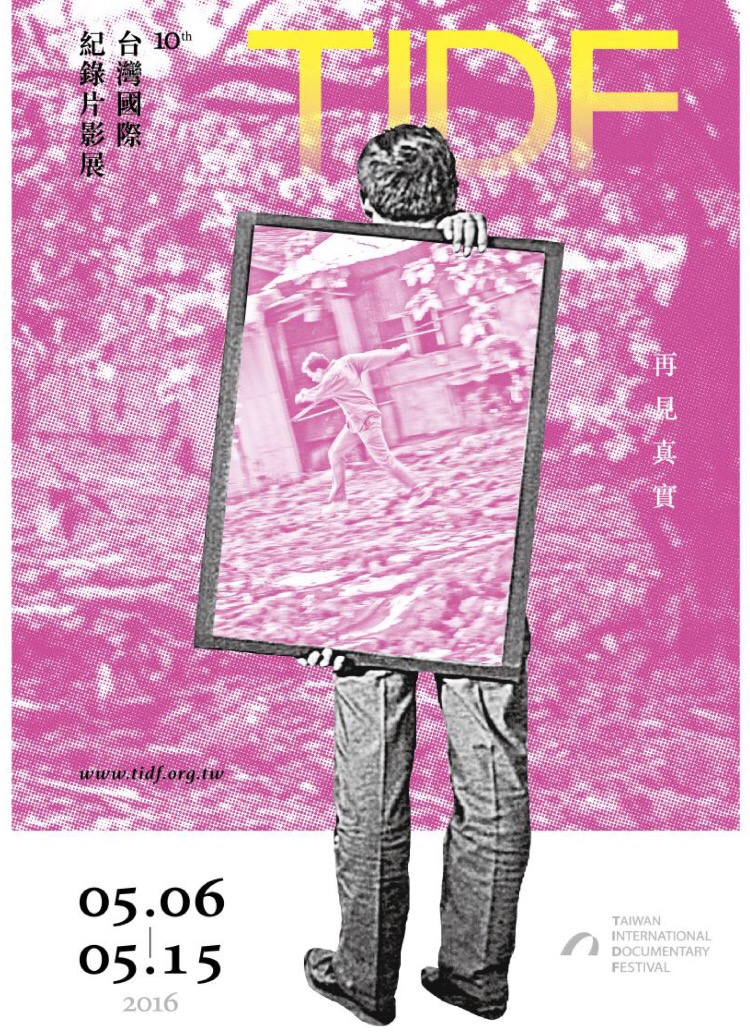
The Taiwan International Documentary Festival kicked off its 10th edition over the weekend, an important event for the region and one of the main avenue and showcase for non-fiction in Asia, the festival will last 10 days, till May 15th.
Let’s take a look at the presentation for this year edition as written in the official brochure:
Founded in 1998, TIDF is now 18-year-old, reaching the age of adulthood. This year marks our 10th edition. With the core spirit o‘f Re-encounter Reality’, TIDF preserves its traditions as well as blazes new trails, aiming to present diversity, break boundaries and bring back the essence of documentary.
During the preparation of the film festival, we went through rounds of discussions, debates and brainstorming. Our initially vague ideas and perceptions were elaborated step by step. When most of the decisions have been made, it is the best time for us to examine our original intention.
This year we have arranged more Q&A sessions, set up a regular venue for professional interaction, organised a new interdisciplinary workshop, cancelled the policy of‘not allowing admission 20 minutes after each screening starts’, and launched a long-term volunteer plan DOC U. All these changes are made in the hope of making things more practical and convenient for festival-goers. It also means we are offering more accessibility and trust. In our programme, time, memory and aesthetics are in conversation. We have curated three special sections: Director in Focus: Hubert SAUPER, the Folk Memory Project, and the retrospective celebrating the 30th anniversary of Green Team. Although focusing on different regions and periods of time, these films share a power to challenge history, fight authority and bravely reveal the reality most people avoid. Furthermore, they lead us to reflect on how to take actions, make changes and be able to imagine the future.
As we progress along the trail of documentary, future does not lie ahead of us but rather in the past.
Welcome to participate in TIDF’s coming-of-age celebration. Let us walk into the cinema and re-encounter reality!
15 documentaries will take part to the International Competition, among them the Taiwanese Why Aren’t You Angry (2016) shot by Green Team and about the Wild Lily Movement, a student demostration that took place in Taipei in March 1990, and Le Moulin (Huang Ya-li, 2015) also from Taiwan, an experimental documentary that was one of my favorites of the past year (more here). There are many other interesting works from other parts of the world of course, but being this a blog devoted mainly to East Asian documentary, I’ll focus only to movies produced in that part of the globe. Also in competition Realm of Reverberations (Chen Chieh-jen, 2015), about the Lesheng Sanatorium in Taipei, a hospital for lepers established in 1930 during the Japanese colonial period, and a facility that although the government planned to demolish, it’s still there due to people’s opposition.
15 are also the documentaries shortlisted in the Asian Vision Competition, a section that intrigues me a lot for obvious reasons, I’m very happy to see that Aragane (Oda Kaori, 2015) and Dryads in a Snow Valley (Kobayashi Shigeru) will be part of the group. I’ve written many times about Aragane (here my recent review), as for Kobayashi, he’s a cameraman turned director who collaborated prominently with Satō Makoto (Living on the River Agano, Memories of Agano), unfortunately I haven’t seen his new movie yet, but I’m planning to do it as soon as possible since the movie is now in the Japanese theaters. Asian Vision will also present 2 works from South Korea, A Roar of the Prairie (Oh Min-wook, 2015) and Welcome to Playhouse (Kim Soo-vin, 2015), a self-documentary about the 23 year-old director whose life changes when she becomes unwantedly pregnant. The movies from mainland China are 3, Shaman’s Journey (Gu Tao, 2016), Enclave (Li Wei, 2015) and The Road (Zhang Zanbo, 2015), a work filmed for three years in a small town where a section of a new highway is being built, while those from the Philippines are 2, Murmurs from the Somber Depths of Sta. Mesa (Hector Barretto Calma, 2015) and Of Cats, Dogs, Farm Animals and Sashimi (Perry Dizon, 2015). But there are many more documentaries, you can read about all of them in the program – there’s a section devoted exclusively to non-fiction cinema from Taiwan, one on re-enactment and one on significant documentaries shown at international festivals – on the official brochure (here the PDF).
Just a final note on a series of special events and screenings organized by the festival with the Folk Memory Project, an initiative started in 2010 by Wu Wenguang, the so called father of Chinese independent documentary, whose aim is to preserve the oral memories of the Great Chinese Famine of 1959-1961 through documentaries, interviews and theatrical performances.
Aragane is the first full-length movie by Oda Kaori, a talented Japanese director who had her debut in 2012 at the Nara International Film Festival with the short Thus A Noise Speaks, a meta self-documentary that unflinchingly explored her coming out as a female gay and the subsequent reactions from her family. Aragane is a completely different work though, an experimental documentary that Oda directed, photographed and edited herself, but also a “product” of Bela Tarr‘s film.factory, the film school based in Sarajevo and established by the Hungarian director few years ago, a place where the Japanese director studied for three years. Aragane, the Japanese title means “ore” or small pieces of stone, was shot in a Bosnian coal mine and it’s an immersive and hypnotic sensorial experience, a very special and rewarding one that was presented last year at the Yamagata International Documentary Film Festival and later at the DocLisboa in Portugal.
I had the pleasure of meeting Oda in Yamagata and later on she was kind enough to answer my questions by email, you can read the interview here.
Aragane
Bosnia and Herzegovina, Japan 2015, 68’ Director: Kaori Oda, Cinematographer: Kaori Oda, Editor: Kaori Oda, Producers: Shinji Kitagawa – FieldRain, Emina Ganic – film.factory.
The movie starts overground with the camera gazing at some busy workers preparing and checking the machines before going deep down into the mine, the camera then ride on a cart and with a very long tracking shot slowly starts its descent into the inner part of earth. Once inside, we’re introduced and enveloped in a world of darkness, a pitch black curtain broken only by sudden and random flashes of lights revealing a segment of a machine here and a face smeared with coal there. There are really few spoken words, we hear some random sentences uttered every now and then by the workers, but that’s all, much more important is the wall of noise created by movie, the soundscape being a crucial element of it. In the 68 minutes of deep immersion into the chthonian and dissonant world of the mine, we are almost constantly submerged by the cacophonous noise of the machinery, although the movie is also punctuated by sparse but significant and sudden moments of deafening silence. At the end of the movie for instance, when we emerge from the bowels of the earth, the peace and the vivid colors of the changing rooms and the stillness of the hanging clothes have an almost soothing quality for our eyes and ears. As stated by the director herself, Aragane is not a direct inquiry into the harsh conditions of the people working in the mine, although it’s something that eventually and necessarily emerges, but more an attempt to convey on screen the time and the space of the coal mine as experienced by the workers, or, I would add, as experience by the mine itself. It takes some time to get used to the alien space and almost abstract geographies of the mine, for most of the time we don’t really know what’s going on and who is doing what, it’s more like being thrown into a cubistic landscape in the middle of its making. Once we get accustomed to the time and the space presented on screen though, everything slowly begins to make sense, what starts to surface from the images and sounds, and through the tracking shots and the slow and hypnotic camera movements, is the time of the mine – time experienced as duration – and the materiality of the space depicted. On this point Aragane is a documentary very akin to the works of the the Harvard Sensory Ethnography Lab, Aragane reminded me – albeit with some distinctions of course- of Leviatahn, Single Stream and The Iron Ministry, just to name a few.
Aragane is a compelling viewing experience, not a cinematic revolution or a masterpiece of course, but nonetheless a very significant work for Japanese documentary – it’s only partly Japanese to be honest, since it was produced and shot outside the archipelago. What particularly interests me here is that finally Japanese cinema has an important work of non-fiction able to emancipate itself from the imprint of social and political documentary that usually dominates the contemporary non-fiction scene in Japan, and a work that in doing so liberate and explore the experimental qualities of documentary. I might exaggerate, but to find something similar in the history of Japanese cinema we have to go back to the great Matsumoto Toshio and his Ishi no uta (The Song of Stone, 1963).
Directed, shot and edited by Oda Kaori, Aragane was one of my favorite documentaries of 2015, a work that came out from film.factory, a film school based in Sarajevo and founded by renown Hungarian director Bela Tarr.
Aragane it’s an experimental documentary shot in a Bosnian coal mine, an immersive and hypnotic sensorial experience that was presented last year at the Yamagata International Documentary Film Festival, where it got a special mention.
I wrote a review of the movie in Italian for the blog Sonatine, but I’m planning to write one in English as well and post it here, time permitting.
In October I had the pleasure of interviewing Oda for the Italian newspaper Il Manifesto, the following is the original and longer version of that interview.
Can you tell us how you got involved in cinema, that is, how you got interested in watching and making movies in the first place?
I wanted to be a professional basketball player, I played for 8 years since I was 10 years old, but unfortunately my right knee got broken. I underwent two big operations but it was not possible to keep playing seriously. Doctors said NO to me. So I was lost completely because the only thing I knew in life was basketball. I decided to go to the US to study abroad then, you know the typical thought that if you move the place, something may change in your life. There I took a film course, that was the first encounter to filmmaking, I was not cinephile at all and I am still not. (but I like some films, of course)
I made the very first film with my family in 2010 (ノイズが言うには Thus a Noise Speaks). It is a self-documentary made by my real family and myself about the coming-out as gay. The idea was to use filmmaking to communicate with my family and face the fact that they could not accept that I was gay. It was a tough experience but I learned a lot from that and started to see and use camera as a tool for communication. Communication between myself and the subject (the people/ the space).
(A still from Thus a Noise Speaks 「ノイズが言うには」)
How about film.factory? how did you happen to move to Sarajevo and be part of the group?
I got a chance to screen my first film in the student section of Nara International Film Festival in 2011, and there I met Kitagawa Shinji, the person who more than anybody else understands my filmmaking. He was the programmer/organizer of the section. The film got an audience award and we kept in touch since then. In 2012, he wrote me an email that there would be a new program in Sarajevo to support young filmmakers from all over the world. I was very much lost at that time, because it was very difficult to make my next film after a self-documentary by which I confronted the biggest conflict I had.
So I decided to apply to the program, moving to a new place and meeting new people.
Luckily, my application got accepted.
Can you tell us more about Aragane, where did the idea come from? I heard that originally it was supposed to be a fiction inspired by a Kafka story (A Visit to a Mine), is that true?
Bela (Tarr) gave us an assignment to do an adaptation work. He wanted me to do ‘Bucket Rider’ a short story from Kafka that revolves around man looking for coal. So I went to a coal mine company to do research for the project. The space and the workers were incredibly attractive, immediately I knew I wanted to shoot them as I felt and not through an adaptation work.
What was the involvement of Bela Tarr in the making of Aragane? Did he give you any suggestions, ideas or was he just supervising the project?
I brought some shots I made there and told him that I wanted to make a film. He watched them and said ‘Go and shoot’. We had one meeting when I was still shooting and I had doubts about which direction I should go with the project, should I go more for the people and their story or more with the space itself?
He told me ‘Listen to yourself, what do you want to do?’
I said ‘I am attracted to the space and the physical work of miners’
After shooting, I edited the film and showed the first rough cut to him and he gave me some comments such as ‘maybe you should eliminate this shot’ or ‘keep this one’.
More than once you’ve mentioned space and your relationship with space when making a film, I think is a very fascinating subject. When I watched Aragane I felt very strongly that it’s a work about landscapes (a dark one, the mine), the materiality of it and the machinery in it. An “alien” landscape and the beauty of it. What brought you to focus more on the space/landscape and the machinery, and is there a reason behind the use of long takes?
I think I was fascinated by the space because it was something totally new, complete darkness, magnificent volume of noises, but also sudden silence where there were no machines around.
The space drugged me into the film, my camera (gaze) was a communicator/mediator between what was there in front of camera and myself. I tried to understand and feel what was going on by shooting the space and its own time. Also, I didn’t approach the subject from the angle of the hard conditions of miners, unfairness and danger of their works (even though it is there in the film because it was just there). I hope people would not get me wrong by saying this. I/my camera shared some moments with them, I tried to be with them moment by moment. Focusing on social issue can be something good for miners, to say what is the problem and how ignorant we are about the issue, but I think the best I can do with my filmmaking is to try to be with the subject (space/people/time) and make them seen by being with them.
About the machinery, I think I shot them because their existence is big in that space and also because miners were proud of the machines, especially the huge ones digging into the side walls.
It may be a bit difficult to explain why the shots needed to be so long, but I tried to be honest toward the moments I captured with my camera.
I think the sound in Aragane is as important as the images, can you tell us more on how you were able to capture and magnify the sounds of the machines and, if you can, tell us about your relationship (as a filmmaker) to sounds/noise and soundscapes?
It is very interesting to me that lots of people mention about sounds and soundscapes. The sound was recorded with the internal microphone of a Canon 5D, because I didn’t have something like Zoom, also I was most of the time alone, so my hands and focus was with the Camera/Image. My light was on the helmet to make the curtain space visible, so it would have been impossible for me to take care of the sound recording. What was recorded was done “without care” and automatically.
I did the sound mix myself, changing the volume here and there, cleaning a bit of noises, and making rhymes/music by adding some noise on top of another noise. That was fun and I think made the film to gain a sensorial feeling.
I was just playing with sound in Aragane , but I want to learn more about sound. The film made me realize and feel that Film is an audiovisual art.
It’s interesting that you’ve used the words “sensorial feeling”, the first time I saw Aragane I thought straight away of the works of the Harvard Sensory Ethnography Lab (Leviathan, Manakamana, Iron Ministry, etc.), you told me already you haven’t watched their movies and that you’re not really a cinephile, but I was wondering if you got ispired for your approach by any movies or more in general by any other work of art.
After your email, Matteo, I watched ‘Manakamana’ ‘Iron MInistry’, and ‘People’s park’,
and I see what you see as similar.
It is very interesting because, before you mention about the Lab, I’ve thought that if I stop making films, I want to be an anthropologist. And I feel I am learning about human beings by making movies.
I might not be so good yet and I have not a clear idea about what I am doing with my camera, but it has been very clear for me that my theme is ‘where we come from, what we are, and where are we going?’ .
I know it sounds abstract and even pretentious, but I’m serious. I may not get the answers before I die, but I have at least the right to explore and challenge these themes with my life, I guess.
I am inspired by: Wang Bing, Pedro Costa, Raymond Depardon, Wiseman, Cezanne. My bible: Letters To A Young Poet by Rilke.
One last question: what are your future plans, are you working on something at film.factory and how about after film.factory?
I have a few projects now.
One is my essay film, to conclude the experience in Bosnia and filmmaking here. This is my priority right now. It’s in the production stage.
And then I plan to do a workshop of filmmaking/photography/camera in a discipline center in Sarajevo. (It is a institution for the underage kids who commit crimes, not strict as much as a prison). I want to share the possibility of using the camera as a tool of communication and expression with these kids. This kind of workshop is what I want to do as my life time project, I don’t know if I can finance such a project, but I want to try my best to make it a constant practice in my life.
Or I might move to Mexico to do a project after film.factory, one of my colleagues is from Mexico and I want to shoot something there related to sea/water/cave. It’s still in the research/developing stage. Or maybe I’ll go back to Japan, it all depends on if I can support myself and how these projects can be produced!
Feel free to add something you want to say or share.
So many people have been supporting my filmmaking. My family, Kitagawa Shinji, Bela Tarr, and my dear colleagues. Most of the time, I shoot and edit alone and this sometimes make me misunderstand that I am making films alone, but in fact, there is always someone who introduces the subject to me, tries to support me mentally, gives me some thoughts on the film, shares the film, writes about the film, and watches the film. All these people make films. All these spaces and times make films. I’m just one of the gears/energies that make films happen.
As 2015 comes to an end, it’s that time of the year again, the period when every cinephile is compelled to make his/her best movies list. I couldn’t not post my own one. I’ve mostly watched documentaries from East Asia, my list is then more like a “Best documentary of 2015 from East Asia” type of list, but at the end I’ve added a couple of movies from other part of the world and some (re)discoveries I’ve done during this 2015. Just a disclaimer, it’s a favorite list more than a best list, here we go (listed in the order I’ve seen them):
Walking with my Mother (Sakaguchi Katsumi, 2014)
An exploration of loss, sickness and memory in a society (the Japanese one) that is getting older and older, told in the shape of a private documentary, here some thoughts on the movie.
Aragane (Oda Kaori, 2015)
The camera follows patiently and almost hypnotically the workers of an old coal mine in Bosnia down into the darkness of their daily routine. The movie is visually stunning, partly documentary and partly experimental cinema, director Oda Kaori knows how to use the digital medium for her cinematic purposes in a work that revolves around the concept of duration and its materiality, and that is almost structural cinema in its construction. I had the pleasure of meeting and interviewing the director, the conversation was published on the Italian newspaper Il Manifesto, I’m currently working on an English translation and on a review/piece for this blog (maybe next year).
Oyster Factory (Sōda Kazuhiro, 2015)
The latest work from Japanese director Sōda Kazuhiro, together with Theatre 1 and 2, my favourite among his documentaries. I’ve written more about the film here.
France Is Our Mother Country (Rithy Panh, 2015)
Rithy Panh (2-21: The Khmer Rouge Killing Machine, The Missing Picture) constructs a critical and satirical work about the colonial rule of Cambodia by France, using only footage, archival images and propaganda films shot by the rulers themselves. The power of re-editing and collage documentary.
Night and Fog in Zona (Jung Sung-il, 2015)
A documentary about the great Wang Bing by movie critic-turned-director Jung Sung-il, here you can read my review.
The Moulin (Huang Ya-li, 2015)
Formally engaging and elliptical, I don’t really know how much of my fascination for this movie comes from its themes, a group of Taiwanese avant-garde artists active in the 30′ during the Japanese colonial period, and how much from the documentary itself.
Documentaries from other parts of the world:
The Iron Ministry ( J.P. Sniadecki, 2014) and in general all the movies by Sniadecki: Demolition, People’s Park, Yumen….
Jujun (Paul Thomas Anderson, 2015)
(re)discoveries of 2015:
The Vampires of Poverty (Carlos Mayolo, Luis Ospina, 1977)
All the documentaries/works of the great Agnès Varda (it was a pleasure watching 14 of her films this year)
From a rainy Yamagata, I wrote down some thoughts about yesterday, October 10th, my first day at this year festival. Good movies, some unexpected discoveries, lively discussions and as always, great atmosphere at Komiya, the place where almost everybody meets & drinks at night.
My day started with a surprisingly good documentary, France Is Our Mother Country (2015), from Rithy Panh, the French-Cambodian filmmaker author of The Missing Picture and s21, works that focus on the aftermath of the Khmer Rouge regime in Cambodia. France Is Our Mother is an archive documentary entirely made of footage from the former French colony of Indochina, but Panh uses these images in a creative and even ironic way, when not sarcastic, to express all the sense of superiority of the colonizers (France) towards the colonized. Without a single spoken word but rich in music, now minimalist, now almost noise-like, and with the use of ironic but thought-provoking intertitles, the movie reaches almost an hypnotic quality. After few minutes in it we already start to realise how the film is a history in images, but also and at the same time a history of images, besides the obvious but tragic elements of oppression shown, what slowly sneaks into the viewers’ mind is a sense that basically everything can be demonstrated with images, after all wasn’t the footage shot by the colonizers themselves? At a certain point, this is my personal and extreme experience of it, I even started to doubt about the “reality” of the images, “couldn’t some of them just be fake?” I asked myself. The answer is: of course not, but this reaction made me realised how deceptive and open to interpretations images can be, and this is for me the best quality of France Is Our Mother Country.
The second movie of the day was Millets Back Home (2013) by the Taiwanese Sayun Simung, a documentary about the small Tayal ethnic minority living in a mountain village in Taiwan, a tribe to which the young director herself belong to. A very interesting work for its topic – how to transmit and keep alive minor languages, traditions and customs in our present world- but less for its style, too journalistic and straightforward, at least for my taste. Better was the talk after the screening when a member of the Tayal went onstage and sang a traditional chant.
The first movie in the afternoon was the highly anticipated The Pearl Button by Patricio Guzmán, a film that deserves all the praised it earned around the world. It stretches from the very distant – in time and space, the stars and the universe – to the very small of a button found at the bottom of the ocean. From the purity of a quartz and the almost celestial lightness of the sky and the water, to the gravity of death, torture and human beings smashed in the cogs of History (the Chilean dictatorship).
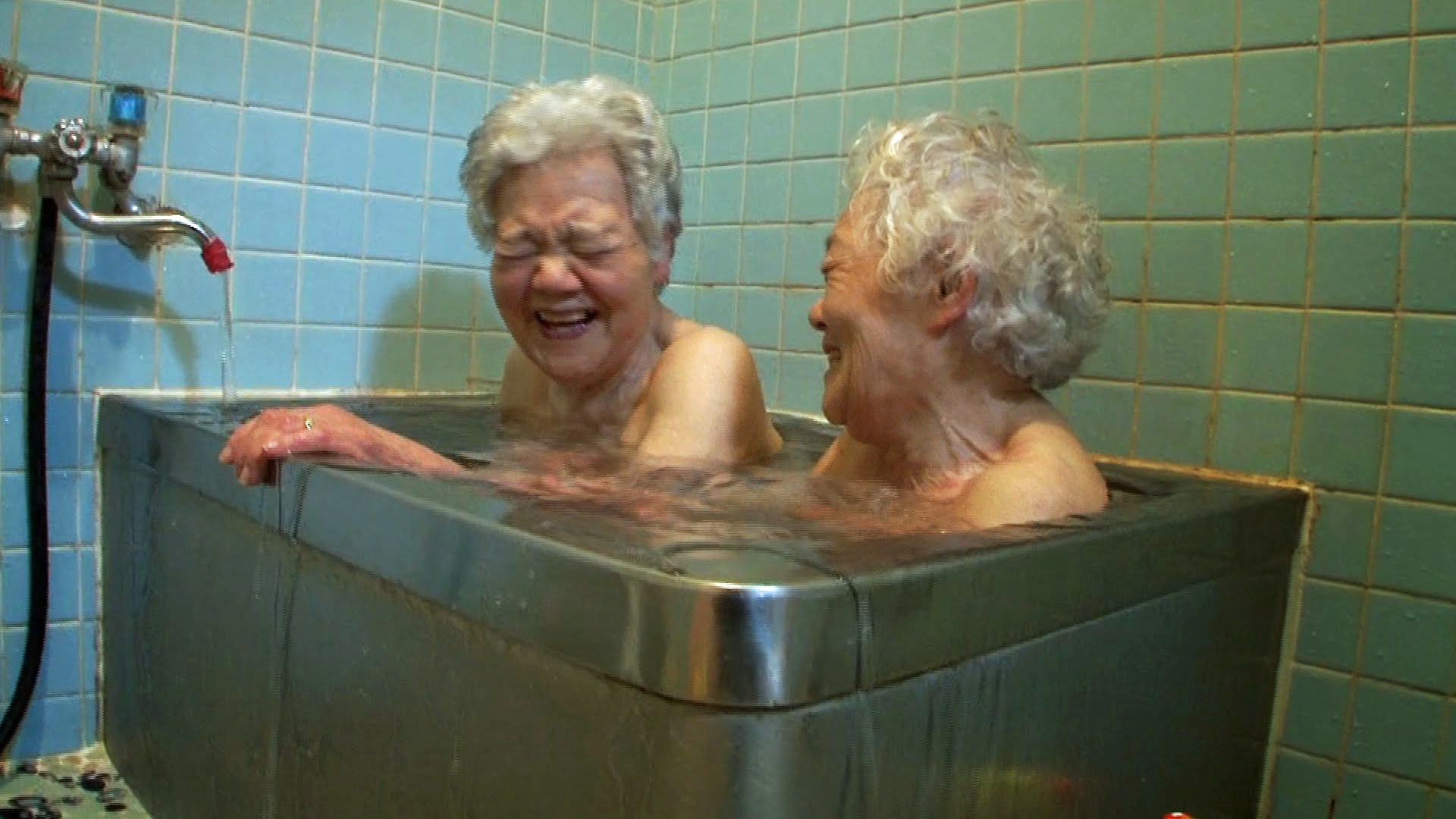
The 4th documentary of the day was Under the Cherry Tree (2015) by Tanaka Kei, a young Japanese director who followed the lives and struggles of 4 elderly people in a public housing complex in Kawasaki. Shot in low-tech and very simple in its style, no narration but intertitles to explain the background of these people and their problems, nonetheless Tanaka is very good at conveying through her camera the loneliness, the feeling of approaching death and the dreariness of their lives.
The last one of the day wasn’t a novelty for me, I had watched Aragane (2015) by Oda Kaori a couple of months ago on a screener, but seeing it on the big screen and with the proper sound system just confirmed the quality of the movie and the boldness of Oda in making an experimental work in form of documentary. Shot in a mine in Sarajevo, Aragane is composed of long takes mainly in the underground darkness, the real protagonists of the movie are the machinery, the flashing lights and a ceaseless noise enveloping the images. Hypnotic in the way Oda conveys the materiality of time and the sense of duration, Aragane reminded me, with due distinctions, of some works made by Harvard University’s Sensory Ethnography Lab, I’m thinking especially of The Iron Ministry and Manakamana.
That’s all for the first day in Yamagata, tomorrow or maybe after tomorrow for the next reports.












 Asian Docs
You must be logged in to post a comment.