A Yangtze Landscape (Xu Xin, 2017)

Festivalscope is giving access, till mid April,  to some of the documentaries screened at this year edition of Cinéma du réel, one of the most prestigious festivals dedicated to non-fiction cinema. (You can learn more here)
I grabbed the chance and last night I watched A Yangtze Landscape, a movie directed, photographed and edited by Xu Xin. IMDB describes it as follows:

A Yangtze Landscape utilizes a non-narrative style, setting off from the Yangtze’s marine port Shanghai, filming all the way to the Yangtze River’s source, Qinghai/Tibet – filming a total distance of thousands of kilometers. Experimental music and noise recorded live on scene are used in post-production, painstakingly paired with relatively independent visuals, creating a magically realistic atmosphere contrasted with people seeming to be ‘decorative figures’ right out of traditional Chinese landscape scrolls.

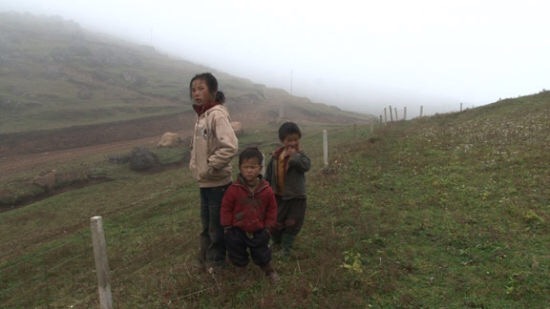
The documentary is composed of stunning scenary rendered in beautiful digital black & white, particularly the night landscapes are of almost pictorial quality, punctuated by scenes of people inhabiting the areas along the river, mostly areas ruined or emptied by the industrial and urban changes of the last decades. These parts with people are, in my opinion, performative, in a sense that the people seen, most of them poors, with mental problems or homeless, are performing themselves and their daily routine in front and for the camera. A Yangtze Landscape is for this reason a very partial film that focuses its attention on certain edges of Chinese society, I’m pretty sure that most of the comunities living near or on the banks of the Yangtze river are very different from the few exceptional individuals shown in the movie. Yet this is not a demerit of the film, a certain quality of artificiality so to speak, or performance as I have called it above, is very obviously present from the first minutes of the documentary, and the fact that it’s shot in its entirety in black & white is after all the biggest hint of its poetic aspiration and quality. Also on a technical side, it is worth noticing how in more than 2 hours and half there’s never a camera movement and a zoom in or out, the frame never moves, everything is crystallized and done by a very crafted editing, we have the camera “moving” only in the scenes where it is positioned on a ship floating on the river.
The movie has some similarity in its basic concept and structure to P. J. Sniadecki’s The Iron Ministry, if I’m not wrong, the american director is among the people thanked at the end of the documentary. There the camera followed the lives of Chinese people commuting by train from one part of the country to the other, from the lower to the upper class, here Xu Xin directs his gaze from the port of Shanghai to its source in Tibet.
We see and learn through intertitles, there’s no narration, about abandoned old villages, a bridge where every year many people commit suicide and other disasters and accidents that have happened near or on the river in the last 5 or 10 years.
The only witness of all these happenings seems to be the landscape, it is almost useless to say it, but the real protagonist of the movie is the landscape, a space where natural, human and industrial histories/stories intermingle and merge.

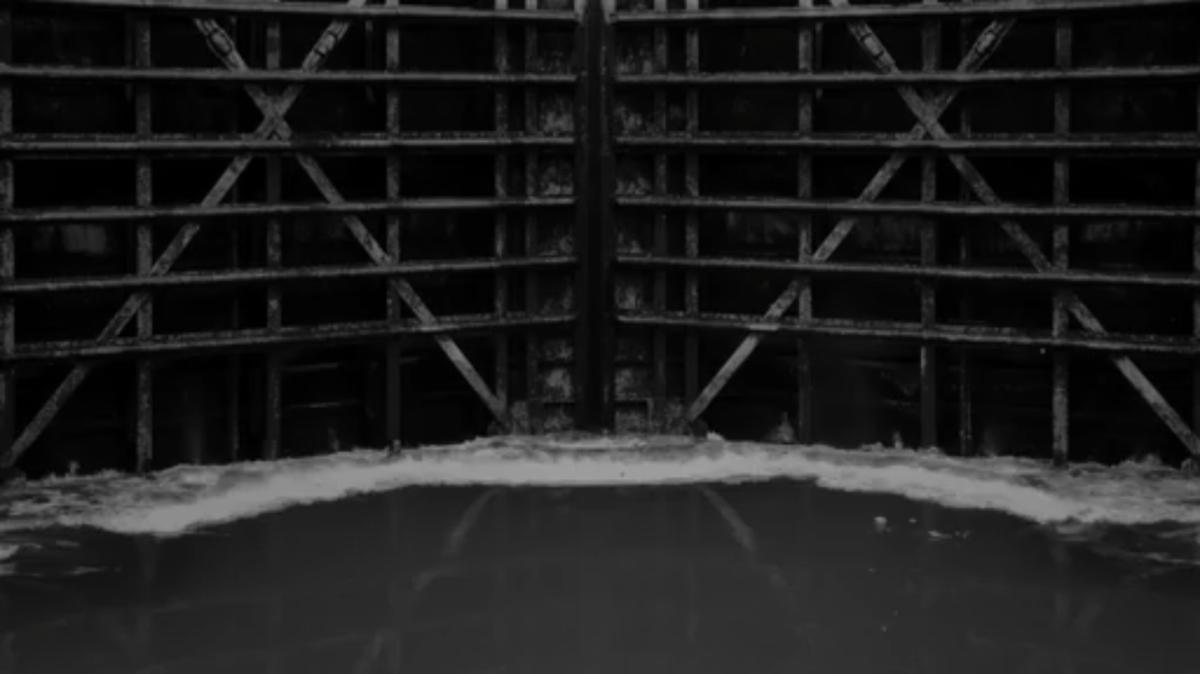
Interesting and well crafted as it is, I nonetheless feel that something is missing from it, to denounce and criticize certain aspects of contemporary Chinese society, and not only China, is something that absolutely must be done, but now that the country is in the spotlight internationally the risk is to look too redundant. For instance, towards the end of the movie there’s a long part all dedicated to a couple of homeless, their shacks and their dogs, we can see them on the foreground sitting in an old sofa or wandering among ruins with the ultramodern city and its skyscrapers on the background. The image is beautiful in its contrast, and even if it possesses a degree of truth, it ends up being trite and obvious, weakening the potential of the movie. While I like the general style, again the black & white is pictorial and the editing is perfect, it must be said that sometimes the film looks too “beautiful” and the image too “clean” without being subversive. The parts that resonate with me the most are those where Xu Xin explores the aesthetics of documentary to its limits. The aforementioned night scenes of the cities lights along the river, shiny but empty jewel boxes, or those at the river locks, slow and almost endless images of the water level, the ships raising and the gates opening, paired with a cacophonous soundscape made of squeaking noises and experimental music.

Forgetting Vietnam ( Trinh T. Minh-ha, 2015)

Writing about Trinh T. Minh-ha, one of the most significant filmmakers, cultural theorists and artists active today, was something I meant to do for a long time, and the occasion finally came a couple of weeks ago when I had the chance to watch her newest movie, Forgetting Vietnam (2015).
For everyone interested in documentary also as a way of questioning the ontological status of cinema and the nature of filmic representation, Trinh T. Minh-ha is a familiar name. Born in Vietnam and raised in Hanoi during the Vietnam War, she migrated to the U.S. in 1970, where she now resides and is active as a filmmaker, writer, composer, and professor of rhetoric and of gender and women’s studies at the University of California, Berkeley. Among her most important films are the seminal Reassemblage (1982), Surname Viet Given Name Nam (1989) and The Fourth Dimension (2001).

Forgetting Vietnam was screened at this year Cinéma du Réel in Paris and at various sites throughout U.S., here the movie’s description:

Vietnam in ancient times was named đất nứớc vạn xuân – the land of ten thousand springs. One of the myths surrounding the creation of Vietnam involves a fight between two dragons whose intertwined bodies fell into the South China Sea and formed Vietnam’s curving ‘S’ shaped coastline. Legend also has it that Vietnam’s ancestors were born from the union of a Dragon King, Lạc Long Quân and a fairy, Âu Cơ. Âu Cơ was a mythical bird that swallowed a handful of earthly soil and consequently lost the power to return to the 36th Heaven. Her tears formed Vietnam’s myriad rivers and the country’s recurring floods are the land’s way of remembering her. In her geo-political situation, Vietnam thrives on a fragile equilibrium between land and water management. A life-sustaining power, water is evoked in every aspect of the culture.
Shot in Hi-8 video in 1995 and in HD and SD in 2012, the images unfold spatially as a dialogue between the two elements—land and water—that underlie the formation of the term “country” (đất nứớc). Carrying the histories of both visual technology and Vietnam’s political reality, these images are also meant to feature the encounter between the ancient as related to the solid earth, and the new as related to the liquid changes in a time of rapid globalization. In conversation with these two parts is a third space, that of historical and cultural re-memory – or what local inhabitants, immigrants and veterans remember of yesterday’s stories to comment on today’s events. Through the insights of these witnesses to one of America’s most divisive wars, Vietnam’s specter and her contributions to world history remain both present and all too easy to forget. Touching on a trauma of international scale, Forgetting Vietnam is made in commemoration of the 40th anniversary of the end of the war and of its survivors.

“The image, a singular experience of blindness”

With Forgetting Vietnam Minh-ha revisits her native land forty years after the war, an event that touched her personally, and depicts the Vietnamese landscape and its evolving culture – exploring the daily life of women and the importance of the binary interplay between water and land in Vietnamese history – but at the same time the movie is a deconstruction of the documentary as a direct mode of representation and subtle exposure of the constraining power of the image.
Minh-ha is trying to break, or at least to weaken, the spell of the image and the univocity through which it’s usually perceived and consumed, as she writes “The question is not so much to produce a new image as to provoke, to facilitate, and to solicit a new seeing” (The Digital Film Event, Routledge, 2005). To sparkle a new seeing Minh-ha is placing hurdles and barriers to complicate the simple fruition of images and the easy formation of meanings. Written words, quotes, poetic lines, superimposition, screen wipes, music and montage are used to create a fluid, disorienting and ever-escaping cinematic experience, a work whose speed and continuous progressing don’t allow us to get too much attached to the images and stories we are fed. There’s no time and space for the viewer to reflect or engage on what she or he sees on screen, although the hinted events are of the largest scale such as the infamous Huế Massacre, the “forgetting” in the title is thus not only the oblivion of the tragedies the country and its people had to endure, but also a way of experiencing the movie as an impermanent event, or, as someone has beautifully pointed out “the diaspora of the film is thus not only cultural, but formal, in the sense that we never find any sort of grounding here. We are always on the move, always distanced from the images of Vietnam, never given time to sit with any given frame.”


“The bigger the grain, the better the politics?”*

An important subtext present throughout the movie is the dialectic between Hi-8 video and SD/HD, a dichotomy that sparkled from a purely coincidental and fortuitous event, Minh-ha started filming in the mid 90s, but had to stop for lack of funding and went on shooting again only in 2012, when the digital techonology had already made a huge leap forward. A difference that on the one hand highlights the the particular quality of the image in HD, a quality of tangibility and immediacy making the places and the people in it very present, “real”, while on the other hand the image in super Hi-8 seems to pose a distance with the viewer, a temporal but also aesthetic gap with the “present”, a sense of history and of things past captured on film,”a difference of memory systems” as  written on screen in one scene of the movie. This formal discrepancy is also reflected, amplified and complicated in the polyphony of voices used to tell the big and small stories that compose Vietnam, historical facts are interwoven on the same plane with comments from bus drivers, popular songs and much more with an almost Pynchonean touch.
Forgetting Vietnam is a work conceived by Minh-ha as a maze, a smooth place (in the sense used by Deleuze and Guattari) where the viewer can wander, think and ask herself questions. As stated by the artist in a recent interview “How to open onto infinity within the finite has always been at the core of my work motivation. This then means that there’s also room to wander and err in my films, since they offer more than one entry or one exit, and the viewers who miss one could always catch another entry as they stay on with the work.”

*quote from the film

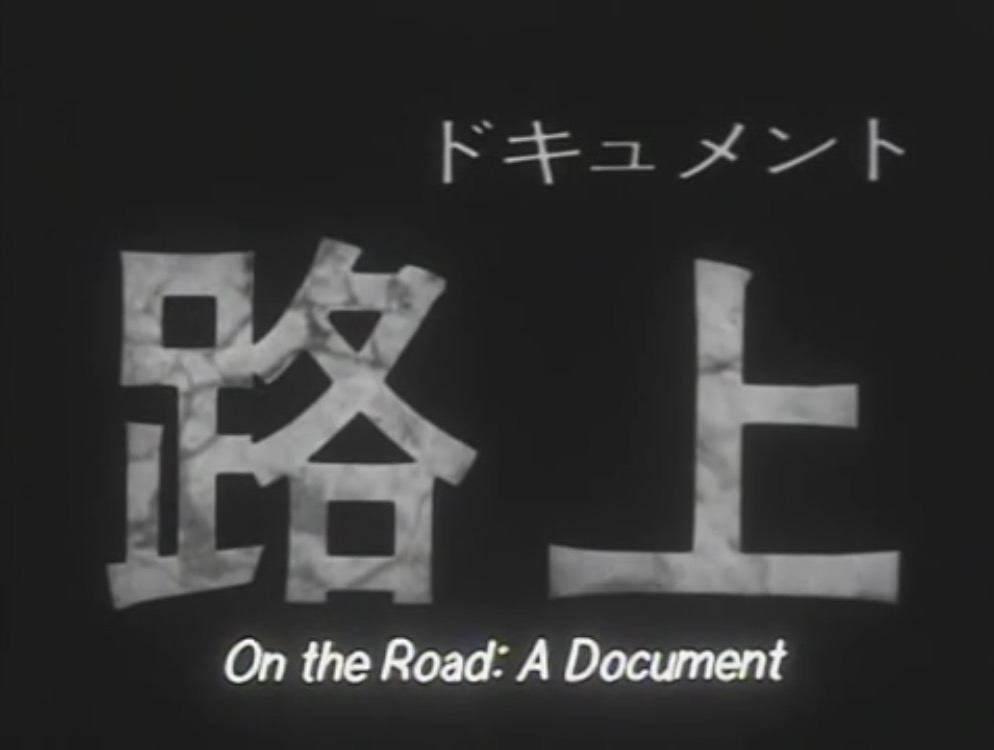
On the Road: A Document ドキュメント 路上(Tsuchimoto Noriaki, 1964)

One of the towering figures in Japanese documentary, Tsuchimoto Noriaki began his career as a documentarist, like many of his generation, at Iwanami Production in 1956. Tsuchimoto was since his university years a very active student, involved in the establishment of Zengakuren, member of the Japanese Communist Party and eventually expelled from Waseda University in 1953 for political activities. Mostly known in Japan and in the rest of the world, and rightly so, for his life-long series on Minamata and the mercury poisoning caused by Chisso Corporation, a total of 15 films in more than 40 years, Tsuchimoto in his long career tackled with his movies many different issues. Another Afghanistan: Kabul Diary 1985 and Traces: the Kabul Museum 1988, two movies set and about Afghanistan in a crucial time for the country, Nuclear Scrapbook (1982) on the danger of Japan’s nuclear policies, and On the Road: A Document, are some of his best non-Minamata works. It’s on this last one that I’d like to focus my attention today.
At the Beginning of the 60s Tokyo, and Japan in general, was in turmoil and experiencing huge changes, on the one hand the country was trying to leave behind and “forget” the tragedies of war, the consequent American occupation and more than 20 years of militarization and nationalism, on the other hand Japan was projecting itself and its people at maximum speed towards the future and a new phase. This “double” movement implied, among other things, starting a series of infrastructure projects that would completely alter the landscape of urban and suburban areas of the country, especially in preparation for the big international showcase of 1964, the Tokyo Olympics: streets, highways, the launch of the Shinkansen (the famous bullet train), and the devil’s pact with atomic energy. All changes that would shape, for better or for worse, the country’s future and made it what it is today.
On the Road was made in this whirl of structural, social and political changes, let’s not forget the huge demonstrations against the ANPO treaty in 1960 and those that would shake the country in the following years, a period of turmoil that is reflected in the film’s production history, as Zakka Films site puts it:

On the Road was originally commissioned as a traffic safety film with the Metropolitan Police as one of the sponsors. But it actually had a double existence: in reality Tsuchimoto was also working with the drivers’ union. When a police official finally saw the film, he dismissed it as “useless—the plaything of a cinephile,” and so it was never used for its original purpose. While winning numerous awards abroad, including at Venice, it was shelved in Japan for nearly 40 years.

The production is also a strong statement of Tsuchimoto’s artistic independence and creativity as a filmmaker, “The film was conceived as an experimental dramatized documentary” and “Tsuchimoto had amateur actors play the principal roles and, because the sound and image were recorder separately, asked drivers to reenact their duties, meeting and conversations”*. For all these reasons On the Road turned into a formally and highly creative documentary and a very different one, in style and concept, from those of the Minamata series that would follow in five years. Alienating music, fast editing and a cacophonic cityscape rendered through a jazz-like rhythm bring to mind the city symphony movies of the beginning of the 20th century, reimagined for and in the 60s. A snap-shot of an era of change for Japanese society framing a mutating urbanscape with a free-style touch that makes it highly watchable and fresh even for today’s viewers.

While it’s important to praise and introduce all the movies of the Minamata series to the broadest audience possible, it’s also vital not to overlook some of Tsuchimoto’s works made outside of his life-long series and by doing so affirming his importance and role in the history of Japanese documentary.

On the Road: A Document is available on DVD (with English subtitles) at Zakka Films, of course!

* from the DVD booklet

Documentary in East and Southeast Asia, a list/database

Few months have passed since I’ve launched here on the blog, a project to create a list of the most significant East and Southeast documentaries, and, as I expected, the submissions did not come in big numbers — after all “documentary” and “East and Southeast Asia” are terms still part of a niche in the discourse about cinema around the world — but the quality of their content was very high. I think it’s about the right time to publish the list and have it circulated around the web.

The idea was to compile a list of the most significant and important works of non-fiction made in East and Southeast Asia, a database that could function as a guide for cinephiles and anybody else interested in documentary, but also as a sort of cartography to discover and explore non-fiction cinema, and its history and development in the region.
Cinema arrived at varying times in different areas of the continent, thus evolving in completely diverse ways, and this is even more true when considering documentary, a minority mode of cinema whose limits and definitions have been hazy and shifting since the dawn of the seventh art. Moreover, because many countries in the region have experienced, and tragically are still experiencing, colonization and dictatorship, in most of the area documentary was for a long period associated to propaganda, and it’s only in the last decades, with the impact of political change and the liberating advent of new and affordable technologies, that non-fiction cinema was able to free itself, rise and gain its status as a mode of free-expression and art, although unfortunately not yet in every country. For these reasons some national cinematographies (namely Japan) are more represented than others on the list, while others are sadly absent. Lack of access is also another problem that affected the making of the list, even today in the internet age and in a time where the net has become, or at least is trying to be, a different mode of distribution, access is a big and unresolved issue.
I’m sure there are many knowledgeable scholars out there in the world, who could give us more titles and insights to enrich the project. The list does not pretend to be all-inclusive, it’s not a dictionary or a documentary encyclopedia — although at certain stage in the future it might turn into one — but the aim is nonetheless to offer a database, a list and a sort of expanding work in progress. If you think there are works worth to be included, do please leave a comment or even better, reach me by email here, we can discuss about it.

Last but not least a big and special thank you to the bunch of scholars and film experts who submitted their titles, the project wouldn’t have seen the light without their vital contributions. Special credits go to Rowena Santos Aquino, film scholar and critic who specialises in documentary film history/theory and Asian cinemas/histories, Nadin Mai, independent researcher specialized in Slow Cinema and Trauma Cinema, and curator of Tao films, and Frank Witkam were essential in broadening and deepening the scope of the list.

Works are listed in chronological order:
vlcsnap-2013-10-27-18h56m10s89

Fighting Soldiers (Kamei Fumio, Japan 1939)
Although in the 20s and 30s Japan had Prokino, it can be said that Fighting Soldiers was the first true example of Japanese (Asian?) non-fiction cinema made with an authorial touch. You can read more here.

Children in the Classroom (Hani Susumu, Japan 1954), Children Who Draw (Hani Susumu, Japan 1955)
Capturing the daily routine of an elementary school class in the manner of  direct cinema and cinema vérité, but way before the terms were coined, these two films brought radical changes and opened up new possibilities in the world of Japanese non-fiction cinema.

The Weavers of Nishijin (Matsumoto Toshio, Japan 1961)
The process of manufacturing textile in a famous Kyoto’s district rendered through rhythm, montage and music in a beautiful and grainy B&W.

Record of a Marathon Runner (Kazuo Kuroki, Japan 1964)
Focusing on the young runner Kimihara Kenji and his preparation for Tokyo Olympics, Kuroki turns a PR sport movie into a fine piece of authorial expression.

Summer in Narita (Ogawa Pro, Japan 1968), Narita: Heta Village (Ogawa Pro, Japan 1973)
The two films here stand for the whole Sanrizuka/Narita series, but especially Heta Village deserves to be in this list, a milestone in world documentary and an extraordinary documentary about time and place“.

Okinawa Islands (Higashi Yoichi, Japan 1969)
From August to October 1968, a film crew from the Japanese mainland ventured into U.S.-controlled Okinawa. Student struggles entered a new phase from 1968, rejecting “values” in the broad sense of the word. Higashi strongly felt the need to be free from previously established values, choosing in this work to grapple with the theme of Okinawa. The Okinawan problems analyzed in this film remain unresolved today. (from YIDFF)

A.K.A. Serial Killer (Adachi Masao, Japan 1969)
The avant-garde Japanese documentary film par excellence, and the first embodiment of Landscape Theory, A.K.A. Serial Killer is a film solely composed of a series of locations where young Norio Nagayama lived and passed by before committing the crimes for which he was later arrested.

Motoshinkakarannu (NDU, Japan 1971), Asia is One (NDU, Japan 1973)
Promoting an anonymus cinema made by amateurs and not by professionals, the Nihon Documentary Union delves here into the margins of Okinawan and Taiwanese society, focusing their gaze on the minorities and on the historical fractures in the areas. More here.

Minamata: The Victims and Their World (Tsuchimoto Noriaki, Japan 1971), The Shiranui Sea (Tsuchimoto Noriaki, Japan 1975)
Another monument in the history of world documentary, the Minamata series is an incredible and touching exploration of one of the biggest poisoning incident ever happened in Japan, and how it tragically affected people and their lives. You can read more here.

Extreme Private Eros 1974 Love Song (Hara Kazuo, Japan 1974)
A defining work for Japanese non-fiction cinema, exploring the personal sphere (the famous scene showing the birth of Hara’s child remains shocking even by today’s standards) in a period when it was “cool” to make politically engaged films, Hara was nonetheless able to avoid sealing himself and the movie off from the rest of the world in a sort of closed and solipsistic universe, more than ever the private is here the public and vice-versa.

God Speed You! Black Emperor (Yanagimachi Mitsuo, Japan 1976)
The camera follow a group of Japanese bikers, “The Black Emperors”, part of the so-called bōsōzoku movement, the motorcycling subculture that arose during the 70s in Japan.

The Cherry Tree with Grey Blossoms (Haneda Sumiko, Japan 1976)
Shot in a small valley in Gifu prefecture, the movie is a reflection on the mortality and ephemerality of all things disguised as a documentary about a 1300-year-old cherry tree. More here.
turumba

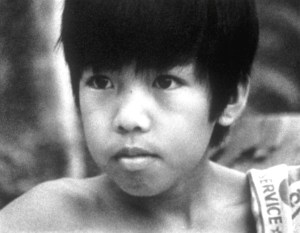
Turumba (Kidlat Tahimik, the Philippines 1981)
Turumba is a commissioned piece, which shows the work of a family making paper mâché figurines in preparation for the major “Turumba” festival in the area.

Oliver (Nick Deocampo, the Philippines 1983), Children of the Regime (Nick Deocampo, the Philippines 1985), Revolutions happen like refrains in a song (Nick Deocampo, the Philipines 1987)
These three films are all part of a trilogy of life under Marcos and Martial Law. Children is a documentary on child prostitution while Revolutions is a personal essay film in which Deocampo traces his own personal development and history against the backdrop of the People Power Revolution, which started in 1983 and later led to the ousting of president Marcos. Just like Oliver, a work that follows the life and work of a transvestite in the Philippines in the 1980s, it is shot on Super-8.

Magino Village: a Tale (Ogawa Production, Japan 1986)
Another masterpiece from Ogawa Pro, a stunning and epic movie that follows and tracks down the various histories traversing a village in Northern Japan, and at the same time a record of 15 years lived together by the collective.
bumming_in_beijing

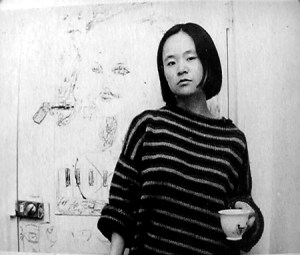
Bumming in Beijing – The Last Dreamers (Wu Wenguang, China 1990)
Generally considered one of the films that heralded the advent of what Lu Xinyu terms the ‘New Chinese Documentary Film Movement,’ its subject is fittingly a group of Wu’s artist friends and their (marginal) lives in Beijing.

I Have Graduated (Wang Guangli, China 1992)
Series of interviews with university students graduating in 1992 in the post-Tiananmen Square protests/massacre, interspersed with performances of songs.

The Murmuring (Byun Young-joo, South Korea 1995), Habitual Sadness (Byun Young-joo, South Korea 1997), My Own Breathing (Byun Young-joo, South Korea 1999)
Byun’s ‘comfort women’/‘low voice’ trilogy is a monumental project that gives space for Korean survivors to give their testimony, protest for redress, and fight against the social stigma of their traumatic past, staunchly filmed in the observational, present tense of the everyday and with the women’s direct collaboration.

Quitting (Zhang Yang, China 2001)
Centered on the late actor Jia Hongsheng’s real battle with drug addiction, the film is a docudrama in which Jia, his actual parents and sister, and his doctors play themselves as they reenact events that occurred during his addiction in the 1990s.

DV China (Zheng Dasheng, China 2002)
With its subject of a state employee making amateur films in collaboration with the villagers of Jindezheng, with limited state funds and equipment, the film gives the lie that ‘independent,’ ‘amateur,’ and the state media are mutually exclusive terms.

The Big Durian  (Amir Muhammad, Malaysia 2003)
A soldier who in 1987 began to randomly fire his rifle in the streets of Kuala Lumpur is an entry point to exploring racism and racial politics that the incident triggered among the city’s diverse population.

tie-xi-qu-west-of-the-tracks

Tie Xi Qu: West of the Tracks (Wang Bing, China 2003)
Quite possibly one of the most startling documentary debuts in recent decades, one that painstakingly observes the gradual decline of state-run factories as well as livelihoods and community bonds in the Tiexi district.

S-21: The Khmer Rouge Killing Machine (Rithy Panh, Cambodia-France 2003)
Arguably Panh’s most striking documentary on the Cambodian genocide, as it brings together survivors and torturers/executioners to the site of Tuol Sleng, now a museum but formerly a prison during the Khmer Rouge regime where tens of thousands were killed.

Memories of Agano (Satō Makoto, Japan 2004)
Ten years after the acclaimed film Living on the River Agano, the film crew returns to Niigata. Personal memories reflect upon remnants of those who passed away as the camera observes abandoned rice fields and hearths that have lost their masters.
More here

Singapore Rebel (Martyn See, Singapore 2004), Zahari’s 17 Years (Martyn See, Singapore 2006), Dr. Lim Hock Siew (Martyn See, Singapore 2010)
These three works represent oppositional voices/perspectives – opposition party leader Chee Soon Juan, ex-political detainee Said Zahari, and the second-longest held political prisoner the late Dr. Lim – which betray See’s commitment to political filmmaking and suppressed Singaporean histories.

Dear Pyongyang (2005,Yang Yong-hi Japan)
A second generation zainichi Korean director makes inquiries about the history of her activist father and mother. Over the years she records on video visits to her three brothers and their families, who migrated from Ikuno, Osaka to Pyongyang over thirty years ago, while reflecting on how she had been running away from the values her father forced upon her. (from YIDFF)

Oxhide I (Liu Jiayin, China 2005), Oxhide II (Liu Jiayin, China 2009)
Novelistic in detail and scope and in pushing the notion of filming in real time and filming real life perhaps to an extreme, with a shot count of twenty-three and nine, respectively, Liu and her family reenact real-life events and pierce the multilayeredness of lived experience.

The Heavenly Kings (Daniel Wu, Hong Kong 2006)
Following the formation of the boy band Alive, of which Wu is a member, the film follows the band’s attempts to crack the music market and, in the process, delivers satirical jabs at the Cantopop industry and Hong Kong popular culture in general and reveals itself as a hoax.

24 City  (Jia Zhangke, China 2007)
One of Jia’s documentary contributions, with a bit of fictional play with the interview, which nevertheless does not take away from its sober examination of the demolition of a factory town and its transformation as ‘24 City’.

Investigation on the night that won’t forget (Lav Diaz, the Philippines 2009)
Perhaps Diaz most invisible and least accessible film. The films is a two-shot recording of Erwin Romulo speaking about the circumstances of the death of popular film critic Alexis Tioseco and the subsequent investigation.

Disorder (Huang Weikai, China 2009)
A black-and-white found-footage film assembled from 1,000+ hours of footage shot by amateur filmmakers of everyday scenes in the Guangzhou region, whose effect is assaulting and absorbing.

Last Train Home (Lixin Fan, Canada 2009)
Canada-based Chinese filmmaker’s debut follows a couple who work in the city and annually make the long trek to their home village for Chinese New Year and becomes, in the long run, a frank portrait of one family’s diverging values/priorities.

The Actresses (E J-yong, South Korea 2009) Behind the Camera (E J-yong, South Korea 2012)
This mockumentary diptych takes the premise of a photo shoot and remote directing, starring top Korean stars, to address celebrity culture, the (absurd) nature of filmmaking, and the public/private divide.

Live Tape (Matsue Tetsuaki, Japan 2010)
On New Year’s Day in 2009, Musician Kenta Maeno strums his guitar and sings in a pilgrimage from Kichijoji Hachiman Shrine, packed with people paying respects, to Inokashira Park, where he joins his band on the outdoor stage. Live Tape is a miraculous live documentary capturing Maeno’s New Year’s Day nomadic guerrilla show in a single 74-minute take.

Arirang (Kim Ki-duk, South Korea 2011)
Kim’s sole documentary effort thus far followed a three-year hiatus from directing and is aptly a self-portrait of himself as a suffering (and at times, insufferable) artist – and perhaps even a parody of artistic self-portraits.

Golden Slumbers (Davy Chou, France-Cambodia 2011)
With his lineage of being the grandson of famed (and disappeared) Cambodian producer of the 1960s/1970s Van Chann, Cambodian-French filmmaker searches for the oral history of pre-Khmer Rouge Cambodian cinema and cinephilia.

ex_press

Ex Press (Jet Leyco, the Philippines 2011)
A passenger train travels across the landscape of the Philippines, while a monologue description of the journey presents fragments of memory and fantasy that look back at the country’s past.

Theatre 1 and 2 (Soda Kazuhiro, Japan, USA, France 2012)
The most complex and broadest in scope of Soda’works. Following Oriza Hirata and the Seinendan Theatre Company, Theatre 1 and 2 form a deep analysis of the creative process, but at the same time touching topics such as politics, performance, economy, art, engagement.

No Man’s Zone (Fujiwara Toshi, Japan 2012)
One of the best works about the triple disaster that hit Japan in March 2011, No Man’s Zone reflects on the meaning of natural and man-made disasters for our age, but has also been defined Tarkovskian in its aesthetics.

The Act of Killing (Joshua Oppenheimer, Christine Cynn, Anonymus, Norway-Denmark-UK, 2012), The Look of Silence (Joshua Oppenheimer, 2014)
Two successive works on the 1965-66 massacres of civilians in the name of Communist purges and the suppression of this past are set stubbornly in the present and made in collaboration with both perpetrators and survivors.

War is a tender thing (Adjani Arumpac, the Philippines 2013)
Arumpac is the child of a Christian mother and a Muslim father. She explores the second-longest running conflict in the world, the Mindanao War, through the lens of her parents’ divorce.

Storm Children, Book I (Lav Diaz, the Philippines 2014)
The film is supposed to be the first part of a two-part film, albeit Diaz never said when he would finish the second part of it. Storm Children follows the lives of children in the parts of the country hit hardest by typhoon Yolanda in 2013. Months later, the documentary shows that nothing has been done to alleviate the people’s struggle.

IMG_0170Aragane (Oda Kaori, Bosnia and Herzegovina, Japan 2015)
A breath of fresh air in the Japanese documentary world, Aragane, made by Oda at Bela Tarr’s school in Sarajevo, explores in the manner of structural cinema the time and dark spaces of a Bosnian coal mine. You can read more here.

Jade Miners (Midi Z, 2015), City of Jade (Midi Z, 2016)
This duology by the Taiwan-trained Burmese filmmaker was clandestinely shot in northern Myanmar to capture hundreds of labourers (one of which has been his brother, City of Jade’s focus) toiling the earth in jade mines, which are also part of a site of a civil war.

We Shall Overcome 「戦場ぬ止み」available on DVD

Just a short post to announce that our friends at Zakka Films are putting out on DVD another interesting Japanese documentary, We Shall Overcome 「戦場ぬ止み」(Ikusaba nu todomi) directed by Mikami Chie in 2014 and nominated by The Kinema Junpo poll as the second best Japanese documentary of 2015.

As the American based label’s page states:

A hundred thousand non-combatants—one in four Okinawans—died in the brutal Battle of Okinawa at the end of World War II. Postwar, the U.S. military forcibly constructed military bases throughout Okinawa. Even today, 43 years since Okinawa’s reversion to Japan and 70 years since the war, 74% of all U.S. military facilities in Japan are crowded onto the Okinawan islands.

We Shall Overcome reports on what is actually going on right now in Okinawa. Today there are plans to construct a brand new military base that requires reclaiming a portion of a beautiful ocean where rare coral and the vanishing dugong make their home. Most Okinawans are opposed to this base, and have launched protests, on sea and on land, to somehow stop construction. Okinawa’s rage has boiled over. In November 2014, Takeshi Onaga was elected Governor of Okinawa in a landslide victory on a platform opposing new base construction. But the national government refuses to budge. It uses subsidies to buy off some Okinawans and uses the Okinawan Prefectural riot police against others, pitting Okinawans against Okinawans. Tensions build daily at the scene of the protests, with injuries and arrests.

Violent confrontations are not the only subject of this documentary. It also reveals the rich culture and way of life of people who have had to live alongside the U.S. military bases, the music and humor they have carefully nurtured in spite of Okinawa’s harrowing history. The film conveys to the world Okinawa’s wish that an end be made to seventy years of conflict.

Mikami is a journalist and filmmaker who in 2013 authored another movie set in and about Okinawa and the struggle of their people, The Targeted Village, the theatrical version of which was screened at the 2013 edition of Yamagata International Documentary Film Festival. I very clearly remember that after a packed morning screening, many young viewers (especially women) came out of the theater in tears and moved by the experience.
We Shall Overcome is narrated by Cocco, singer and actress herself from Okinawa, cinema lovers will certainly remember her as the disturbed protagonist of Tsukamoto Shin’ya’s Kotoko and as the subject of a music documentary by Kore’eda Hirokazu, Daijōbu de aru yo ni Cocco owaranai tabi「大丈夫であるように-Cocco 終らない旅」.

You can purchase We Shall Overcome directly from Zakka Films website using Amazon payments.

youtu.be/FEc_D_meOBY

East and Southeast Asian documentaries, a list/database of the most significant works


updated September 14th 2016
In the past few days I was online looking for list(s) about East and Southeast Asian documentaries, lists that could give me an idea of what to watch if I wanted to explore the history non-fiction cinema in East and Southeast Asia, well….I couldn’t really find anything. So I told myself “why not making this list? a list that would also function as a sort of database for people interested in non-fiction” and then I realized that although I’m a kind of an expert in the history of Japanese documentary, I don’t really know that much about non-fiction cinema in the rest of Asia, besides of course Wang Bing, Rithy Panh and few others.


In most of these Asian countries cinema as a form of art is something pretty new and still in development, and often documentary is basically nothing more than state propaganda, fortunately things have slowly started to change few decades ago, when the new digital technologies allowed virtually everyone to become a documentary filmmaker and the social unrest set in motion the arts.
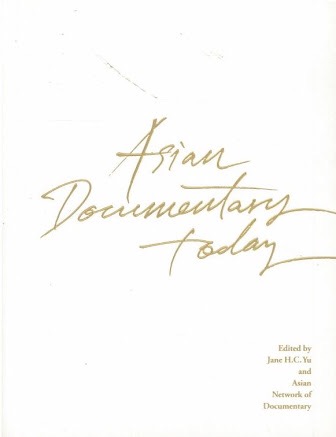
An interesting and useful resource on the topic, although it focuses more on the contemporary situation, is Asian Documentary Today, a book published by the Busan International Film Festival in 2012 and compiled and edited by AND (Asian Network of Documentary).

If anybody out there in the vastity of the internet is interested in helping me with this tiny project, a list/database of the most significant and important documentaries made in East and Southeast Asia, please feel free to get in touch with me: matteojpjp [at] gmail.com
Just a few “rules”:

– new works are accepted but don’t forget that the list is about “important and significant documentaries in the history of cinema”

– accepted are documentaries from these countries:  China, Hong Kong, Japan, North Korea, South Korea, Mongolia, Taiwan, Indonesia, Malaysia, Singapore, Philippines, East Timor, Brunei, Christmas Island, Cambodia, Laos, Myanmar (Burma), Thailand and Vietnam.

– if you’re kind enough to send me some suggestions or titles, it would be nice to have also few sentences contextualizing the documentary and briefly explaining what the movie is about.

the deadline is the end of September, once done and organised properly, I’ll publish it here on the blog and I’ll try to have it spread in the internet.

Thank you

Memories of Agano (阿賀の記憶 Satō Makoto, 2004)

This is an unfinished draft for an essay on Satō Makoto’s Memories of Agano 「阿賀の記憶」, a work in progress, at this stage no more than a series of random thoughts about one of my favorite movies.


last update: 26 September 2017


“…the habit of imposing a meaning to every single sign”

Trinh Minh-Ha


Satō Makoto’s documentaries seem to be (again) part of the filmic discourse in Japan, or at least on the rise in some cinematic circles, and deservedly so. Nine years have passed since his death, this year (2016) a book titled「日常と不在を見つめて ドキュメンタリー映画作家 佐藤真の哲学」(roughly rendered “Gazing at everyday and absence, the philosophy of documentarist Satō Makoto”) was published and a screening of all his documentaries, followed by discussions and talks, was held in Tokyo in March and later at the Kobe Planet Film Archive. I haven’t read the book yet, but the title summarizes and conveys perfectly the themes embodied in Satō’s last works: the dicothomy absence/presence and the presence of absence, that is to say the phantasmatic presence of cinema.

Sato’s final works, Self And Others, Memories of Agano and Out of Place: Memories of Edward Said witness and embody a shift in Satō’s approach, movies through which he was attacking and partly deconstructing the documentary form, to be fair with his works though, it’s a touch that was partly present in his films since the beginning, but in these three documentaries it becomes a very prominent characteristic. This publication seems to be timely and enlightening because is tackling Sato’s oeuvre not necessarily from a purely cinematic point of view, the book’s curator is by her own admission not a cinema expert, but it’s expanding the connections of Satō’s movies and writings towards the philosophical.

I hope the book will kindle and revive a new interest on his works, Satō is in my opinion one of the most important Japanese directors of the last 30 years, and sadly one of the most unknown in the West, I don’t really think there’s much out there in the internet or on paper about Satō, nor in English nor in other non-Japanese languages, and it’s a pity and a missed occasion because his movies, again, are more than “just” documentaries, or even better, are documentaries that have the power to question their own form and stretch in many differents areas. If you’re not familiar with his works, you can get a glimpse of Satō and his touch reading this beautiful and long interview, or you can buy them on DVD thanks to Siglo, it’s a rarity in Japan, but they come with English subtitles.

This year (2017) Yamagata International Documentary Film Festival will also hold a retrospective for the 10th anniversary of Satō’s death, commemorating and celebrating his works, his influence and his reception abroad.

One of Satō’s documentaries that resonates with me more than others, even after many viewings, is Memories of Agano (阿賀の記憶, 2004). As the YIDFF describes it:

Ten years after the acclaimed film Living on the River Agano, the film crew returns to Niigata. Personal memories reflect upon remnants of those who passed away as the camera observes abandoned rice fields and hearths that have lost their masters.

It is a relatively short but complex movie running only 55 minutes, an experiment in the form of a non-fiction film, splendidly shot on 16mm by cameraman Kobayashi Shigeru, the same cameraman who worked and lived together with Satō in Niigata for more than three years during the shooting of Living on the River Agano. The film is a poem on the passing of time and consequently on the objects that will outlive us, the persistence of things in time, including cinema itself. The original idea was in fact to make a film about the remnants of Meiji, that is “the glass photographic plates of the Niigata landscape from the late Meiji to early Taisho era (1910s) left behind by photographer Ishizuka Saburo. Using those old black and white photographs as a motif, we started out making the film with the same concept as Gocho Shigeo in Self and Others”. This quasi-obsession with objects is the thread that waves through the film’s fabric: boiling tea pots, old wooden houses, tools…

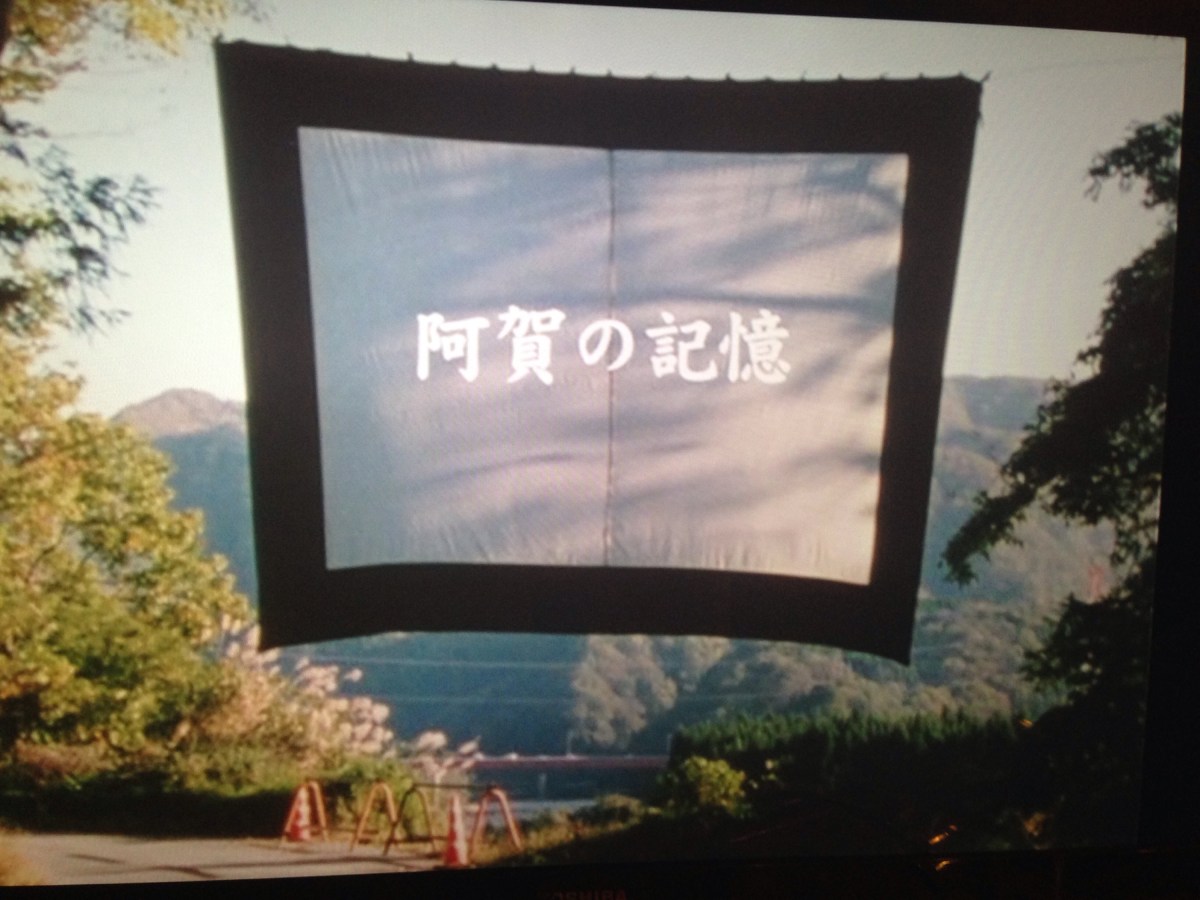
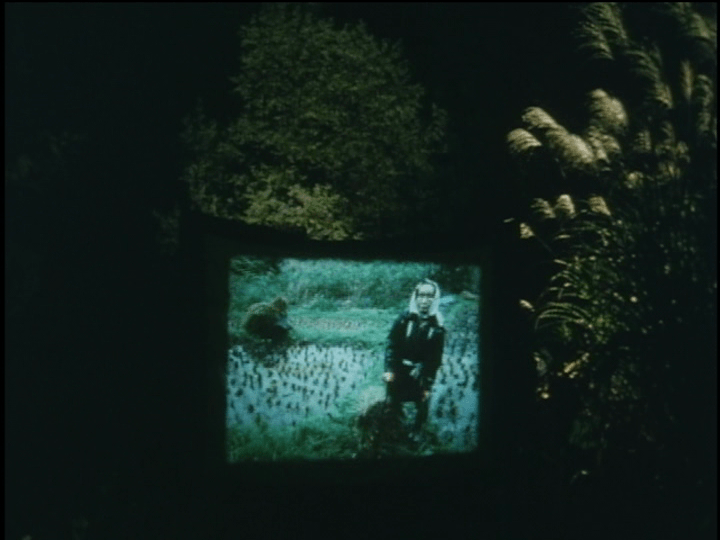
One of the most stunning scene of the movie and one that defines Memories of Agano is placed at the very beginning, when Satō and Kobayashi after returning to the area where the first movie was shot hang a big canvas tarp in the middle of a wood projecting on it the documentary they made 10 years before. The effect is profoundly disturbing and touching at the same time, images and thus memories are suddenly like tangible spectres.

On another level, Memories of Agano with its intertwining of past, present and landscapes ー the external ones with mountains, fields, rivers, and the interior landscapes of old and almost empty houses ー could also be read as an attempt to approach and partly re-elaborate the fūkeiron-cinema, the theory-of-landscape-oriented-cinema, 「footnote: “launched” almost five decades ago with A.K.A. Serial Killer (1969),  The Man Who Left His Will on Film (1970), Red Army/PLFP: Declaration of World War (1971) and The First Emperor (1973)」

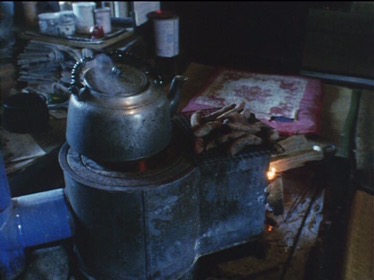
As for its aesthetics, one of the quality that strikes me every time I rewatch it, is the slow pace and the use of long takes that give the movie a dreamlike quality of lethargic torpor. The scene that embodies at most this aesthetic idea is an almost static shot of a teapot boiling on an old stove lasting about 10 minutes, on the background, sort of white noise, the words of an old lady spoken with a thick Niigata accent. She talks sparsly with Satō himself also about the fact she doesn’t wanna be filmed, half jokingly half seriously, a breaking of the fourth wall so to speak, a dialogue between camera and object filmed that was prominently present in Living on River Agano as well (“Are you filming me?” “Don’t shoot me!” are sentences that punctuate the course of this movie and the one made in 1992).

Memories of Agano also present itself as a documentary of opacity rather than one of transparency, the choice of not using the subtitles when people speak with their thick Niigata accent, a Japanese citizen from another area of the archipelago would probably understand 50% or 60% of what is said, a technical option that was used in Living on the River Agano – signals a major change in Satō’s approach to documentary and cinema in general. Feeding the viewer with limpid and clear messages and making a “comprehensible” movie is not what interests Satō here, but rather placing obstacles, visual riddles so to speak – the aforementioned tarp for instance, but also visually striking moments of pure experimentation – and thus presenting the opacity of the cinematic language seems to be the goals he had in mind when he conceived Memories of Agano. The images are thus escaping the organizing discourse tipical of so many Japanese documentaries, in contrast they open to new (cinematic) discoveries and keep resonating with the viewers and engage us on many different levels.

Ogawa Production’s Sanrizuka Series – DVD Box set is out today

img_2206

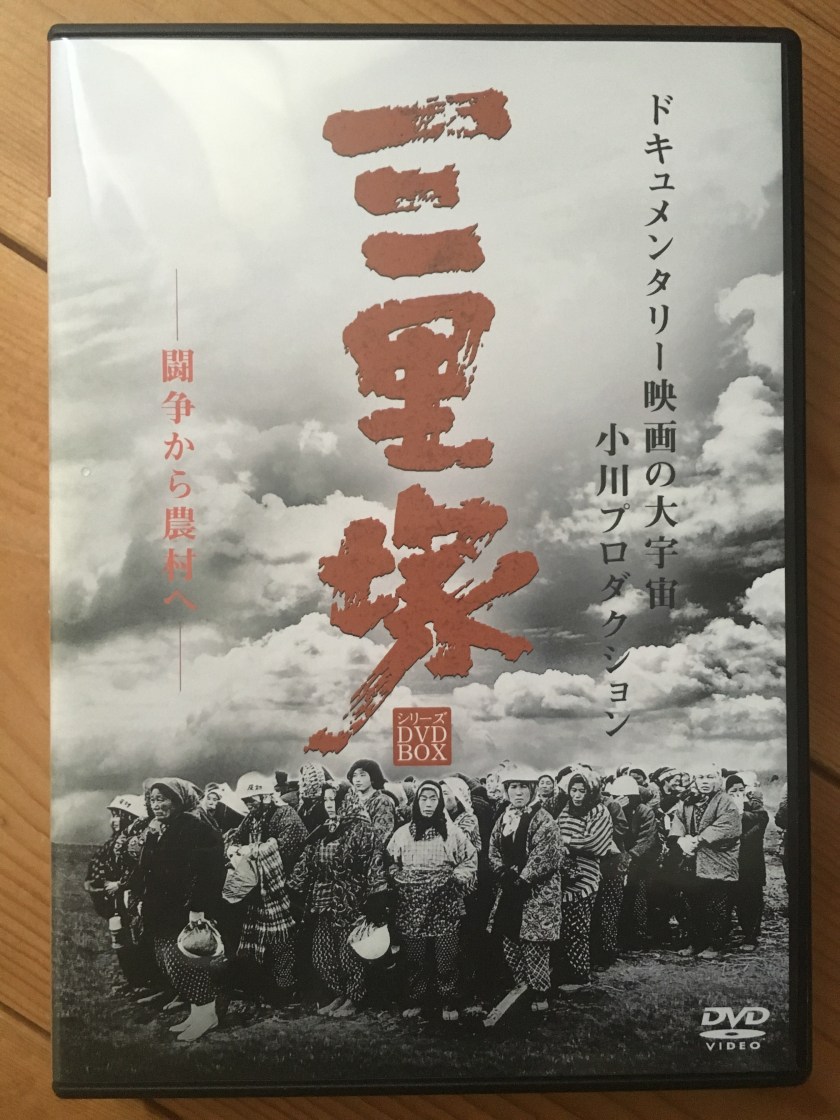
Known outside Japan as the Narita series, the works made by Ogawa Shinsuke and his collective from 1968 to 1973 (with a return to the area in 1977) filming the battle and resistance of farmers, students, activists against the building of Narita airport, are usually called in Japan the Sanrizuka series, from the name of the area where the main struggle and land expropriation took place (an ongiing battle that is not over, by the way). As written briefly in a previous post, the Japanese label DIG is putting out on DVD all the documentaries of Ogawa Production, the first 3 films were released in June, and today (July 2nd) DIG is also releasing a DVD box set of the Sanrizuka/Narita series. Here’s the list of the works included in the box set:

  1.  Summer in Narita『日本解放戦線 三里塚の夏』(1968)
  2. Winter in Narita 『日本解放戦線 三里塚』(1970)
  3.  Three Day War in Narita『三里塚 第三次強制測量阻止斗争』(1970)
  4.  Narita: Peasants of the Second Fortress『三里塚 第二砦の人々』(1971)
  5. Narita: The Building of Iwayama Tower  『三里塚 岩山に鉄塔が出来た』(1972)
  6. Narita: Heta Village 『三里塚 辺田部落』(1973)
  7. Narita: The Sky of May  『三里塚 五月の空 里のかよい路』(1977)
  8. as an extra work, available only in the box set: Fimmaking and the Way to the Village (1973, Fukuda Katsuhiko)『映画作りとむらへの道』(1973)

The box set comes with a booklet where each movie is introduced and a final note by renown documentarist Hara Kazuo. I haven’t had the chance to watch them yet, so I can’t say anything about the transfer*.
All the DVDs don’t have English subtitles, but that fact that finally these important documentaries are available on home-video basically for the first time, the only Summer in Narita was released with a book a couple of years ago, is something to rejoice. My hope is that some label outside Japan (maybe Zakka Films or even Icarus Films, why not?) will one day in the near future put together an international edition.

* July 4th addendum: I’ve watched some minutes of Heta Village, The Building of Iwayama Tower and Narita: Peasants of the Second Fortress just to get an idea of the transfer’s quality. As I expected the DVDs mirror the quality of the original prints – I’ve seen them all on the big screen, but many times on quite battered DVD samples, so my memory might trick me here. Be that as it may, the movies are not in a good state, lots of scratches, flecks and dirt, in a perfect world they would have had a restoration first and they would have been transferred on DVD only later. But we don’t live in a perfect world and the huge debt left by the group is still hindering any “normal” process of preserving and presenting the works in a pristine state. That being said,  this release is an important step anyway, because it will help to introduce Owaga Pro and its documentaries to a wider and younger audience, and just for this reason it’s a project that should be praised.

Documentary film festivals in East Asia

Surfing through the internet in search of information and publications about documentary in East Asia, I’ve stumbled upon what seems to be an interesting and original dissertation.”Extending the local: documentary film festivals in East Asia as sites of connection and communication” is a thesis written in 2012 by Cheung Tit Leung at Lingnan University and, as the title suggests, it’s a study about the importance of East Asian documentary film festivals for the development, nurture and distribution of Asian non-fiction cinema, and Asia in general, across the globe. The author focuses his attention on four film festivals in the region, arguably the most important ones, the Yamagata International Documentary Film Festival (Japan), the Documentary Film Festival China (China), the Taiwan International Documentary Festival (Taiwan) and the Hong Kong’s Chinese Documentary Festival (Hong Kong). 
I’ve read a dozen of pages so far and I have to say that the topic is really fascinating, more than I expected; whether or not you’re into Asian cinema, this thesis is an important piece to the relatively new field of Film Festival studies, but also one that explores the connections between cinema and a region, East Asia, seldom analysed on specialist periodicals or inside academic circles. 

Your can legally download and read the thesis here.

Land of the Dawn 「夜明けの国」(Tokieda Toshie, 1967)

The Chinese Cultural Revolution began 50 years ago, and newspapers, websites, magazines, blogs and books have recently taken the opportunity of this anniversary to write about, discuss and analyse the huge and still controversial historical event that shaped the Asian country and whose ripples were felt all over the world.
In 1966, a group of filmmakers from Japan were allowed to enter the country, or rather, they were lucky enough, almost by chance, to be in China just after the revolution was proclaimed (in August 1966) to film and record, almost without knowing what was happening, the changes brought about by the event. This was something of a “miracle”, as there were no formal diplomatic relations between the two countries at the time. The documentary is by no means a critical view of the revolution, as it was still in its infancy, and also because there were areas the group was not allowed to film, but it works as a visual and unique document of the early period of the revolution. The group spent seven months filming landscapes, factories, cities, farms and people across China, and the resulting documentary was compiled the following year under the title Land of the Dawn 夜明けの国.

The film was directed by Tokieda Toshie, a filmmaker who worked for and was associated with Iwanami Production for over 30 years. Among her extensive filmography, at least worth mentioning is Town Politics-Mothers Who Study 町の政治 – 勉強するおかあさん」 (1957), a depiction of a group of mothers-turned-activists in the town of Kunitachi, Tokyo (the short documentary is part of the films featured in this edition box set).

There’s an interesting interview with Tokieda on the Yamagata International Documentary Film Festival website, in which she recalls her experiences of filming in China. The film is also discussed in a chapter of Nakajima Takahirō’s The Chinese Turn in Philosophy (2007):

「The film」opens with a scene showing young Red Guards arriving from throughout China and gathering in Tian’an men Square. In the following scene a train appears with a plate indicating “Wansui Maozhuxi [long live Chairman Mao];” it is an express train traveling from Beijing to Shanhai Guan. The narrator of the film tells us that the young people clustering around Shanhai Guan station are tourists going to see the Great Wall. However, Tsuchiya Masaaki suggests that
these young people teeming around the station are not tourists, but are going to Tian’an men Square to see Mao Zedong.
It must be easy to reach such an understanding if we could comprehend the meaning of August 1966, or at least if we could grasp the meaning of the opening scene of the young Red Guards gathering in Tian’an men Square. However, the film presents the opening scene like a picnic or a school excursion, when they take souvenir photos and write their names in Mao notebooks and exchange them. It is “daily life” in the New China, which is regarded as being similar to daily life in Japan where people enjoy having fun. Following this line, the second scene at Shanghai Guan station is to be understood as showing tourists going to the Great Wall. Likewise, if we go to the third scene, it shows people bathing in the Songhua River in Ha’erbin City. In short, “Country of the Dawn” is edited to make the unusual event of the Cultural Revolution become normal and understandable to a Japanese audience.

This is just an excerpt from a chapter in which the author analyses the documentary in relation to Soseki Natsume’s Travels in Manchuria and Korea (here if you want to read more).
A final note on the availability of the film. In 2008 the movie was released on DVD, together with a book about the Cultural Revolution, it’s in Japanese without English subtitles, but if you’re interested you can buy it here.