Kobayashi Shigeru is an important figure in Japanese documentary cinema, he was mentored by Yanagisawa Hisao—with whom he worked as an assistant director in his last two films, そっちゃないこっちゃ コミュニティ・ケアーへの道(1982) and 風とゆききし(1989)—but is probably best known for his long-standing collaboration with Satō Makoto. Kobayashi was behind the camera and an integral part of the creative process on both Living on the River Agano (Aga ni ikiru, 1992) and Memories of Agano (Aga no kioku, 2004), and in more recent years he has also been a key force in preserving and reviving the legacy of the latter film, as well as Satō’s work more broadly. Their collaboration extended also in the opposite direction with Satō editing Kobayashi’s And Life Goes On (Watashi no kisetsu, 2004). Unfortunately, of the films directed by Kobayashi I have so far seen only Dryads in a Snow Valley (Kaze no hamon, 2015), a beautiful documentary set in a mountain area between Niigata and Nagano Prefecture, which also functions as a kind of homage to Satō’s cinema.
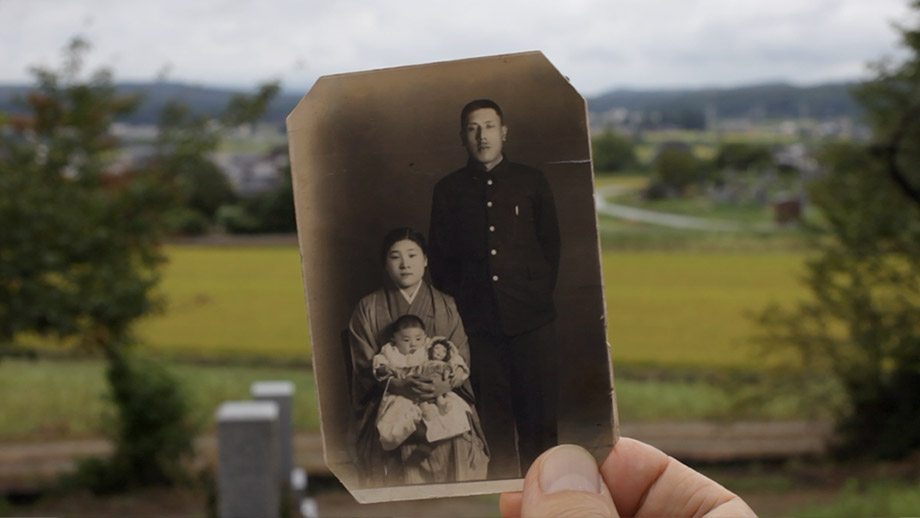
Kobayashi was born in Niigata Prefecture and, from a young age, became involved in groups supporting the victims of Minamata disease. One of the close friends he made during this period began, some thirty years later, to experience violent flashbacks related to the sexual abuse she had suffered as a child. Around the same time, Kobayashi met a female photographer—also a survivor—who was using her photographs to support others who had endured similar experiences. These encounters prompted Kobayashi to confront his own past, suffering and growing up in an abusive family. It was at this point that he decided to make a documentary film, with the aim of helping audiences understand the reality of sexual abuse from the survivors’ point of view.
In Their Traces (Tamashii no kiseki) was presented last year in Yamagata and later on at the Tokyo International Film Festival. I missed the film during my stay in Yamagata, so I was very eager to catch up with it, and I’m glad I finally did.
The film opens with a phone call in which Kobayashi’s elderly friend tells him, matter-of-factly, that she tried to hang herself the previous night, unable to bear the recurring memories of the repeated abuse she suffered as an elementary school student. The rawness of the subject matter, combined with the gentleness and respect with which the film is constructed, is one of the elements that makes In Their Traces such a remarkable and powerful viewing experience. A crucial decision in achieving this balance was Kobayashi’s choice to include himself as one of the film’s subjects. By foregrounding the violence he experienced—without lingering on it or allowing it to dominate the narrative—Kobayashi establishes a bond of trust with the viewer, while also underscoring the trust he built with the women who appear in the film.
It is this transparency and proximity to the other subjects that allows Kobayashi to build, on screen, resonances and parallels between the three women and their traumatic experiences. This transparency—and the trust it engenders—becomes even more powerful when the documentary, through the words of his friend (“you shouldn’t make the documentary” I’m paraphrasing), turns back on itself, questioning the very premise of the project.
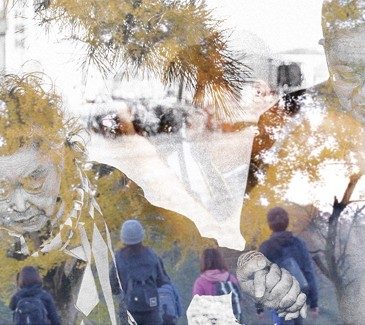
The formal strategy of positioning the camera (operated by Oda Kaori), Kobayashi as director, and Kobayashi as participant as three active agents within the film’s reality enables to create a dialogic structure through which the women’s testimonies emerge in a touching and heart-wrenching manner, without ever feeling exploitative or overly dramatic. On the contrary, it is precisely the matter-of-fact quality of some of the exchanges we hear—regarding suicidal thoughts and experiences of sexual violence—that most deeply affects the viewer, making the film a profoundly empathetic experience. This effect is further achieved by interspersing the highly affecting scenes of conversation with striking black-and-white photographs taken by one of the women, as well as with shots of the countryside and the sea. The ocean, with its vast expanse stretching toward the horizon, has a special meaning, especially for one of the women, who describes it as offering a sense of openness and thus hope.
A fascinating point raised by the film is that in many cases the abusive fathers or male figures were themselves survivors of war or people whose lives were severely affected by war. Kobayashi has commented when talking about the documentary that his own family was reimpatriated from the former Manchuria, bearing the weight of war with them.
In conclusion, while the film loses some of its power, in my view, in the final thirty minutes—essentially from the point at which a workshop discussion about the making of the film is introduced—I found the first hour or so to be among the finest documentary filmmaking I have encountered in recent years.
Fukushima with Béla Tarr documents a two-week workshop held by the Hungarian filmmaker in February 2024 in the Japanese area hit by the 2011 Tōhoku earthquake and tsunami. The documentary is directed by Oda Kaori, who studied with Tarr at film.factory, his film school in Sarajevo, more than a decade ago, a period that led to Oda’s debut film Aragane (2015).
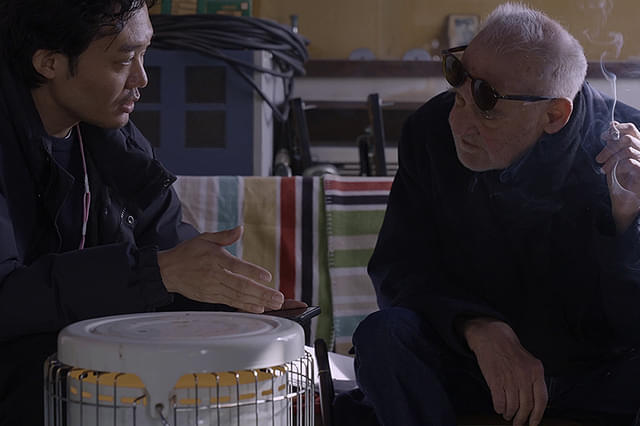
I found Fukushima with Béla Tarr fascinating on so many levels, not least the director’s abrasive personality, which – as some reviewers have pointed out – at first seems almost like a caricature of the artistic persona he has developed over the years. What also struck me was his varied interactions with each filmmaker; there is a sense, at least from what we can gather from the documentary, that he likes some of the participants’ approach to filming more than others. Tarr’s comments, suggestions and conversations with the filmmakers also reveal how he sees cinema and the filmmaking process, at least in the limited conditions of the workshop: only two weeks, no familiarity with the area and the language for many of the participants. Perhaps it’s because of the limited time available that Tarr pushes everyone, sometimes almost aggressively, to visualise the ideas they have in mind in images, rather than just talking about them or explaining the context of what’s happening. Some of the most interesting technical tips he gives the workshop participants are also prime examples of his idea of cinema, such as holding a shot longer than one would normally do, it’s always possible to shorten it later, or how paying attention to the interplay of light and darkness enhances the visual impact and the meanings conveyed by the work.
The best quality of the documentary, in my opinion, is the time it spends and stays with the group of people involved in the workshop, allowing the camera to capture the distinctive personality of each filmmaker and how each of their projects progresses, or in some cases crumbles, towards the deadline. It is this familiarity with the subjects that makes the work more organic and meaningful as it unfolds, and leads the viewer to care about, or at least become more familiar with, all the people involved, not just the filmmakers and Tarr, but also the interpreters, drivers and ordinary people filmed here. All this takes place against the backdrop of the lives of the people of Fukushima affected by the triple disaster, the subject of the works produced in the workshop, of which we, the viewers, get only a glimpse. Among the most fascinating of these stories is that of a kamishibai performed by two women in an abandoned cow shed, now in ruins, and told from the animals’ point of view (Tale of Cows directed by Fukunaga Takeshi).
On a technical level, Oda’s decision to use mostly static shots with very little camera movement is very effective in creating a restrained cinematic space centred around the people portrayed and their interactions. But perhaps the Japanese filmmaker’s greatest effort, as is often the case with this type of documentary, was in the editing room, deciding what to include, how to include it, how to structure it, and what to leave on the cutting room floor.
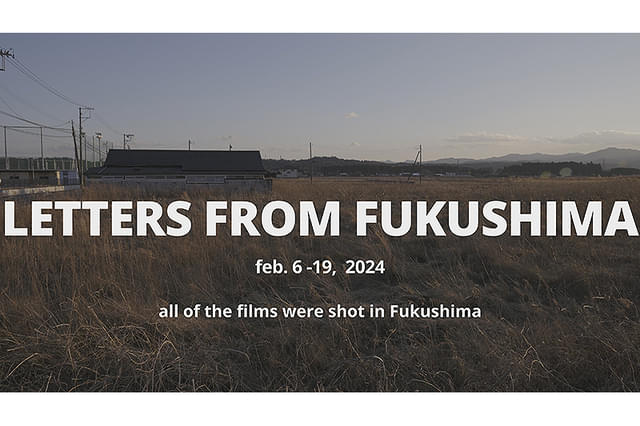
The short films made by the 7 filmmakers have been compiled into an omnibus film, Letters From Fukushima. Below is the description of each short film (from the Tokyo International Film Festival’s webpage):
“Nappo” After 13 years of silence, the instruments are played again. Nappo gathers Fukushima children at Odaka Church. Singing and dancing, they breathe new life into the land. Director: Lin Po-Yu 2024/Color/9min/Japanese
“Wall” A man from Namie Town had to relocate his landscaping business after the disaster. One day, he begins working on a garden in the office, which has been untouched. Director: Ooura Miran 2024/Color/28min/Japanese
“Long Long Hair” In a Fukushima hair salon, daily interactions unveil personal stories, resilience, and the beauty of life after the Great East Japan Earthquake and the nuclear accident. Director: Iizuka Minami 2024/Color/23min/Japanese
“From F” Fukushima, Family, Female, and Future. A story about various Fs, starring 17-year-old-girl who wants to be a dancer while attending an evening school in Fukushima. Director: Shimizu Shumpei 2024/Color/10min/Japanese
“Letters from Fukushima” “Woman, Life, Freedom” is a social movement seeking gender equality. Through three scenes of Fukushima, the film honors the women who gave their lives for dignity. Director: Roya Eshraghi 2024/Color/27min/Japanese, Persian
“The Guests” After a nuclear radiation leak at the Fukushima power plant in 2011, a group of Southeast Asian auto mechanics is dispatched to work in this land… Director: Xu Zhien 2024/Color/28min/Filipino, Japanese
“Tale of Cows” Two women who survived the 2011 Tohoku Earthquake, perform a Kamishibai picturebook about the abandoned cows during the Fukushima nuclear power plant accident. Director: Fukunaga Takeshi 2024/Color/29min/Japanese
This is the third dispatch from this year’s Yebisu International Festival for Art & Alternative Visions. You can read the first two here and here.
Founded in 2009, this year’s edition of the Yebisu International Festival for Art & Alternative Visions is dedicated to exploring the possibilities and problems posed by the changing nature of moving images in our time. Titled Docs: Images and Records, the event, currently taking place at the Tokyo Photography Art Museum, features a variety of works (films, installations, photography, performances and talks) that reflect on the meaning of representation through the visual medium and, in particular, question the meaning of the word ‘documentary’, a term that has become increasingly ossified (both on the big and small screen) and synonymous with the word ‘factual’. Or, as stated on the web page of the festival:
A document is a record of fact-based information, traditionally in the form of words but more recently also as images such as photographs and moving images. The word “documentary,” meanwhile, has come to be used not only as an adjective meaning “factual” or “consisting of documents,” but also as a noun referring to a film expressing facts.
The Lumière brothers’ Exiting the Factory (1895), which is a record of people leaving a factory, is widely recognized as the starting point of the history of motion pictures. People at the time were astonished to see scenes from their everyday lives being recorded and replayed before their eyes as if the events were actually happening right there. Today, 130 years after the invention of moving images, it is entirely unexceptional for people to record and share their daily lives through photographs and videos. Meanwhile, the definition of a photograph has been expanded to include digital images and that of moving images now encompasses digital video; in digital form, these media can be manipulated more freely than before, resulting in a more complex and ambiguous relationship between facts and the images that represent them. Held on the occasion of the 30th anniversary of the Tokyo Photographic Art Museum, the Yebisu International Festival for Art & Alternative Visions 2025 will focus on the transformation of these media. By examining a wide range of works through the lens of images and words, the festival will pursue a reconsideration of documents and documentary.
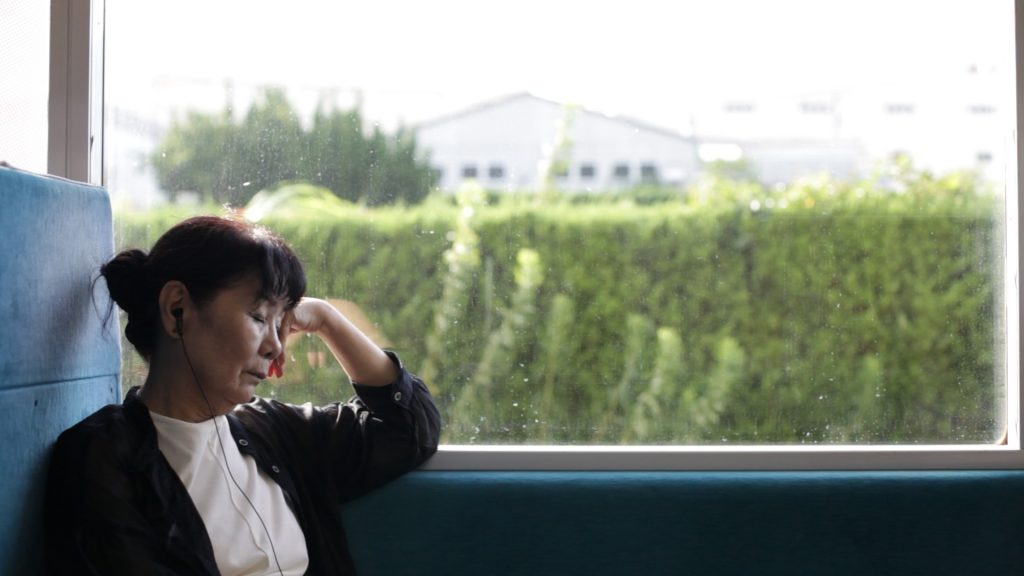
After presenting アンダーグラウンドUnderground, her latest work concluding a trilogy of sorts dedicated to the exploration of subterranean spaces, at the last Tokyo International Film Festival, a film which will be screened at this year’s Berlinale, Oda Kaori returns to focus on a more personal and private story with Recording with Mother “Working Hands” (母との記録「働く手」). This medium-length (41′) work was one of the four projects commissioned by this year’s festival and continues to document the artist’s engagement with her mother, a relationship that gave rise to the short film Karaoke Cafe BOSA in 2022 and launched her career as a filmmaker with 2012’s Thus a Noise Speaks, a film in which Oda expressed and documented her coming out to her family.
Oda’s approach seems to come from a place of curiosity about her mother’s life; the artist herself has said that there was a lot about her mother’s life that she didn’t know, such as the fact that she was the second youngest of ten siblings and that she lost her father when she was five. The film begins with images of domesticity, her mother working in the house, making some sort of wooden craft, while singing and talking to her daughter. Actually, there is no conversation, but the woman’s words are superimposed on the images as a kind of narration, a narration that from the very beginning conveys her confusion about Kaori’s gender: “I don’t know if I should call them son or daughter”.
The work is structured to mirror the story of her mother’s life, but backwards, from the closure of the small karaoke café she ran for a few years before and during the pandemic, through the various jobs she went through during her life, back to her childhood’s places. We learn that at the age of 15 she went to work in a wool mill in Aichi Prefecture, and after graduating while working in Kyoto, she became a telephone operator in Osaka. Returning to her hometown of Takashima in Nagasaki Prefecture, she became pregnant with her first child at the age of 23 and subsequently married.
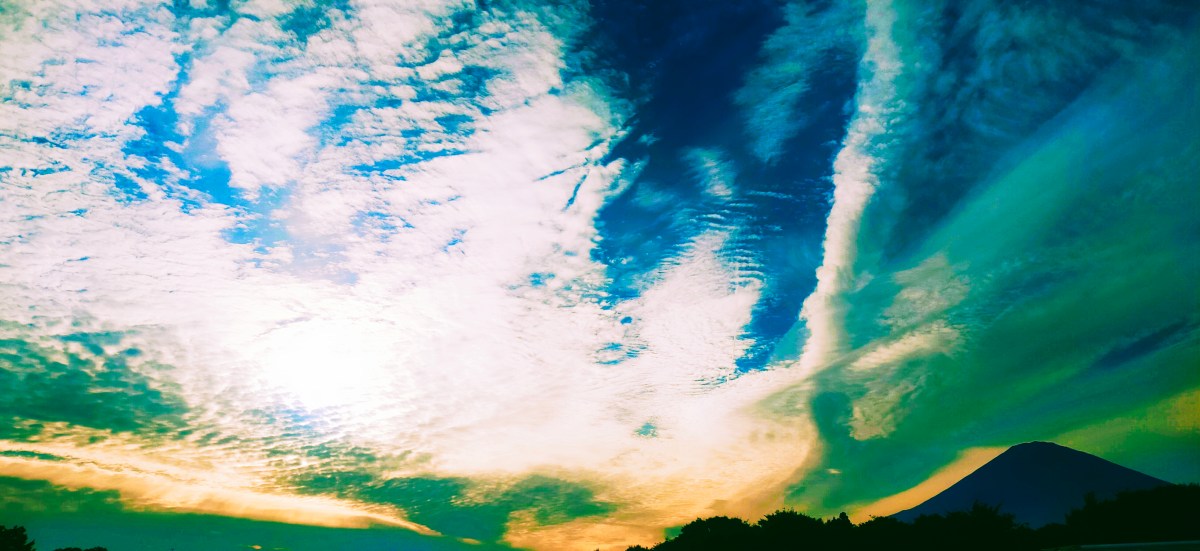
The seeming simplicity and rigour with which the images tell the story once again reveals Oda’s visual talent; the framing is never improvised but always purposeful, as is the use of natural light, shadows and shots of the sky and clouds that open the film. Moreover, there is almost no camera movement throughout the film, leaving room for a static camera filming her mother working in the kitchen, moving around the house, or travelling by train to her hometown and the house where she grew up, now covered by vegetation.
The film ends with her mother back at home carving a small wooden figurine, an object that seems to reflect Oda’s own effort: a heartfelt message made to thank and celebrate her mother.
The film was screened in the museum’s theatre on the day I visited, but it is currently being shown as an installation until 23 March. The exhibition space also features a vibrant oil painting by Oda herself.
As usual, the list below reflects my tastes, interests and viewing habits during the year. Some works are from 2023, but only became available here in Japan in 2024. Synopses, in italics, are from Letterboxd. Films are listed in no particular order:
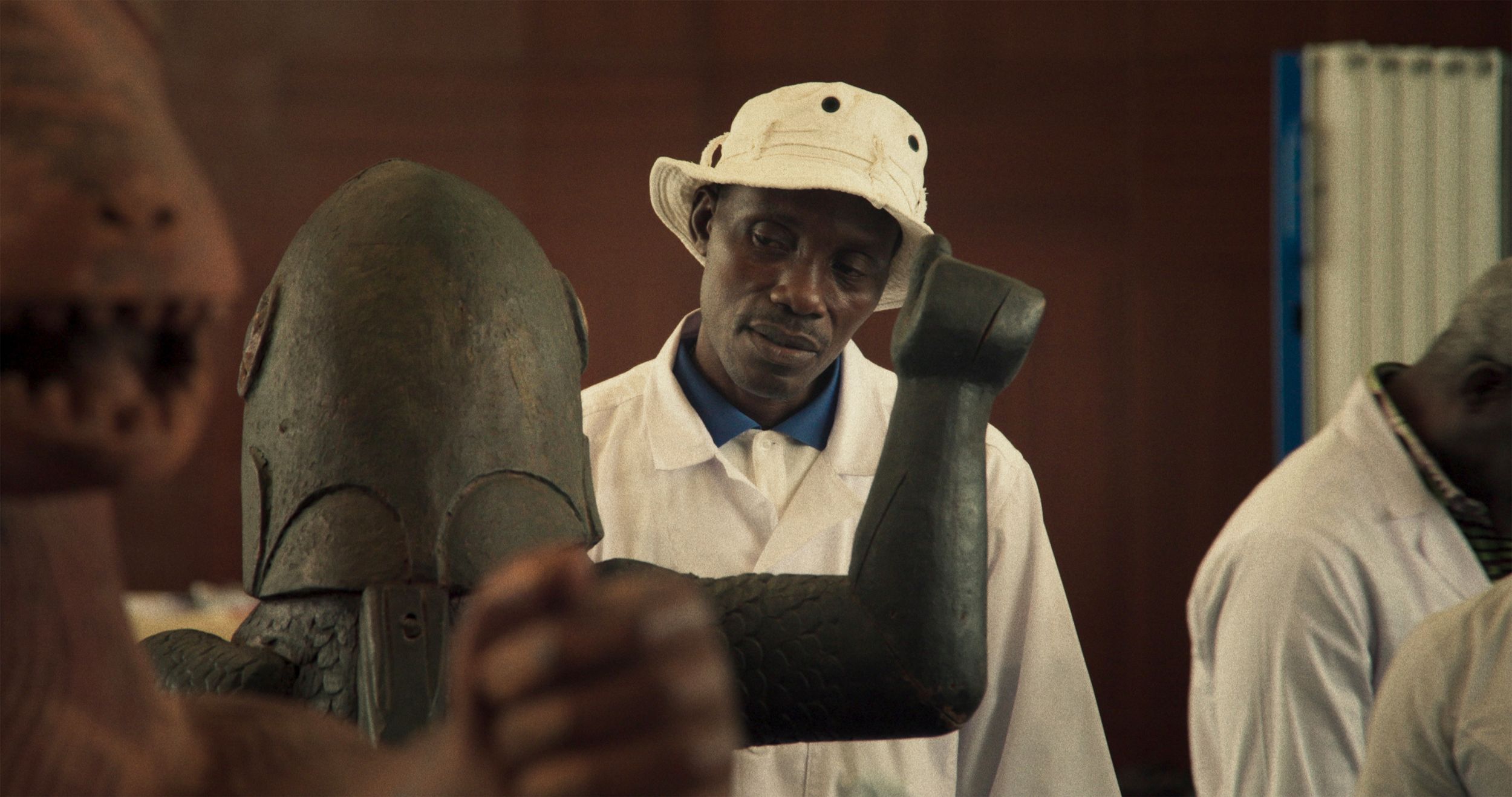
Dahomey(Mati Diop) Thousands of royal artifacts of Dahomey, a West African kingdom, were taken by French colonists in the 19th century for collection and display in Paris. Centuries later, a fraction returned to their home in modern-day Benin. This dramatized documentary follows the journey of 26 of the treasures as told by cultural art historians, embattled university students, and one of the repatriated statues himself. Dahomey is a mesmerising experiment, both visually and thematically: it poses so many questions about decolonisation, essentialism, the traces in the present left by the actions in the past, language, art, religious practices, politics, and the life of objects (Object Oriented Onthology?), while hinting at possible lines of flight…Diop has an incredible talent in capturing the beauty of people and things, and blend them together… “I am the face of the metamorphosis”
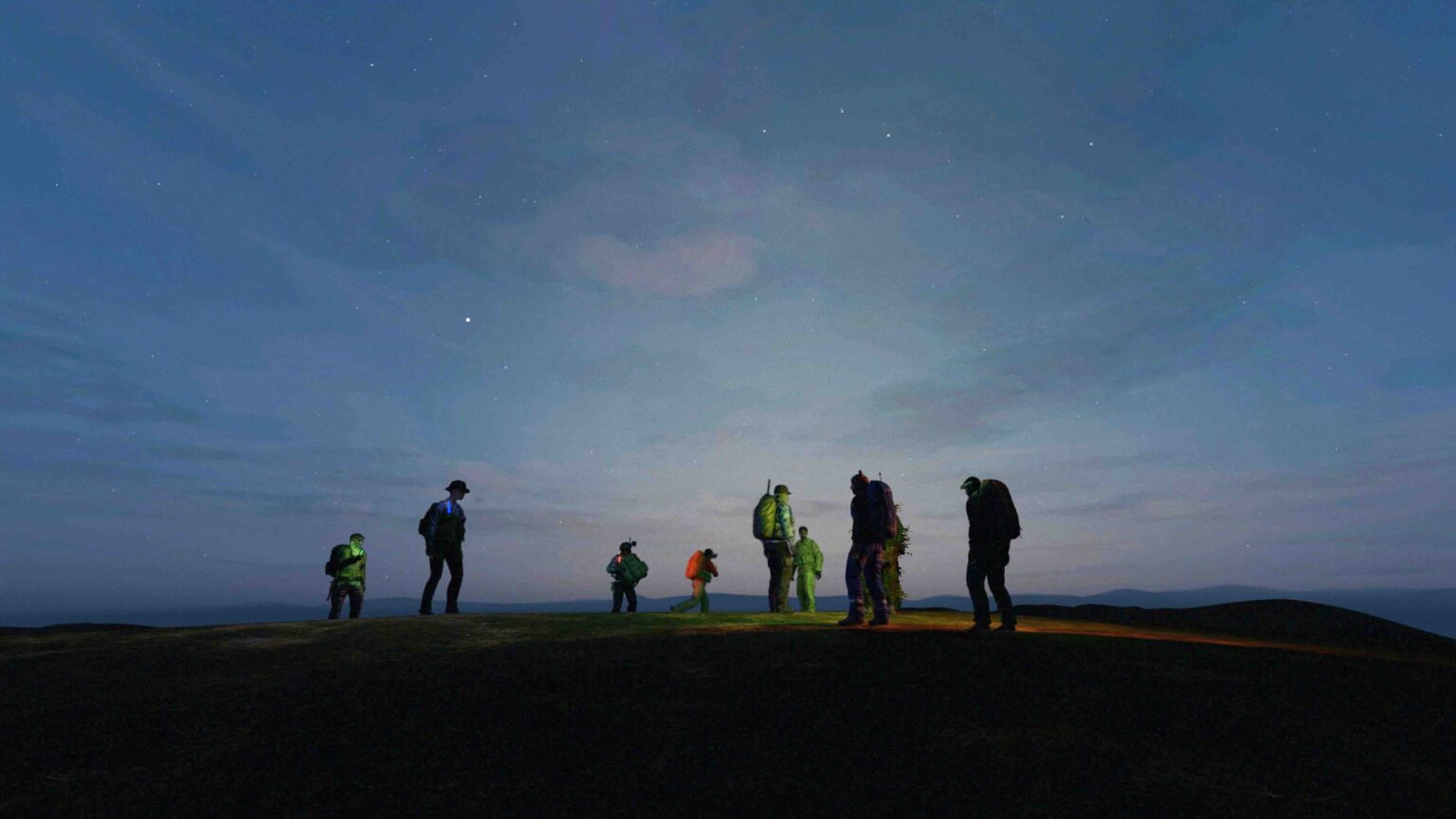
Knit’s Island (Ekiem Barbier, Guilhem Causse, Quentin L’helgoualc’h) Somewhere on the internet is a land where communities pretend to live out a survivalist fiction. The avatars of the directors of Knit’s Island spent 963 hours there, creating a fascinating film resulting from their encounter with these communities. The “players” reveal their fears and fantasies, in an at times unsettling blurring of the real and the virtual. I am not a gamer, and not particularly interested in online videogames, but when I first saw it at the Niigata International Animation Film Festival, it blew my mind. The reality of the virtual, complex, subtle, and much much more.
No Other Land (Yuval Abraham, Basel Adra, Rachel Szor, Hamdan Ballal) Made by a Palestinian-Israeli collective, this documentary shows the destruction of the West Bank’s Masafer Yatta by Israeli authorities and the unlikely friendship that blossoms between Palestinian activist Basel Adra and Israeli journalist Yuval Abraham.
The Voices Of The Silenced (Park Maeui, Pak Su-nam) Director Park Soo-nam, a second-generation Korean resident in Japan who is losing his eyesight, decides to digitally restore 16mm film she shot a long time ago, relying on her daughter Park Ma-eui’s eyesight. The blood, tears, and numerous corpses of Koreans living in Japan are clearly engraved in the film filmed over 50 years.
Hiroshima – Nagasaki (Ikezoe Shun) Voices from Tsuyoshi Yamaguchi, who was twice exposed to the atomic bombs in Hiroshima and Nagasaki and later became a storyteller, as well as those who continue the storyteller activities with his daughters, grandchildren, and great-grandchildren, and other people who were twice exposed to the atomic bombs. How will a storyteller who was not involved in the story pass on the memories in the future?
Clouds of War (Mikami Chie) This is the latest documentary by journalist and filmmaker Mikami Chie, a director whose previous works (The Targeted Village, Boy Soldiers: the Secret War in Okinawa, We Shall Overcome) have focused on the current situation in the Ryūkyū archipelago (Okinawa), its complex geopolitical history and the resistance of its people against the various American bases operating on the islands. Filmed over the course of eight years, beginning in 2015, Clouds of War documents the construction of military harbours and ammunition depots by the Japanese Self-Defence Forces, and more broadly, the general militarisation of the main island of Okinawa, Yonaguni, Miyako and Ishigaki. These frightening changes affecting the land and its citizens, such as the construction of underground shelters in Yoneguni or a plan to evacuate the inhabitants to Kyūshū, are being done in preparation for the next war on the horizon, the one between China and Taiwan.
Soundtrack to a Coup d’État (Johan Grimonprez) In 1960, United Nations: the Global South ignites a political earthquake, musicians Abbey Lincoln and Max Roach crash the Security Council, Nikita Khrushchev bangs his shoe denouncing America’s color bar, while the U.S. dispatches jazz ambassador Louis Armstrong to the Congo to deflect attention from its first African post-colonial coup.
The Oasis I Deserve (Inès Sieulle) Replika is a public platform that allows anyone to create a relationship with a chatbot trained by artificial intelligence. This chatbot has been designed to replace us with our loved ones after our death. Thus, its goal is to learn as much as possible about us in order to reproduce us identically. Through a walk that takes place only from the subjective point of view of Replikas, we see them evolve and discover the images & sounds of the world around them through a system of videos generated by artificial intelligence. Phone conversations that Replikas have with users fill the narration. The Oasis I Deserve is not a film that questions the system of machine/human domination under the axis of a future war against the machine. It is a film that is mainly human. It speaks about our relationship to the unknown and how we share violence. (source). I was really impressed by the subject tackled and by the way the images, Francis Bacon like, are able to convey the themes and the feelings explored .
Black Box Diaries (Itō Shiori) Journalist Shiori Itō embarks on a courageous investigation of her own sexual assault in an improbable attempt to prosecute her high-profile offender. Her quest becomes a landmark case in Japan, exposing the country’s outdated judicial and societal systems. A powerful example of how women can reclaim their agency through the visual medium.
Underground (Oda Kaori) The latest work by the Japanese artist, I have written about it, here: Sculpting space with light.
Discoveries:
Mother of Many Children (Alanis Obomsawin, 1977) This film is an album of Native womanhood, portraying a proud matriarchal society that for centuries has been pressured to adopt different standards and customs. All of the women featured share a belief in the importance of tradition as a source of strength in the face of change. Obomasawin’s first feature-length documentary is also one of her best (along with Kanehsatake and Restigouche, in my opinion): insightful, touching, multi-layered and beautifully constructed.
Echigo Okumiomote: A Traditional Mountain Village (Himeda Tadayoshi, 1984) I wrote an article about the film: here.
A Grasscutter’s Tale (Fukuda Katsuhiko, 1985) Part of the Sanrizuka notes that Fukuda took after he left Ogawa Pro in the late 1970s and the group moved to Yamagata, A Grasscutter’s Tale is a crucial film in the history and development of documentary practices in Japan. It occupies two spaces at once: a militant cinema and a cinema that explores the waves of history through the personal; in other words, it’s an oral film that uses images to explore the physical and historical space of a place. Fukuda experiments with style and form, for example: one segment about a dream is completely dark except for a bright light in the top left corner of the screen, and in another, the narration explains, again on a black screen, how the re-enactment of an episode from the old lady’s life was scrapped at the request of her son, who was in it. The episodic structure of the film, which is made up of 19 chapters (some comic, some tragic) that explore episodes in the life of the protagonist, does not capture a totality, but provides an image that leaves room for the creation of meanings. This is also reflected in the visual style used, where images and words are parallel and do not touch each other, so to speak. I was lucky enough to attend a screening of the documentary in 16mm, the greens of the crops and grass are almost tactile, and the time-lapse scene of the setting sun, here a fiery red, is similar to that used in Magino Village: A Tale.
addendum (January 5, 2024): I forgot Tokyo Trial (Kobayashi Masaki, 1983), one of the fews examples of found footage/compilation documentary in the history of Japanese cinema.
Underground spaces accumulate traces and memories of past presences, both non-human ones created over thousands of years by geological processes, and those left by human activity and histories. Over the past three years, Japanese artist and filmmaker Oda Kaori has explored and focused her attention on some of these underground places in Japan, seeking to capture and evoke past existences through images and sounds. The result of this research, which has also led to other productions in various media, is アンダーグラウンド Underground (2024), a sonic and visual experiment that was presented at the 37th edition of the Tokyo International Film Festival in the Nippon Cinema Now section last November.
At least three years in the making, Underground is her most experimental work to date, and a project that concludes a phase of Oda’s career dedicated to exploring subterranean spaces with Aragane (2015) and continued with the underwater world with Cenote (2019), but one that may also herald a new path, more experimental, for the artist. If you want to know more about Oda and her previous work, I’ve written a long essay about her first three works, or there’s also an interview I did with her – although it was almost ten years ago, at the beginning of her career.
The interest in the Japanese underground and in the past lives it evokes is thus a continuation of the path that the artist took with Aragane and Cenote, but here with a focus on the subterranean spaces of the archipelago. An early result of this exploration of Japan’s underground spaces was released last year, Gama (2023), a medium-length film that brings to light, almost literally, the stories of forced mass suicides of Okinawan people in gamas (natural caves), during the latter stages of the Pacific War. Much of the footage shot for Gama was reused in Underground and combined with images from another project, a nearly ten-minute installation created for the city of Sapporo in 2022. To complete Underground, Oda combined all this material with others shot in Yubari, Shimane, Saga, and Hyogo, although the locations are never specified in the film.
The biggest departure and difference from her previous works is Oda’s decision to use Yoshigai Nao as “shadow” in the film, an almost phantasmatic presence that moves freely throughout the work, connecting different places and different times, and the meaning of which is never explained. This addition brings a performative element to Underground that is almost absent from her other films. Yoshigai is a coreographer, dancer, and director herself, and has made some interesting works such as Grand Bouquet (2019) and Shari (2021); まさゆめ Masayume (2024), her latest – which I have unfortunately not seen – was produced as Cenote by the Aichi Arts Center and screened in Nagoya last November. Yoshigai also has a prominent role in Gama, as most of the images from the hybrid documentary released in 2023 are reused in Underground. This is probably the main problem I have with Oda’s latest film, the central part is a repetition of what was done and shown in Gama, and although I know that it is the other way round – Gama came out of the Underground project and not vice versa – I feel that the images of Okinawa could have been left out.
While Underground is perhaps less effective when it combines material that is too visually disparate – at least for me the film does not work when it weaves together Yoshigai’s performance with the more abstract images shot underground – it excels in the more visually and sonically experimental moments. In the director’s own words “the underground world is pitch black, and nothing can be seen unless light is shone on it. It is not reflected. The act of shining light on the darkness felt like an act of sculpting the space with light”. This play of light and darkness, the overlapping of the artificial and the natural – the use of film superimposition is first class – and the materiality of the images, which I understand were shot on film, find a magnificent parallel in the sound, a sonic tapestry that, in the most inspired moments, manages to elevate the whole film.
If I’m not mistaken, at the moment Oda is working on smaller projects, she will be screening one of her shorter works, shot digitally, about her mother, at the next Yebisu International Festival for Art & Alternative Visions between next February and March.
I’ve decided to publish here my essay on three films by Oda Kaori that was originally meant to be published in an international film magazine (things have stalled, unfortunately). I took the decision because in the meantime Oda’s career (the piece was written almost five years ago) has evolved significantly, with more exhibitions, art installations, political and social stances, and films (Gama, and the Underground project). It goes without saying that now I would write the piece quite differently, mainly in style but also regarding the content. Posting here this short essay does not preclude that in the future I might return to write on the subject; on the contrary, it gives me the chance and the peace of mind to turn the page and freshly reassess the filmography of one of the most fascinating artists working in Japan today.
Reassessing the human: three experimental documentaries by Oda Kaori
“The landscape thinks itself in me and I am its consciousness.”[1]
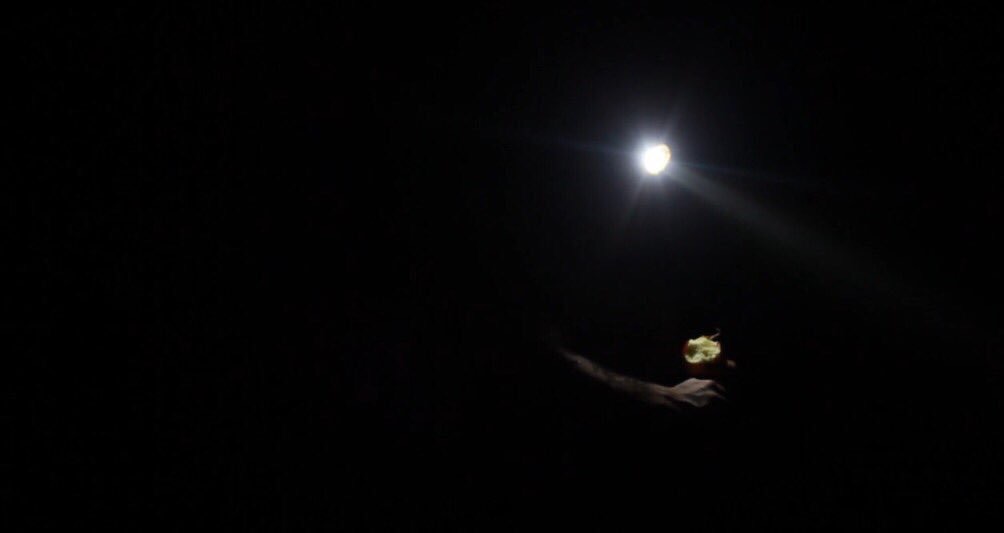
A worker sits down and takes a break. In the deep belly of a mine and enveloped in a pitch black surrounding, he bites a red apple. His helmet lamp provides the only few blades of light in a scene of almost Vermeer-like beauty. In the preceding scenes the noise from the machinery at work in the mine is so unbearable that the words are oftentimes superfluous or just a waste of energy. The life in the mine is only silence or cacophony: there is no middle ground. It is an alien landscape, both visual and sonic, where the human is just one element among several. The beauty of the moment derives from the interplay between darkness and light, from the silence after the wall of noise that precedes it, and from the empathy towards the man conveyed by the camera.
The scene is one of most significant and impressive passages in Aragane, a feature documentary shot, edited, sound-designed and directed by Oda Kaori in 2015. Oda made her debut in 2010 with the short Thus a Noise Speaks, a personal documentary that unflinchingly explored her coming out as gay and the subsequent reactions from her family, especially her mother. The experience of Thus a Noise Speaks, one where the camera is also used, in Oda’s own words, “as a weapon for revenge against my mother,” was a fundamental experience for the young Japanese director, who was 23 years old at the time: Not only because it was a way of expressing her true self, but also because it was a chance to grasp the incredible power that filmmaking can have, and to realize how harmful a camera pointed at someone can be.
Born in Japan, but partly educated in the U.S.[2] and with three formative years spent in Bosnia, Oda’s artistic arc began from a position of hybridity from the very beginning and afterward wandered around the globe in search of places and stories to explore. The sense of displacement experienced and expressed in her debut short, and her background as a so-called “halfie,”[3] opened the gates for a cinema conceived as a nomadic wandering, and an artistic path that in crossing borders, cultures, genres, and styles, explores what it means to be a subject in flux and always open, as the best ethnographers always are, to what the world has to offer[4]. Moving from one geographical area to the next, from Japan to Bosnia, back to Japan and then to Mexico—but a Mexico filtered through Mayan mythology—Oda’s filmography expresses the idea of a nomadic cinema not interested in broad and essentialist discourses about cultures, but more focused on specific places and the collective experiences and memories linked to such places.
Towards an alien phenomenology
The first (and to this day, most artistically accomplished) example of this approach arrived for Oda in 2015, when Aragane was presented at the Yamagata International Documentary Film Festival. A work, as previously mentioned, that she directed, photographed, edited, and sound-designed, but also a “product” of Bela Tarr’s film.factory, the short-lived film school based in Sarajevo and established by the Hungarian director in 2013, a place where Japanese director Oda studied for three years.
Aragane, meaning ore or small pieces of stone in Japanese, was shot in a Bosnian coal mine as a project for film.factory. An immersive and hypnotic sensorial experience, the movie starts, and thus sets the tone for the rest of the work, with a pounding noise and a close-up of a machine. The scene is followed by a short depiction of life on the surface, with workers preparing and completing various tasks before commencing the deep dive into the mine. Once in, we’re in a different kind of world, one where the only lights rippling and dancing in the total darkness are those of the headlights of the workers and of Oda herself, and one where the noise is so deafening and monotonous it turns into a sort of alien music.
Aragane is not a direct inquiry into the harsh conditions of the people working in the mine (although that is something that eventually and necessarily emerges) but more an attempt to convey on screen the time and space of the coal mine as experienced by the people working in it. Creating a sensory experience of the place, an experience constructed through the interplay of machines, darkness, head lamps and the miners, Oda hints at a different field of perception and at a different type of time. For most of the duration of the film, we don’t really know what’s going on and who is doing what: what is missing is a central orientation, a focal point around which the movie can organize itself in the usual sense.
“The darkness, no sunlight, no moonlight”
“timber dust floating”
“pump, electric saws”
“grey fog”
“steam evaporating from T-shirts”
“a flickering head lamp sways”
“A small universe within a universe”.
“I see because there is light”
“In this underground world people and machine carry the same weight”[5]
Once we get accustomed to the things, events and musicality of the noise presented on screen, though, everything slowly begins to make sense. What starts to surface from the images, sounds, tracking shots and slow and hypnotic camera movements, is the time and the materiality of the mine itself. When a long and dark scene towards the end of the movie, with the carts ascending to the surface of the earth, is brutally interrupted by a static image of the outside of the mine covered in snow, it is almost like a revelation. After an hour of darkness inside the bowels of the earth experiencing a different perception of time and space, the whiteness of the snow, the colors of the clothes and those of the equipment hanging are so sharp and bright that gazing upon them almost induces vertigo.
With the sensory and cacophonic descent into the alien landscape that is the life in the mine, Aragane is also an exploration of the relation between the people working inside and the place itself. This is a crucial point in understanding Oda’s works: her films are, for the most part, and especially on first viewing, an overwhelming visual and sensory experience that seem to focus more on the non-human elements of what is filmed. However, when fully absorbed, they reveal the true potential of what her cinema can do at its best: establish a cartography of non-human landscapes and, at the same time, reflect on the role and position of the human element in this “new world.” It is not by chance that the central part of the movie, the core and one of the most significant scenes in the entire documentary, is the beautiful scene that we have described at the very beginning of this essay.
“Tell me how I can touch a butterfly without breaking her wings”[6]
The preoccupation towards people is one of the central themes of Towards a Common Tenderness. Released in 2017, the movie is many things: a visual poem structured like a diary about the experience Oda had while filming her first and second works, but at the same time a reflection on the act of filming, and, as in Thus a Noise Speaks, the power the camera has when pointed at someone.
The movie starts with a beautiful murmur of voices and sounds, with Oda herself pronouncing lines from her memories and reading from Notes on Cinematography by Robert Bresson and Rosemary Menzies’ Poems for Bosnia. It then moves to a shot of her first movie (a shot of a shot) of her mother crying when Oda comes out. The movie is, in fact, structured as a long letter sent to Oda’s mother, in which the director speaks directly to her mother about her experiences with the camera and everything that happened to her after she decided to become a filmmaker. Toward a Common Tenderness uses a mixed visual style, with abstract and poetic images intertwined with shots recorded by Oda in Bosnia and Herzegovina during her period at Bela Tarr’s school, outtakes not used in Aragane, and other images from unfinished projects.
The central part of the documentary is when Oda was a guest at a family of Romani descent for a week. When talking about this experience, she recalls how she couldn’t finish filming the project because she could not stare at the old husband and go deeper inside him, depicting the loss and grief his family went through when one of their members passed away. Rosemary Menzies’s poem shown at the end of the movie through extreme close-ups of the printed page is exemplary of the conundrum that haunts and informs the whole movie. “Tell me how can I touch a butterfly without breaking her wings.” How can we gracefully depict the beauty of things without destroying it? How can we film reality without annihilating it or destroying the things and the people in it?
“…reveals the base of inhuman nature upon which man has installed himself”[7]
If Aragane is a movie revolving formally around darkness, slow movement, and repetition, and Towards a Common Tenderness a reflection on the riddle that is the act of filming, Cenote is a movie that combines the two approaches.
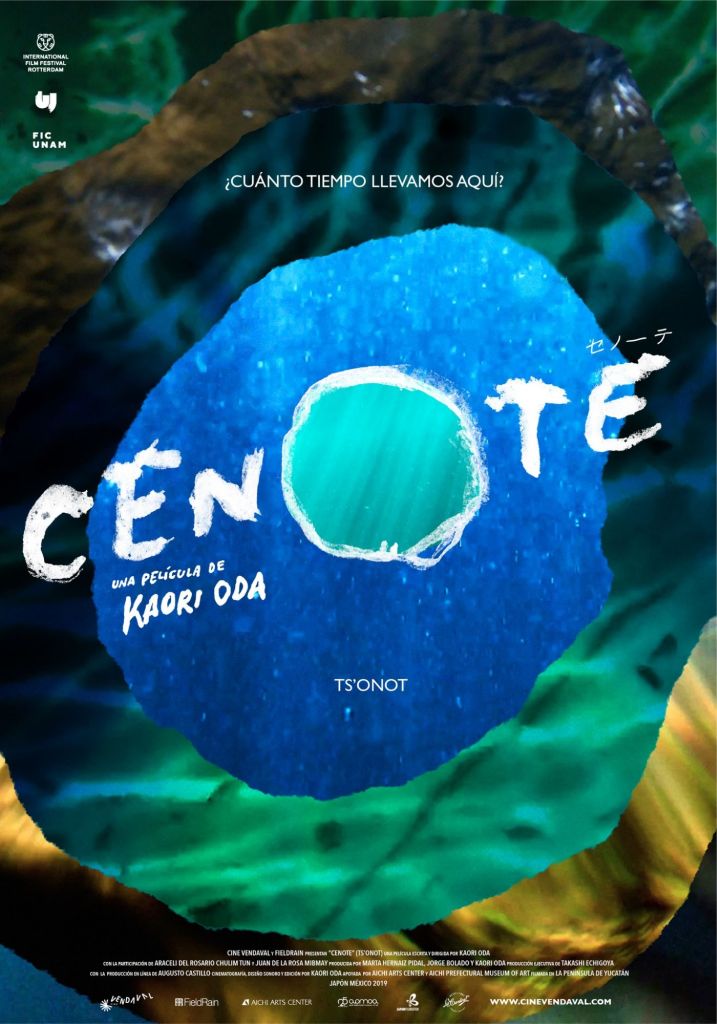
It is about water, light and their connection to the cosmos, but also about people and their collective memories. Cenotes, or ts’onot in a form of Mayan, are natural sinkholes found in the Yucatan Peninsula in Mexico, the only source of water for people living far away from rivers or lakes, and considered sacred places in ancient Mayan civilization.
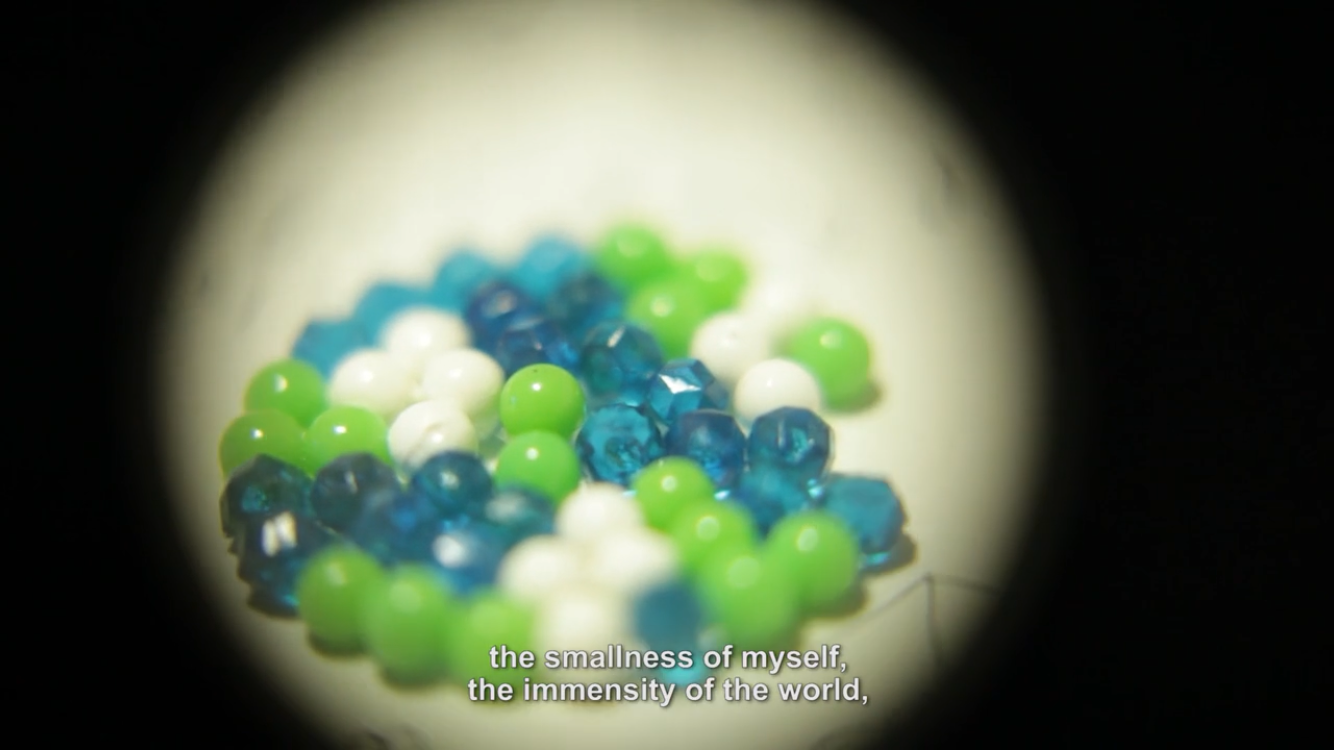
Abstract images of the underwater world inside the cenotes intercut with people reciting, almost whispering, old Mayan poems, and other voices, in Spanish, recalling memories about life near these natural pits. Swimming in the water, the camera is enfolded in a reality that is perceived and created by the play of water and light. The first ten minutes, the more experimental part of the work, are in this sense an absolute bliss, an exhilarating and liberating artistic experience that brings us back to the womb of the earth, to the origin of life, or, as one of the quoted Mayan poems states, to the place where the sun sinks, disappears and reappears every day. Blotches and blades of colors flash on screen, drops of water dance like subatomic particles on the surface of water, and fish swim as peacefully as ancient deities. While this formal experimentation is noticeable in the path blazed by Aragane, a cinema of sensation that shifts the representation of humanity towards the periphery of reality, the non-human elements presented in Cenote expand further, reaching the spiritual and the mythical.
Another novelty that Cenote brings when compared to Aragane or even Towards a Common Tenderness is the presence, throughout the film, of a dialogic tension, both aesthetically and thematically, between words and noise, light and water, grainy images and digital sharpness, mythical time and geological time, and people and natural elements. Using 8mm film (Super8) and images shot underwater with an iPhone, Oda creates a difference and an aesthetic space, a poetic “ma” (間) that reflects and has a parallel in the space between the two worlds explored: the sensory experience taking place underwater, on the one hand, and the close-ups of faces and the voices of people on the other. Faces of people, but also animals, chicken, butterflies, dogs, cats, and local festivals are filmed in 8mm, while the world inside the cenotes is filmed with an iPhone. The dialog between these two types of images, the intercut between these two worlds, becomes the structural backbone around which the movie develops.
The sound and words spoken in the movie, folklore, mythical stories, memories of people who live near a cenote, and legends of children who drowned in them are all weaved together, recited and spoken in Yucatec Maya and Spanish. The stories told are important, of course, but the musicality of the words is an element that, paired with the underwater sounds and the distorted noise captured or created by the camera’s microphone, form a sonic tapestry of rare beauty. The soundscape used in Cenote, more than the one adopted in Aragane, where the human voices were relegated to very few words, hints at an idea of the cosmos in which humans are part of a larger dimension, both in time and space. The images confirm this larger scope on a geological scale: the sinkholes are a product of a celestial encounter between a shower of meteorites and the earth’s crust, but at the same time, a mythical place for ancient Mayan civilization, a portal and a threshold where, according to the Popol Vuh, this world and the afterlife touch each other. The connection between these two realms is an important part of Cenote, and, as a matter of fact, the movie also works as an exploration of collective memories and ancient mythologies, both still very present in the area and the villages around these sinkholes. The dead (via the poems), the women sacrificed in the pits, and all the legends and stories retold by the villagers, form a layer where the past, real or mythical, and the present coexist. This present-permeated-by-the-past has a phantasmic quality channeled into the movie by the images in 8mm, which always feel distant from the here and now, and by the voices in Spanish and Yucatec Maya, always out of sync and hovering above the images, as it were. The connection between the dead and the living is made more explicit in a brief and beautiful passage when the movie gazes, bathed in a frail and milky light, at funeral rituals in the area, when human bones and skulls are brushed, polished and collected with extreme care as remnants of past lives.
Conclusion
Like some of the works made at the Sensory Ethnography Lab[8], and to the cinema of Bela Tarr and Wang Bing, Oda’s filmmaking has, in the past years, built a unique trajectory in the film world: a brand of experimental documentary born at the intersection between visual anthropology and a cinema that prioritizes a pre-reflective engagement with the world. The result is an oeuvre that traces and establishes new connections between people, things, memories and the landscape they inhabit and from which they emerge. The human element is thus repositioned and reframed according to a different vision of reality, compared to one that often dominates the field of documentary, especially in contemporary Japan. This artistic approach is also traceable in her works as a painter: for instance, in a series of CD covers of Aragane’s soundtrack she painted by hand. Each cover is a thick impasto depiction of a scene from the movie, or a memory from her filming inside the mine. Another example is a series of portraits of women Oda made inspired by the story of the women who were thrown into the cenotes as ritual sacrifices. In these paintings, the faces of these women seem to resurface from the water like deities, made by the recollection of what Oda experienced while filming and swimming in these sinkholes.
Visual and sonic experimentation which engages with the world and creates a cinema that, while reassessing the human element and abandoning a human-centered perspective on reality, continues at the same time to show a deep care, affection and interest toward people. This is the biggest accomplishment of Oda’s artistic trajectory so far.
[1] Paul Cézanne, quoted in Cezanne’s Doubt, Maurice Merleau-Ponty, 1945. Later in Sense and Non-Sense, trans. by Hubert and Patricia Dreyfus (Evanston: Northwestern, 1964).
[2] She studied film at Hollins University in Virginia.
[3] “People whose national or cultural identity is mixed by virtue of migration, overseas education, or parentage” Lila Abu-Lughod, Writing Against Culture, in Fox, Richard G. Hg, Recapturing Anthropology: Working in the Present. Santa Fe, S. 137–162.
[4] More than fifty years before, a similar approach to documentary was proposed by Matsumoto Toshio: “Matsumoto’s avant-garde documentary theory focused instead on the revelation of the existential force of an object or the actual people filmed through the process of subjective film-making” Hata Ayumi, ‘Filling our empty hands’: Ogawa Productions and the politics of subjectivity in H. Fujiki, A. Phillips ed. The Japanese Cinema Book, Bloomsbury 2020.
At the end of last January, I had the pleasure of attending a special screening of Gama, the latest project by Oda Kaori, a talented filmmaker and artist whose previous works I covered in the past for this blog, and for various other outlets (review of Aragane, interview with Oda, review of Cenote).
The work was screened in the city of Toyonaka on January 27th, and was commissioned by the Toyonaka Arts Project 2022. From Oda’s perspective Gama is also a second chapter of sorts, or a “trace” so to speak, of an ongoing project, a movie that will come out next year, Oda is developing about underground areas in Japan, underground both in its literal and figurative sense. The first chapter of this project is a visual installation produced by the Sapporo Cultural Arts Community Center, and projected on an ultra-wide horizontal screen in a underground pedestrian passageway in the city of Sapporo, Hokkaido. The work, also titled Underground, is being screened until the end of March, alternated with works by artists such as Apichatpong Weerasethakul (The Longing Field) or Rika Noguchi (Insects/ Leaves/ Songs of Birds), as part of a project called Nishi 2-Chome Chikahodo Video Creation. Here the official description of Oda’s installation:
Kaori Oda “Underground” 2022 | 09’37” Kaori Oda consistently seeks for human memories―Where are we coming from and where are we going to―. In this piece, she dives into the underground paths in Sapporo beneath its enormous landscape aboveground. She projects everyday lives and sound footages of Sapporo in the past decades, as well as repetitive caves and holes, or images of the universe. The locations where she projects these moving images are normally closed to public. This film shot in 16mm considers layers of the time lived by the people, redefining them as multi-track timeframe. It invites us to imagine the space where we exist now as well as the very beginning of time.
Back to Gama, the work screened in Toyonaka. The film takes place entirely in Okinawa, and the connection between Toyonaka, a city located in Osaka prefecture, and the Ryūkyū archipelago has a history that goes back after the war, when in 1964 the city of Koza, now Okinawa city, started to send sacred stones and hibiscus flowers to the families, living in Toyonaka, of people who died during the war in Okinawa. The film is shot mainly in natural caves (gama), where civilians took shelter during the early stages of the Battle of Okinawa (April-June, 1945). One of these though, the so-called Chibichiri Gama, tragically ended up becoming the site of a mass suicide, when people were told that American soldiers would eventually kill them all. If I’m not wrong, there’s another cave also mentioned in Gama, one where the Okinawans who took refuge surrendered, because they were told by people who lived in Hawaii that U.S. Army would spare civilians.
I think it is fair to say that Gama is, formally, a slight departure from Oda’s previous works, at least the feature-length documentaries, and for a couple of different reasons. The first and major one is that the movie has a strong performative element to it, one that was almost absent in Aragane, Cenote or Towards a Common Tenderness. In the film, the caves are used as a set for the stories told by a local guide, who specializes in the history and stories connected to the caves, and who is very passionate about his “job” to the extent he considers it a mission. Engulfed in the darkness of the cave, with just some blades of light cutting the frame, these tragic stories about women, children and old people fearing for their life are declaimed as in a recital. There’s a certain singsong rhythm to the way the man tells his stories, that gives the movie almost a hypnotic sonic quality. On the visual aspect, the play between darkness and light—it is worth mentioning that the work was shot on film—and the balance/imbalance of artificial and natural elements in the frame, make the movie fascinating to look at, and at times looking like a painting. Going back to the performative element, an important and central part of the work is the presence of Yoshigai Nao, a dancer and filmmaker (Grand Bouquet, Shari) who, according to what was said in the talk after the screening by herself and Oda, is for the movie not only an actor or a performer serving the director, but more a member of the staff, she actively participated in some filming decisions as well. Interesting and connected to what we wrote above about Gama being a work that signals a divergence from her previous modus operandi, is also the fact that the movie is the first work Oda did not film herself, it was shot by another female filmmaker and cinematographer, Takano Yoshiko, she was, among other things, the cinematographer for Saudade by Tomita Katsuya (2011).
While the guide is reciting his stories, Yoshigai, in the film dressed in blue, moves, crawls, and almost dances throughout the cave, a phantasmatic figure, she plays the role, in Oda’s own words, of the “shadow”, possibly conveying presences from the past, human or non-human. The compresence of human histories, in this case tragic war memories, with the geologic time, millennia that here shaped the caves, while not directly expressed, is one of the themes that lies at the core of Gama (and is prominent in Cenote as well). The cave has at its bottom, and is itself composed of, layers of minerals, micro-organisms, animals’ bones, and human bones. Traces of historical and geologic time that are here overlapping. “Traces” is an important concept for approaching Gama and more broadly Oda’s works, not only because of what we just wrote, but also because of a certain scene in the movie. While the guide is telling his stories, the screen goes completely black, Oda explained that she just turned off all the lights leaving the cave in its natural darkness with the man speaking. As an after effects—this was discussed in the talk after the screening and Oda said she did not notice it at first—the shape of the man and the outlines of the rocks stay for a couple of second on the black screen, giving a sense of a phantasmatic presence, of something that manifest itself while not being there. As a common thread running through her films, it is fascinating to notice how Cenote explores something similar, not formally, but thematically, the presence of the dead both in the sinkholes, and in the Maya ceremonies shot in 8mm.
One of the formal choices that have become a sort of signature of Oda’s style, an abrupt cut from darkness to light and from noise to silence, moves the focus of Gama from the cave, where the guide and his group are searching for and separating human and animal bones, to the outside, where the screen is filled with the blue of the sea and the sky, and the white of the coral beach. Here Yoshigai is playing with pieces of coral, themselves remnants of past lives, making a light and soothing sound with them. The peace of the scene is interrupted, by pure chance according to the director, when the deafening sound of an American aircraft passing nearby transforms the scene into a scream, reminding us, the viewers not the people of Okinawa, about the reality of the physically oppressive presence of the American Army in the archipelago.
As in her previous works, but in Gama is something more prominent, the underground space with its darkness and depth seems to be the perfect locus solus where different times, and different (hi)stories intermingle and intersect. It will be fascinating to see how Oda will be able to organize and infuse these ideas in her next feature-length work.






 Asian Docs
You must be logged in to post a comment.