Indigenous with a Capital ‘I’: Indigenous Documentaries from 1994 to 2000 – TIDF 2021

This is a translation and a partial rewriting of a piece I wrote for Alias (Saturday supplement of the Italian newspaper Il Manifesto) in 2021.

In 2003, Māori director and theorist Barry Barclay proposed the idea of a “Fourth Cinema.” Building on and expanding the concept of “Third Cinema” as theorized by Fernando Solanas and Octavio Getino in the late 1960s, Fourth Cinema designates a practice centered on the Indigenous gaze and Indigenous viewers. Rooted in Barclay’s background in documentary, the concept was initially conceived as an audiovisual practice in non-fiction—works created by Indigenous authors, within Indigenous communities, and for Indigenous audiences.

Paying homage to Barclay’s reflections, the twelfth edition of the Taiwan International Documentary Festival devoted a section of its official program to works by Indigenous filmmakers from the island, produced in the final years of the twentieth century (1994-2000). This was a period when long-standing questions of indigenous identity, resistance, and decolonisation converged with—and were amplified by—the revolutionary arrival of small, portable digital video cameras.

This technological shift, coupled with a transformed socio-political landscape, opened new avenues of self-expression for ethnic groups who, until then, had been confined to the roles of mere actors or spectators in their own representation.
It is worth noting that this followed the profound transformations of the last two decades of the 20th century—a period of seismic historical change for Taiwan, beginning with the lifting of martial law in 1987 and the subsequent democratisation of the country. On a cinematic level, this era also witnessed the rise of the Taiwanese New Wave and, on a smaller scale, the emergence of a grassroots documentary movement exemplified by the Green Team.

The history of Taiwan is one of centuries-long colonial domination. Its arts, customs, traditions, land, language, and landscape all bear traces of the successive layers of a history that, accumulating over time, have shaped the island as we know it today. The various Indigenous peoples who inhabited Taiwan for millennia first faced invasions by the Dutch and the Spanish, followed by the arrival of Han Chinese settlers from the mainland, and later domination under the Qing dynasty and the Japanese Empire.

Today, the island officially recognizes sixteen Indigenous groups, each with its own language and distinct culture. In most cases, these communities—despite enduring countless challenges—continue to strive to keep their rituals, languages, and traditions alive and meaningful, upholding alternative ways of life in resistance to the cultural homogenization brought by modernity.

By the late 1990s, the advent of digital cinema and the spread of small, affordable video cameras—“a theology of liberation,” to borrow a striking expression from Filipino director Lav Diaz—offered Taiwan’s Indigenous groups the possibility, finally and for the first time, of becoming active agents in their own visual representation, adding their voices to the island’s rich mediascape.

C’roh Is Our Name

Indigenous with a Capital ‘I’: Indigenous Documentaries from 1994 to 2000 brings together seventeen works—each between thirty and fifty minutes in length—made by Indigenous filmmakers, focusing on the lives, struggles, and resilience of their communities in contemporary Taiwan.
In New Paradise (1999) by Laway Talay, members of the Pangcah ethnic group leave their ancestral lands to seek work in other parts of the island, only to encounter exploitation and a profound sense of non-belonging—perhaps the most recurrent theme running through the works featured in this special program. This feeling of displacement is often subtle, but at times it emerges openly and even defiantly, as in C’roh Is Our Name (1997) by Mayaw Biho, a short documentary that follows a regatta annually organized by Taiwan’s Han population—the ethnic majority of Chinese origin that constitutes most of the island’s inhabitants. For the first time in the competition’s history, a group of Pangcah—who had traditionally lent their nautical skills to other teams—chose instead to form a team composed entirely of their own members.

For members of these communities, holding a camera also means gaining the ability to recount and preserve ancestral traditions and forms of knowledge that might otherwise vanish with the passing of time. This is the case in several works devoted to capturing the memories of elders—such as former tribal chiefs or weavers—who embody the living memory of their people.

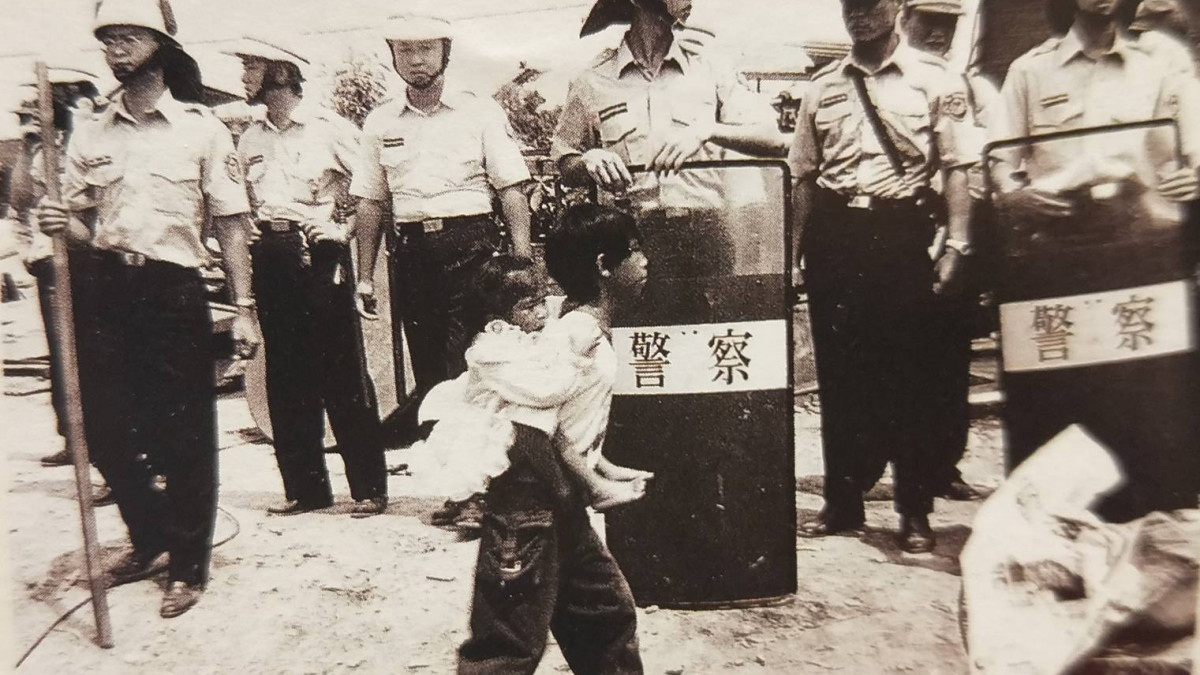
One of the most compelling works presented at the festival is Children in Heaven (1997), also by Mayaw Biho. Although it focuses on a specific ethnic group, the situation it portrays is, sadly, all too familiar in contexts marked by stark economic inequality. For a time, a small Pangcah community was forced to watch, year after year, as the government demolished the shacks they called home, deemed illegal structures. Surrounded by garbage and ruins, the children who grew up amid this Sisyphean cycle of demolition and rebuilding came to transform the recurring tragedy into a kind of game.

In this film, as in all the others in the program, the camera’s perspective is never detached or neutral. Aesthetically and narratively, it knows—and shows—from the very first scenes where it stands. The images are often low-resolution and deliberately anti-spectacular—what Hito Steyerl would call a “poor image.” It is a gaze that, precisely because it comes from within, does not judge—even when, as in Song of the Wanderer (1996) by Yang Ming-hui, it exposes the problems, contradictions, and even the violence that many of these communities face. Instead, it offers both a perspective and a means of expression to those who, until now, have had none.

Film journal, spring 2024 (part two): Mother of Many Children, Clouds of War

note: I took the liberty of writing about a non-Asian documentary today, and it might become the new rule

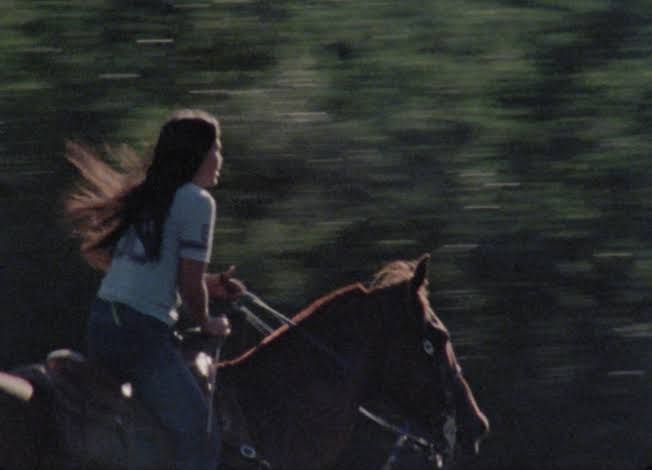
Mother of Many Children (1977) is the first feature-length documentary by Abenaki filmmaker Alanis Obomsawin, one of the towering figures in contemporary non-fiction cinema, and an artist who has been making films about indigenous struggle, representation, and from a Native perspective for almost five decades. Mother of Many Children is not only her first feature-length film, but also one of her best works, in my opinion—I personally think Kanehsatake: 270 Years of Resistance (1993), and Incident at Restigouche (1984) are her two other masterpieces. Insightful, touching, multilayered, and beautifully constructed, it focuses on several Native women of different indigenous people, and from different backgrounds, living in Canada at the time (1977). As Randolph Lewis poignantly notes in his book Alanis Obomsawin The Vision of a Native Filmmaker (University of Nebraska Press, 2006):

Mother of Many Children works on a horizontal plane: rather than diving deep into one or two subjects, it moves around the Canadian landscape every few minutes, pausing to focus on a woman of interest, to take in her story, before moving to another interviewee, often someone quite different. The result of this lateral movement is a feeling that all these women are connected, despite differences in language, tribal affiliation, educational background, and geography.

Mother of Many Children is available on the National Board of Canada’s homepage: https://www.nfb.ca/film/mother_of_many_children/

Mother of Many Children

Clouds of War 戦雲(いくさふむ)(2024) is the latest documentary by journalist and filmmaker Mikami Chie, a director who, in her previous works (The Targeted Village, Boy Soldiers: the Secret War in Okinawa, We Shall Overcome) has been focusing on the current situation in the Ryūkyū archipelago (Okinawa), its complex geopolitical history, and on the resistance of its people against the several American bases operating in the islands.
Clouds of War was shot in the span of eight year, starting in 2015, and documents the construction of military ports and ammunition depots by the Japanese Self-defense Force, and more broadly the general militarisation happening in Okinawa main island, Yonaguni Island, Miyako Island, and Ishigaki Island. These spine-chilling changes affecting the land and its citizens, such as the construction of underground shelters built in Yoneguni, or a plan for the evacuation, to Kyūshū, of all the inhabitants, are done in preparation to the next war on the horizon, the one between China and Taiwan.
If the picture painted by the documentary is as interesting as it is frightening, less inspired is the way the documentary interweaves all the footage together. The style is journalistic, like in the previous works of the director, but there’s here a lack of focus, in my opinion. It’s very informative nonetheless, and there are some very powerful and profound moments.

Clouds of War

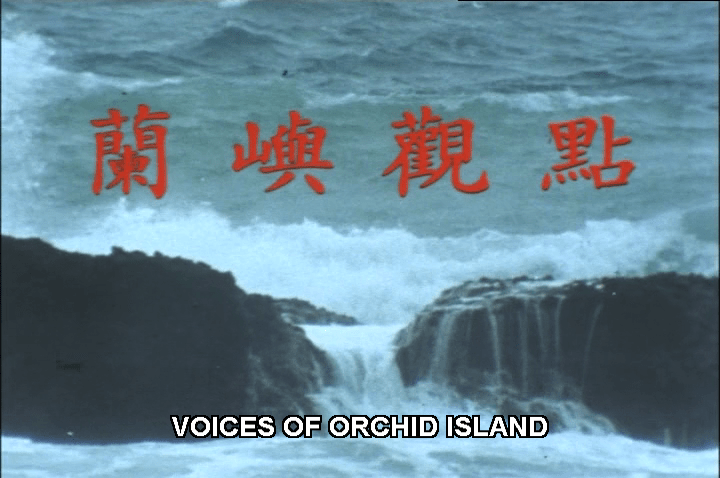
Voices of Orchid Island ( Hu Tai-Li, 1993)

Hu Tai-Li (1950-2022) was one of the prominent ethnographic filmmakers active in Taiwan, a professor, an anthropologist, and also the president, for two decades, of Taiwan International Ethnographic Film Festival. Throughout her career, both as a documentarian and as a visual anthropologist, she tackled issues related to national and native identity, colonialism, and how the culture and traditional practices of the tribes inhabiting the island(s) are surviving in contemporary Taiwan.

At the beginning of the 1990s Hu went to Orchid Island, 45 miles off the southeast coast of Taiwan in the Pacific Ocean and just 20 miles away from the Philippines, to explore how the native people, the Yami, were affected by the influence from outside: tourism, TV people, anthropologists, mass-media…

Voices of Orchid Island opens with a self-reflexive touch, we see director Hu discussing the documentary she is going to make with some of the people who are going to be filmed in a short, casual, but significant exchange of opinions on a beach. There she talks with three people (and a kid) from different ethnic groups, two of them are from the Yami tribe, while the third man is of the Bunun tribe, an ethnic group external to the island, and who, at the time of filming, had been living there for three years, working as a doctor. While two of the people are welcoming the director and her endeavor, the youngest among them (from the Yami tribe) has an interesting response:

I often feel that the more research anthropologists do on this island, the worse the island is harmed. I feel anthropologists come to Orchid Island just so they can advance to a certain social status. They just use Orchid Island as a tool, they don’t benefit the subject of their research.


In the next scene we hear the voice and see a guide on a bus full of tourist from mainland Taiwan, explaining about the Yami people while filming them (the tourists). We (the viewers) are already thrown on the side of the outsiders/tourists, and fed with information and data about the native people. After this “lecture”, it is unsettling to see the group getting off the bus and hoarding throughout the village like it was some sort of tourist spot or a zoo where to admire some sort of rare animals. Hu constructs a cynical mirror of sort where we cannot hide our own reflection, the tourists are “us” viewers, trapped in a cursed routine by which we experience places we’re not familiar with, and objectify people who live differently from us.  It is really compelling how the director is able to hint at the problematics at work in the island just in a couple of minutes of well-edited images. 

“They don’t regard us as human beings” “They called us barbarians in loincloths” complain two of the Yami people interviewed, but we also hear a deeper and more material complaint:

Recently some TV crews came here (…) sometimes we see ourselves on television, and we feel we’re being exploited for profit, we don’t benefit at all, but the people who film us do. They earn all the money, not us.

On the one side we have the villagers’ will not to be exploited or misrepresented, on the other, the bureaucrats and various heads of tourism, usually from mainland Taiwan, who welcome mass tourism as the sole industry in the island. The whole first part of the movie is dedicated to explore these power relations and how the Yami react and interact with Han Chinese while trying to preserve their way of life. Everything however is more complex and layered than it might appear at first sight, it is not a clash between two different and rigid worlds, but more a nuanced blending of the two parts. We discover, for instance, that the Yami are forced (or maybe they’re doing it willingly?) to stage their biggest festival and a very important ritual dance, mainly for attracting tourists, and in doing so keeping the flow of money that guarantees their survival. 

In the second section of the movie, we meet again with the doctor we saw at the beginning, he’s running a clinic in the island and his experiences with patients are as difficult as they are fascinating. The shamanic healing practices they are accustomed to, and the refusal, but also their mediated and occasional acceptance, of a medicine practice alien to them, brought from mainland Taiwan, is an unsolvable dilemma that Hu is able to convey with empathy towards the subjects filmed. This is for me the most accomplished and most powerful part of the entire documentary. 

For instance, if someone didn’t want to live, how was I to change that? He believed his injury was caused by an evil ghost entering his leg and I couldn’t change his mind.

In the last section, the film moves to the resistance of some island’s inhabitants against the big nuclear waste storage facility completed by Taipower at the beginning of the 1980s. The fight and civil resistance is promoted also by a group of Christians,  creolized Christians to be precise, and it intertwines with another big problem affecting the island, that of young people leaving for Taiwan in search of jobs and opportunities.

First they told us they were building a military harbor, then a canning factory. They fooled us and kept us in the dark.

While the resistance against Taipower is a fascinating subject, amplified by the colonialist aspect of the question, an approach that disregard ethnic minorities and exploit their powerlessness, the movie just hints at it and does not explored fully its potential. It definitely would have benefited the documentary to stay a bit longer and delve deeper into the topic, or even better, to make a separate work about the nuclear waste site (it’s very possible that there are already other works out there on the subject that I’m not aware of).

In closing, Voices of Orchid Island is a captivating work, not only because it presents a complex, challenging, and multilayered glimpse at the situation of the place at a specific time in history, but also because it shades light on what it means to approach and confront oneself with “different” cultures, Eduardo Viveiro de Castro would say  different natures, and what this encounter implies for “us” filming/viewing subjects, and for the people being filmed as well.

If you want to know more about the contemporary documentary scene in Taiwan, I’ve written a piece here.


Movie journal (Dec. 2019): Man Who Has a Camera, Many Undulating Things, Nuclear Power Plants Now

Three short takes on some of the most interesting documentaries I’ve seen recently.

The Man Who Has a Camera (Liu Na’ou, 1935)

One the the discoveries of the year for me. Clearly inspired by Dziga Vertov, filmmaker, poet and writer Liu Na’ou shot this movie in four cities across national boundaries: Tainan, Canton, Shenyang, and Tokyo. A beautiful film that is in equal part amateur cinema, a city symphony film, and an experiment in poetic filmmaking, less a work about landscapes of certain areas, and more an actuality film depicting faces and people’ feelings across and beyond borders. Incredibly charming, fresh and well constructed, a feverish dream of transculturality that is much deeper and complex than its simplicity on the surface level might suggest. I’m planning to write a longer piece about the fascinating figure that was Lui Na’ou and this film in the near future.

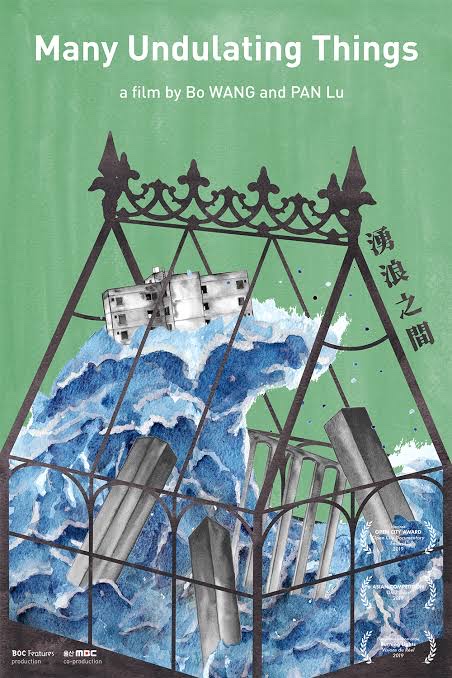
Many Undulating Things (Wang Bo, Lu Pan, 2019)

The film begins and ends in a shopping centre in Hong Kong. We carefully observe the smooth movement of the escalators, the constant flow of people that never stops, the musical fountain that presides over the centre of the internal courtyard, as if this gigantic complex could concentrate the circulation of the entire city, or even, the entire country. From there, it will be more a tale about concrete, enormous port warehouses, glazed galleries built for the 2010 universal exhibition, overpopulated tower blocks, the fragments of still recent colonialism… Through the history of urban changes, we witness the profound social transformation of this territory that is constantly swinging between the East and the West. Hong Kong thus emerges, like an archetypal space of many other cities of globalised capitalism. MANY UNDULATING THINGS offers a complex reflection on the relationships between landscape, nature, urbanisation and society. Thanks to its exhaustive approach, the film questions the function of cities in the development of the capitalist system. A political poem.

I almost despised the first part, the visuals are fascinating, but the narration and the philosophical frame used didn’t really work for me. From the second chapter onward, the work elevates itself and gets definitely more interestingly nuanced and complex, exploring the historical layers that constitute contemporary Hong Kong, analyzed through cinema, photography and paintings. When it moves to the third chapter, the documentary also explores how colonization in the past centuries worked and was deeply linked to the alteration of the botanical realm, “the reorganization of ecosystems under imperial order (…) was actualised through the glass boxes” an important invention and crucial part of the conquering process pushed by imperialism. The glass box would later mutate and evolve into greenhouses, exhibitions, arcades, spectacles and finally into shopping malls. This section, and especially the second chapter of the movie, is an expansion of Miasma, Plants, Export Paintings, a short made in 2018 by Wang Bo, and definitely forms the strongest part of Many Undulating Things, in my opinion. When the movie moves from the historical perspective back to contemporary Hong Kong, moving also from a visual and hybrid approach that uses old movies and photos to convey its meaning, it loses its power, trying to be too many things at once and meandering in too many directions.
That being said and even though Many Undulating Things feels at times too randomly constructed, and a sort of patchwork of three or four short documentaries, it’s still a fascinating piece of work worth revisiting.

Nuclear Power Plants Now いま原子力発電は (Sumiko Haneda, 1976)

This is an obscure and short documentary made for TV by Haneda Sumiko in 1976, shortly before establishing her own company and releasing The Cherry Tree with Gray Blossoms, if I’m not mistaken. Haneda and her troupe visit the Fukushima Daiichi Nuclear Power Plant to explore the state of atomic energy in Japan, and its lights and shadows. The short is mainly composed of interviews, but the most fascinating part is when doubts about safety concerns start to emerge in the talks. While some people from the Tokyo Electric Power Company, the company that owns the plant, compare the possibility of an incident at the power plant to that of a meteor hitting the earth, there’s a professor from Waseda, if I remember correctly, who says that there have not been enough cases to delineate or guess the consequences, or even to calculate the possibility, of a nuclear incident. The style is that of a TV documentary, and there’s a lot of explanation about how nuclear energy is produced, however, the doubts that the film raises, especially knowing what would happen 35 years later, are chillingly prescient and make it an interesting viewing. Even essential if you consider Haneda, like I do, one of the most important female directors in the history of Japanese cinema.

Asian documentaries on streaming platforms, 2: Doc Alliance/DaFilms

This is the second installment of an ongoing series of posts where I highlight some of the documentaries from East and Southeast Asia, offered on the most popular streaming platforms around the globe.

Read part 1, The Criterion Channel

DaFilms/Doc Alliance

Founded in 2008, Doc Alliance is a partnership of seven European documentary film festivals: CPH:DOX, Doclisboa, Docs Against Gravity FF, DOK Leipzig, Marseille Festival of Documentary Film, Jihlava International Documentary Film Festival, and Visions du Réel. The streaming platform is called DAfilms and if you are interested in discovering the broad spectrum of documentaries made in all parts of the globe, this is by far the best streaming service available.
As the name indicates, the platform is dedicated exclusively to non-fiction, here to be understood on its broader sense, and although the service is mainly focused on European cinema, the East and Southeast Asian section is well represented.
The list is long, I’ve divided the movies by country, adding here and there few lines of comment.

West of the Tracks (Wang Bing, 2003) China

One of the most important and influential documentaries of this century, and a mesmerizing masterpiece. Revolutionary.

Double Happiness (Ella Raidel, 2014) China, Austria

Double Happiness (Otsuka Ryuji, 2014) China

P. J. Sniadecki is one of the most interesting directors working between documentary and experimental cinema today. Watch all of his movies if you can, my personal favourites are Demolition, Yumen, People’s Park and The Iron Ministry.

Songhua (P. J. Sniadecki, 2007) China, United States

The Yellow Bank (P. J. Sniadecki, 2010) China, United States

Bailu Dream (Nicolas Boone, 2012) China, France

Demolition (P. J. Sniadecki, 2008) China, United States

Yumen (Xiang Huang, Xu Ruotao, P. J. Sniadecki, 2013) China, United States

People’s Park (Libbie D. Cohn, P. J. Sniadecki, 2012) China, United States

The Iron Ministry (P. J. Sniadecki, 2014) China, United States

Open 24 Hours (Xavi Camprecios, 2004) Spain, China.

A Hundred Patients of Dr Jia (Wang Hongjun, 2014) China

Disorder (Huang Weikai, 2009) China

731: Two Versions of Hell (James T. Hong) China, Taiwan, United States.

Ta’ang (Wang Bing 2016) Hong Kong SAR China, France

Alone (Wang Bing, 2012) France, Hong Kong SAR China
Few years back I wrote a short post on the movie

Silent Visitors (Jeroen Van Der Stock, 2012) Belgium, Japan.

August (Mieko Azuma, 2011) Japan, Germany.

Peace (Soda Kazuhiro, 2010)Japan, South Korea, United States.

Sofa Rockers (Timo Novotny, 2000) Austria, Japan.

Haiku (Naomi Kawase, 2009) Japan.

Most of the works from the Philippines are from the past decade and by Khavn De La Cruz, once called “the most prominent member of Philippine independent cinema”.

The Muzzled Horse of an Engineer in Search of Mechanical Saddles (Khavn De La Cruz,2008) Philippines.

Philippine New Wave: This Is Not a Film Movement (Khavn De La Cruz, 2010) Philippines.

Can and Slippers (Khavn De La Cruz, 2005) Philippines.

Son of God (Khavn De La Cruz, Michael Noer, 2010) Denmark, Philippines.

Squatterpunk (Khavn De La Cruz, 2007) Philippines.

Kamias: Memory of Forgetting (Khavn De La Cruz, 2006) Philippines.

Our Daily Bread (Khavn De La Cruz, 2006) Philippines.

Rugby Boyz (Khavn De La Cruz, 2006) Philippines.

Bahag Kings (Khavn De La Cruz, 2006) Philippines.

Ex Press (Jet Leyco, 2012) Philippines.

State of Play (Steven Dhoedt, 2013) Belgium, South Korea.

Tour of Duty (Dong-ryung Kim Kyoung-tae Park, 2012) South Korea.

img_4261.jpg

I’ve written a in-depth analysis on contemporary Taiwanese documentary a couple of years ago, and Letter #69 is to this day one of the best and more satisfying blend between experimental cinema and political non-fiction, I’ve had the chance to watch in recent years.

Letter #69 (Hsin-I Lin, 2016) Taiwan

In Memory of the Chinatown (Chun-tien Chen, 2015) Taiwan.

Face to Face (Chuan Chung, 2013) Taiwan.

Trace of the future according to Khoa Lê (Khoa Le, 2014) Taiwan.

Temperature at Nights (Yin-Yu Huang, 2103) Taiwan.

Temperature at Nights (Yin-Yu Huang, 2014) Taiwan.

Best documentaries of 2018

2018 has been an intense and fruitful year for documentary, especially on the margins, between works released theatrically, those made available directly on streaming platforms, and those screened almost exclusively at festivals, the offer has become as diversified as ever. As usual on this blog I have tried to direct my attention to some of the most significant works of nonfiction produced in East and Southeast Asia, and in doing so (time is limited I’m afraid) I have neglected many others made in other parts of the world, and living in Japan also didn’t help. For instance I was not able to see Dead Souls by Wang Bing, a movie I’m looking forward to seeing.
If last year my main focus was Taiwan and its dynamic contemporary documentary scene, a research that culminated with this essay I wrote for Cinergie in July, 2018 was more varied. The screening of NDU‘s To the Japs: South Korean A-Bomb Survivors Speak Out (1971) at the Kobe Planet Film Archive, part of my ongoing exploration of the works of the collective, was one of the highlights of the year, unfortunately I didn’t have the time to write about it, but hopefully I will be able to scribble down something next year.
It goes without saying that the list below is a reflection of my taste, interests and viewing habits, and thus it is mainly composed of documentaries made in the Asian continent (but there are few exceptions of course), and works that push the boundaries of what is usually considered nonfiction cinema.

This slideshow requires JavaScript.

Outstanding works

Toward a Common Tenderness (Oda Kaori, 2017)
After Aragane, Oda confirms herself as one of the most original voices in contemporary nonfiction with another excellent work, this time mixing the diaristic and the poetic. Mesmerizing, as usual, the sound design.

Miasma, Plants, Export Paintings (Wang Bo, Pan Lu, 2018)
I discovered the movie a month or so ago, but it was a revelation: history, art, geography and colonialism mixed in an aesthetically challenging piece of work.

A Room with a Coconut View (Tulapop Saenjaroen, 2018)
The most overtly experimental work in this list, not for everyone taste for sure, but I found it refreshingly good.

Inland Sea (Soda Kazuhiro, 2018)
Probably my favorite by Soda, one that resonates more with me and my experience of living in Japan. You can read more here.

Everyday Is Alzheimer’s the Final: Death Becomes Us (Sekiguchi Yuka, 2018)
A really important documentary, not stylistically daring, nonetheless a film that delivers a strong punch in the stomach of the viewer with its matter-of-factness exposure of the disintegration of memory, aging and death.

MATA-The Island’s Gaze (Cheng Li-Ming, 2017)
An elliptical work that focuses its attention on the gaze of Scottish photographer John Thomson, who visited Taiwan in 1871 , and on his relationship with some members of the Siraya tribe – one of the several that inhabited Taiwan before the arrival of the Dutch and the Han. (here more)

The Hymns of Muscovy (Dimitri Venkov, 2017)
“…the sky itself appeared to me like an abyss, something which I had never felt before ー the vertigo above and the vertigo below” Goerge Bataille

Slow Motion, Stop Motion (Kurihara Mie, 2018)
A poetic and witty personal film, documenting the filmmaker’s wanderings and meetings in Laos, Myanmar and Thailand. I’ve written more here.

This slideshow requires JavaScript.

Special (re)discoveries:

What Do You Think About the War Responsibility of Emperor Hirohito (Tsuchiya Yutaka, 1997)
A video experiment and an important time capsule inside a time capsule: the Pacific War and the emperor’s responsibility as perceived by certain strata of the Japanese population during the 1990s.

Jakub (Jana Ševčicová, 1992)
A film of faces, the ancient faces of the Ruthenians people, “painted” in a black and white so dense, grainy and gritty that is almost painful to watch.

Cambodia Lost Rock & Roll (John Pirozzi, 2014)
Incredibly sad, but at the same time incredibly fun to watch and listen to.


This slideshow requires JavaScript.

Best cinematic experience

Heliography
By far the best viewing experience I had in 2018. You can read my excitement here.


This slideshow requires JavaScript.

Honorable mentions:

78/52 (Alexandre O. Philippe, 2017)
A guilty pleasure.

Matangi/ Maya/ M.I.A. (Stephen Loveridge, 2018)
I did not like many things in the movie, but the last 30-40 minutes offer an interesting take on complex topics such as being an artist in the contemporary world, fame, social awareness, and immigration and art.

A Man Who Became Cinema
A documentary about Hara Masato and his struggles to keep making movies, one day I need to write something on Hara, a fascinating and “cinematic” figure.

Image Forum Festival 2018 イメージフォーラムフェスティバル 2018

The 32nd Image Forum Festival ended last Sunday in Tokyo. The nine-day-long event, hosted at two different locations in the Japanese capital, the Theatre Image Forum and the Spiral Hall, screened in total more than 80 films, including 23 in the East Asian Experimental Film Competition, the main section. Established in its present form in 1987, the festival succeeded and replaced an experimental film festival that was held, in various phases and different shapes, in the capital from 1973 to 1986.

To this day the festival continue to embody the mission and the legacy of its predecessors. Primarily dedicated to experimental cinema and video, the event provides a special opportunity for the viewers to experience on a big screen a mix of feature films, home cinema, documentary and experimental animation.
After Tokyo, the festival will move to Kyoto, Yokohama and Nagoya, with slightly different contents, there will be special sections dedicated to artists of each city. This is a right and welcomed decision, since too often Tokyo ends up cannibalizing the cultural and artistic events taking place in the archipelago.

This slideshow requires JavaScript.

This year’s special retrospectives were dedicated to the provocative films of Christoph Schlingensief, German director who expanded his works beyond cinema to touch theater, television and public happenings, Kurt Kren, Austrian artist associated with Viennese Actionism, but also author of structural films, and the experiments on celluloid by Japanese photographer Yamazaki Hiroshi. I wasn’t aware of the films of Schlingensief, and I have to say that it was at the same time a discovery and a delusion. While I really liked 100 Years of Adolf Hitler (1989), claustrophobic and parodic reconstruction of the last hours of the dictator and comrades in his bunker, I couldn’t digest the other two movies of the so called German Trilogy. German Chainsaw Massacre (1990) and especially Terror 2000 (1992) are too much of a mess and stylistically all over the place , and probably too bound to the events of the time, the Fall of the Berlin Wall and the consequent unification of the two Germanies, for me to decipher them.

Unfortunately I wasn’t able to check the works of Yamazaki, but I’m planning to see them at the end of September, when the festival will come to Nagoya. As with his conceptual photos, the shorts made during his entire life explore the relationship between time and light, a topic I’m very attracted to.
I also missed the screening of Caniba (2017) by Lucien Castaing-Taylor and Véréna Paravel, about the “cannibal” Sagawa Issei, if I’m not wrong, this was the Japanese premiere of the film, and the special focus Experimenta India, a collection of visual art from the Asian country.
Interesting was to catch Matangi/Maya/M.I.A. (Steve Loveridge, 2018), about the famous ex-refugee of Tamil origin, now a pop icon and singer, an artist I was completely unaware of. The documentary is based on more than 20 years of footage filmed by herself and her friends in Sr Lanka and London. While I didn’t connect with the first part of the movie, too self-indulgent for my taste, the film gets much better in the last 30-40 minutes when, albeit briefly, touches on complex and fascinating topics such as immigration and art, fame, and social awareness in the show business.

The East Asia Experimental competition was pretty solid, besides several short films coming from a variety of areas like South Korea, China, Hong Kong, Taiwan and naturally Japan, two were the long documentaries screened. A Yangtze Landscape (Xu Xin, 2017), a visual exploration of the social and geographical landscape along the longest river in Asia (you can read my review here), and Slow Motion, Stop Motion (Kurihara Mie, 2018) a movie that positively surprised me and won both the Grand Prize and the Audience Award. A review is coming soon, stay tuned.

Asia is One アジアはひとつ (NDU, 1973) edited

I’m reposting an edited version of my piece on NDU’s Asia is One, an article I wrote two years ago.

NDU (Nihon Documentary Union) was a Japanese collective founded in 1968 by a group of Waseda University students who would eventually drop out to dedicate their lives to filmmaking and political struggle. From 1968 to 1973, when the group disbanded, this group of activists, who saw themselves first and foremost as a collective of activists, made four documentaries, moving from the streets of Tokyo – the first work was Onikko – A Record of the Struggle of Youth Labourers – to the distant islands of Micronesia, passing through Okinawa, the archipelago where they made two of their most important documentaries.

Motoshinkakarannu (1971) was made in and about Okinawa, before the archipelago was ‘returned’ to Japan. The group went to the island in 1971 and captured on film a society in transition. The film shows and focuses on the fringes of society, with illegal prostitution and life in the red districts, while also highlighting the historical and social fractures that have run through the area: anti-establishment and anti-American riots, the Black Panthers’ visit to Okinawa, water pollution and much more. I voted Motoshinkakarannu one of my favourite Japanese documentaries in a poll I organised a year ago, but today I’d like to turn my attention to the second film made by the collective in Okinawa (and beyond): Asia is One アジアはひとつ (1973, 16mm, 96′), a work that I hadn’t seen at the time of the poll and that would have certainly made my list along with Motoshinkakarannu.

Asia is One was screened on June 26th at Kyoto Kambaikan, as part of the AAS in Asia, and it was screen with English subtitles for the first time, the movie was shelved for many many years, forgotten, and was (re)discovered only in 2005 when was screened at the Yamagata International Documentary Film Festival. The screening in Kyoto was followed by a fascinating Q&A with the only surviving member of NDU, Inoue Osamu. Nunokawa Tetsurō, who after the dismantling of the collective made other interesting solo documentaries in Palestine and US, passed away in 2012. As described by Roland Domenig (1), with Asia is One

NDU further explored the margins of Okinawan society and continued to break through borders by focusing on the Taiwanese minority. The film portrays Taiwanese migrant workers on the main island of Okinawa who substitute the Okinawa laborers who in turn are employed as migrant workers on Japan’s main islands. It traces the history of Taiwanese coal miners on Iriomote Island, follows legal and illegal workers to the westernmost island of Yonaguni and finally lands in Taiwan in a village of he Atayal tribe of Taiwanese aborigines, where still the Japanese naval anthem is played every noon.

Formally the documentary is composed of landscapes and interviews, all of them out of sync, possibly due to the equipment used or maybe the lack of it. The uncanny space created by this displacement, but also by the use of music from radio broadcasts and kids voices, thrown here and there during the movie, gives the work a peculiar aesthetic tone, a type of non-fiction cinema that I like to call “chaos cinema”. (2)
To explain and understand the “chaotic” trait of Asia is One, and Motoshinkakarannu as well, we have to delve deeper in the philosophy that laid at the core of NDU’s approach. What the collective has tried to convey through their cinema is extremely fascinating, in their writings (3), mainly published in the magazine Eiga Hihyo, the group was explicitly pushing towards a cinema/activism of anonymity, trying to reach an “impersonal space” and rejecting even the term “work” (sakuhin) because it was seen as the product of a single person in command and as a result of a dominating power structure. In this regard famous was their criticism of Ogawa Production, a collective that bore the name of a single person and that was basically structured hierarchically (4). To this kind of collectivism NDU tried to oppose a more fluid idea of group activism, where the structure was a flat and horizontal one, and in doing so, promoting a cinema made by amateurs (5) and not by professionals. “Everybody can push the button and shoot with a 16mm camera” said Inoue, and this is even more true today since the advent of the digital revolution. Whether this approach was successful or not, and more importantly, whether this horizontal structure and “amateur cinema” is possible at all, are questions without answers that are haunting scholars to this day.
Going back to Asia is One, the part of the movie the resonated more with me was the last one, when the film moves to the Atayal village in Taiwan. There’s a quality in the close-ups of the tribe people, beautiful and ancient faces, that is extremely fascinating, also because it is in these scenes that the political discourse on identity, or the negation of it, reach its peak. From the 17th Century onward The Atayal people, like the rest of the tribes inhabiting the island, were forced to face the colonization of the Dutch first, the Spanish and the Chinese later, and eventually that of the Japanese Empire (1895 – 1945), which called them “barbarians” and tried to assimilate and annihilate their culture (6). That being said, the words spoken by the member of the tribe provide more context and add layers of complexity to the situation. “Japan conquered us and abolished many of our ancient traditions and customs”, but at the same time “we were drafted and went to war with pride and ready to die” and also “luckily the Japanese abolished some of our ancestral traditions like beheading”. Asia is One ends with the militaristic song If I Go to Sea against an everyday scene with the aboriginal Taiwanese people isolated in the mountains singing “We want to go to war again.”

Of course there is oppression and violence, physical and cultural, in every colonization, but things here are deeper than what they seem. In the process of cultural and historical coring that the movie conveys with its images and words, from Okinawa to Taiwan, I believe that two significant elements emerge. The first is the crisis of the identity concept, often a forced cultural and national superstructure imposed by the stronger and more powerful part on a “highly fluid space of human life” (6), as Inoue explained “identity was one of the most hated words inside the NDU, identity is a choking concept”. The second point that struck me is the recurrence of a power and social structure that exploits the margins, the outsiders and the weakest people. In mainland Okinawa the illegal prostitutes and worst jobs are done by people from Miyako island, and in Miyako and other small islands the lower part of society is occupied by Koreans, Taiwanese and aboriginal people. This perpetuating exploitation is possible only as long as a certain part of society is described as different and inferior, and only when and where the concept of border is a monolitic divide used to create the “other”, the “foreigner” and the “stranger”. NDU’s documentaries are an antidote against all this poisonous discourse, and an invitation to break through the borders, those in the world outside us, but also those inside ourselves.
A final note on the title, the movie as a product of a collective that was thriving towards anonymity, has not film credits, nor it had originally a title, Asia is One was attached to it only later, and it’s a kind of a joke because as Inoue himself said “we all know that Asia is not one!”

notes:

1 Faraway, yet so close by Roland Domenig, in The Legendary Filmmaking Collective NDU and Nunokawa Tetsurō ed. Yasui Yoshio, Tanaka Noriko, Kobe Documentary Film Festival Committee, 2012.

2 This might not be the best way to describe the movie, but aesthetically it reminded me, maybe because of the out of sync, of Imamura Shōhei’s documentaries shot in South East Asia during the 70s.

3 Some of the writings are translated in The Legendary Filmmaking Collective NDU and Nunokawa Tetsurō, op. cit.

4 You can find more in Forest of Pressure: Ogawa Shinsuke and Postwar Japanese Documentary, Abé Markus Nornes, Visible Evidence 2007.

5 Some interesting insights on amateurism in cinema can be found in The Flash of Capital: Film and Geopolitics in Japan, Eric Cazdyn, Duke University Press 2002.

6 In 1930 the village was the site of an anti-Japanese uprising, the so called Musha Incident, an event portrayed in Warriors of the Rainbow: Seediq Bale (Wei Te-Sheng, 2011)

7 Nunokawa Tetsurō in YIDFF 2005 Special Program, Borders Within – What it means to live in Japan.

MATA-The island’s Gaze (2017, Cheng Li-Ming)

Taiwan experimental-documentary scene, whatever meaning you want to attach to the term, is one of the most intriguing and vibrant in contemporary cinema, particularly when the themes tackled are going deep into decolonisation, negotiating identity, and the complex history of the island. I’ve written on the subject here, here and here, and a longer and deeper analysis is coming soon.

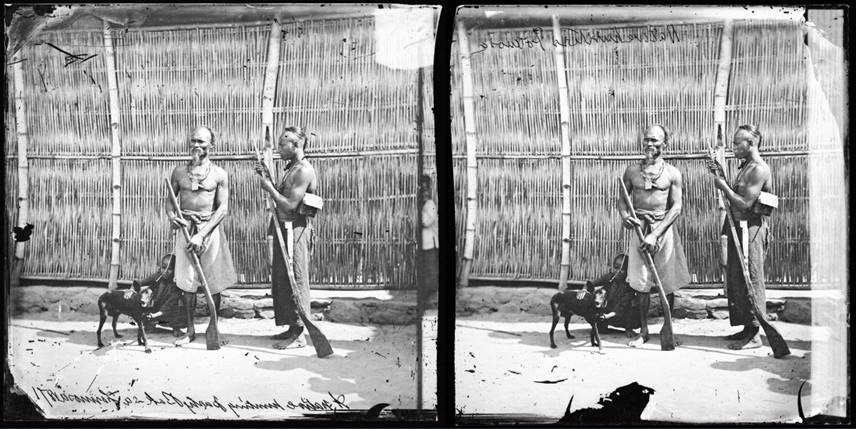
In MATA-The island’s Gaze filmmaker Cheng Li-Ming focuses his attention on the gaze of Scottish photographer John Thomson, who visited Taiwan in 1871, and his relationship with some members of the Siraya tribe – one of the several that inhabited Taiwan before the arrival of the Dutch and the Han— originally settled in the southern part of the island, near Tainan. Here the synopsis:

Scottish photographer John Thomson’s trip to Taiwan in 1871 is an important historical event. In this film we selected a hunter photo to re-interpret that event and visit the Siraya tribe to find an Elder, who talks and sings well, bringing us back to the past through his plucking of strings.

Then we saw the vigorous hunters holding their breath, staying very still in front of that weird machine for a long time, with a boy and a dog squatted at their feet. The director grabbed the view of this moment and invites the audience to watch with curious eyes.

On both sides of the river of time, he repeatedly speculates and watches the past, the future, and the influence of images on this island.

Elliptical in its constructon, the work is centered around the concept of gazing: the mechanical gaze of the camera of the outsider/colonizer on the one hand, and that of the two Siraya people captured in a photo by the Scottish himself, on the other. As the director himself explains “I created a pair of characters out of a photo with a boy and a dog squatted at the corner, through their curious stare at the vigorous tribal hunters and their encounter with the ‘image hunter’, witnessing a duel of old and new world”.

Words of a descendant of the Siraya and his reflections on language and the importance of words in creating a common history and reality are intertwined with an imaginative reconstruction of the encounter between the photographer and the two hunters. Here again the director’s own words:

This film is a sequel to “Looking for Siraya”, and this time starts with a photo of hunters holding shotguns to continue the act of taking back our souls. The stereo camera that John Thomson carried happened to inspire me creating a stereo composition. Through dramatic imitation of John Thomson’s journey as well as recording of Siraya who stays beautifully in primary image in photos yet actually is fading at present, we try to imagine how our Formosa’s “Mata(s)” treat this “mechanical eye” that intruded into the island.

You can watch MATA-The island’s Gaze on Vimeo:

MATA-The island’s Gaze from Li-Ming Cheng on Vimeo.

Documentaries at the London Korean Film Festival 2017

The London Korean Film Festival has opened its 12th edition last Thursday and will run in the capital for two weeks, from November 10th through the 19th the festival will then go on tour around the UK, touching Sheffield, Manchester, Nottingham, Glasgow and Belfast.
In addition to showcasing a wide-range of titles produced in the Asian country, there will also be masterclasses, talks and collateral events, a special occasion for the British audience to get a glimpse of South Korean cinema and film culture in general. This year line-up includes not only UK and European premieres, animations, classics, shorts and indies, but also a fascinating focus on Korean Noir, “Illuminating the Dark Side of Society”, and, of particular interest for this blog, a program dedicated to documentary.

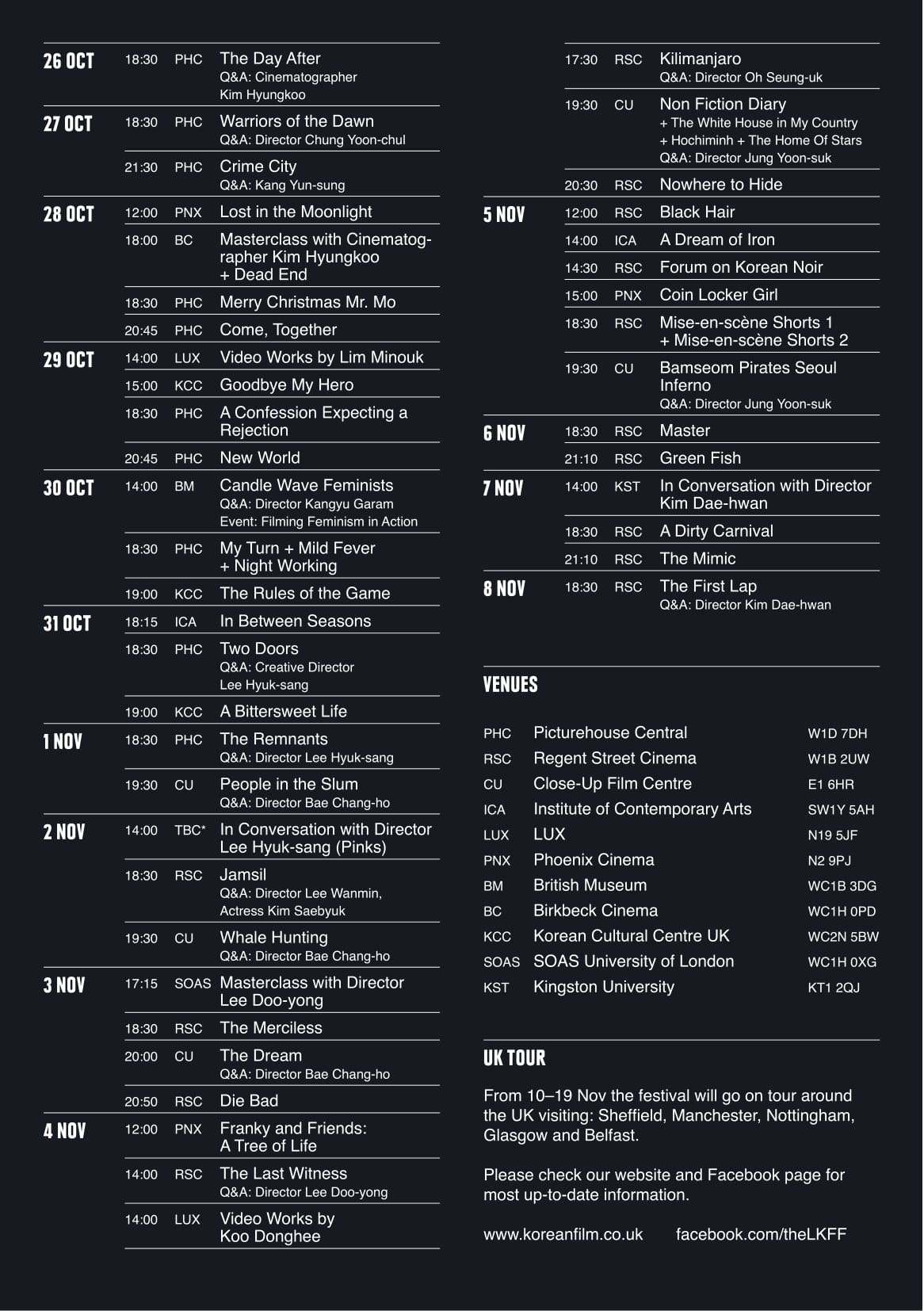
The first movie presented will be Two Doors (2012) directed by Kim Il-rhan and Hong Ji-you, a documentary investigating the the Yongsan Disaster, when in January of 2009 a sit-in rally in central Seoul resulted in the deaths of five protesters and one police officer. While Two Doors focuses more on the legal aspects of the tragedy, amassing documents against the violence used to prohibit the demonstration and the sit-in, The Remnants  (2017) is about the personal tribulations and the legal problems that some the people who took part in the demonstration had to go through in the seven years after the tragedy. The movie was directed by Lee Hyuk-sang, who was also creative director behind Two Doors, and the festival has organised a special conversation with the director on November 2.
Goodbye my Hero (2017) by Han Younghee, a movie addressing labour relations and workers’ rights in contemporary South Korea, and Park Kyung-hyun’s Dream of Iron (2017), a film essay about the development of the steel industry in the country during the 1960s, will complete the section.
The ‘Women’s Voices’ s section includes also a documentary, Candle Wave Feminists (2017) by Kangyu Garam, a movie that delves into the revolution that led to former prime minister Park’s impeachment and her spiritual mentor Choi Soon-Sil’s arrest.

All the documentaries will be screened this week starting from tomorrow, October 31st.

LKFF17-Screening-Schedule-1.jpg