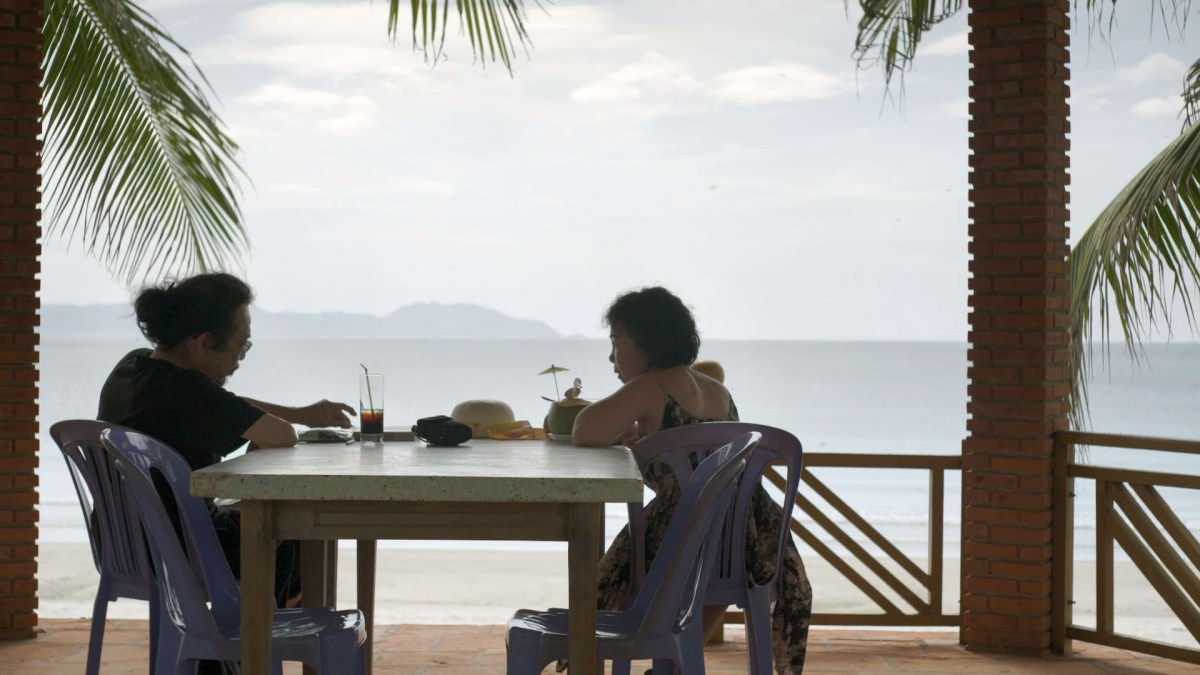
Forgetting Vietnam ( Trinh T. Minh-ha, 2015)

Writing about Trinh T. Minh-ha, one of the most significant filmmakers, cultural theorists and artists active today, was something I meant to do for a long time, and the occasion finally came a couple of weeks ago when I had the chance to watch her newest movie, Forgetting Vietnam (2015).
For everyone interested in documentary also as a way of questioning the ontological status of cinema and the nature of filmic representation, Trinh T. Minh-ha is a familiar name. Born in Vietnam and raised in Hanoi during the Vietnam War, she migrated to the U.S. in 1970, where she now resides and is active as a filmmaker, writer, composer, and professor of rhetoric and of gender and women’s studies at the University of California, Berkeley. Among her most important films are the seminal Reassemblage (1982), Surname Viet Given Name Nam (1989) and The Fourth Dimension (2001).

Forgetting Vietnam was screened at this year Cinéma du Réel in Paris and at various sites throughout U.S., here the movie’s description:

Vietnam in ancient times was named đất nứớc vạn xuân – the land of ten thousand springs. One of the myths surrounding the creation of Vietnam involves a fight between two dragons whose intertwined bodies fell into the South China Sea and formed Vietnam’s curving ‘S’ shaped coastline. Legend also has it that Vietnam’s ancestors were born from the union of a Dragon King, Lạc Long Quân and a fairy, Âu Cơ. Âu Cơ was a mythical bird that swallowed a handful of earthly soil and consequently lost the power to return to the 36th Heaven. Her tears formed Vietnam’s myriad rivers and the country’s recurring floods are the land’s way of remembering her. In her geo-political situation, Vietnam thrives on a fragile equilibrium between land and water management. A life-sustaining power, water is evoked in every aspect of the culture.
Shot in Hi-8 video in 1995 and in HD and SD in 2012, the images unfold spatially as a dialogue between the two elements—land and water—that underlie the formation of the term “country” (đất nứớc). Carrying the histories of both visual technology and Vietnam’s political reality, these images are also meant to feature the encounter between the ancient as related to the solid earth, and the new as related to the liquid changes in a time of rapid globalization. In conversation with these two parts is a third space, that of historical and cultural re-memory – or what local inhabitants, immigrants and veterans remember of yesterday’s stories to comment on today’s events. Through the insights of these witnesses to one of America’s most divisive wars, Vietnam’s specter and her contributions to world history remain both present and all too easy to forget. Touching on a trauma of international scale, Forgetting Vietnam is made in commemoration of the 40th anniversary of the end of the war and of its survivors.

“The image, a singular experience of blindness”

With Forgetting Vietnam Minh-ha revisits her native land forty years after the war, an event that touched her personally, and depicts the Vietnamese landscape and its evolving culture – exploring the daily life of women and the importance of the binary interplay between water and land in Vietnamese history – but at the same time the movie is a deconstruction of the documentary as a direct mode of representation and subtle exposure of the constraining power of the image.
Minh-ha is trying to break, or at least to weaken, the spell of the image and the univocity through which it’s usually perceived and consumed, as she writes “The question is not so much to produce a new image as to provoke, to facilitate, and to solicit a new seeing” (The Digital Film Event, Routledge, 2005). To sparkle a new seeing Minh-ha is placing hurdles and barriers to complicate the simple fruition of images and the easy formation of meanings. Written words, quotes, poetic lines, superimposition, screen wipes, music and montage are used to create a fluid, disorienting and ever-escaping cinematic experience, a work whose speed and continuous progressing don’t allow us to get too much attached to the images and stories we are fed. There’s no time and space for the viewer to reflect or engage on what she or he sees on screen, although the hinted events are of the largest scale such as the infamous Huế Massacre, the “forgetting” in the title is thus not only the oblivion of the tragedies the country and its people had to endure, but also a way of experiencing the movie as an impermanent event, or, as someone has beautifully pointed out “the diaspora of the film is thus not only cultural, but formal, in the sense that we never find any sort of grounding here. We are always on the move, always distanced from the images of Vietnam, never given time to sit with any given frame.”


“The bigger the grain, the better the politics?”*

An important subtext present throughout the movie is the dialectic between Hi-8 video and SD/HD, a dichotomy that sparkled from a purely coincidental and fortuitous event, Minh-ha started filming in the mid 90s, but had to stop for lack of funding and went on shooting again only in 2012, when the digital techonology had already made a huge leap forward. A difference that on the one hand highlights the the particular quality of the image in HD, a quality of tangibility and immediacy making the places and the people in it very present, “real”, while on the other hand the image in super Hi-8 seems to pose a distance with the viewer, a temporal but also aesthetic gap with the “present”, a sense of history and of things past captured on film,”a difference of memory systems” as  written on screen in one scene of the movie. This formal discrepancy is also reflected, amplified and complicated in the polyphony of voices used to tell the big and small stories that compose Vietnam, historical facts are interwoven on the same plane with comments from bus drivers, popular songs and much more with an almost Pynchonean touch.
Forgetting Vietnam is a work conceived by Minh-ha as a maze, a smooth place (in the sense used by Deleuze and Guattari) where the viewer can wander, think and ask herself questions. As stated by the artist in a recent interview “How to open onto infinity within the finite has always been at the core of my work motivation. This then means that there’s also room to wander and err in my films, since they offer more than one entry or one exit, and the viewers who miss one could always catch another entry as they stay on with the work.”

*quote from the film

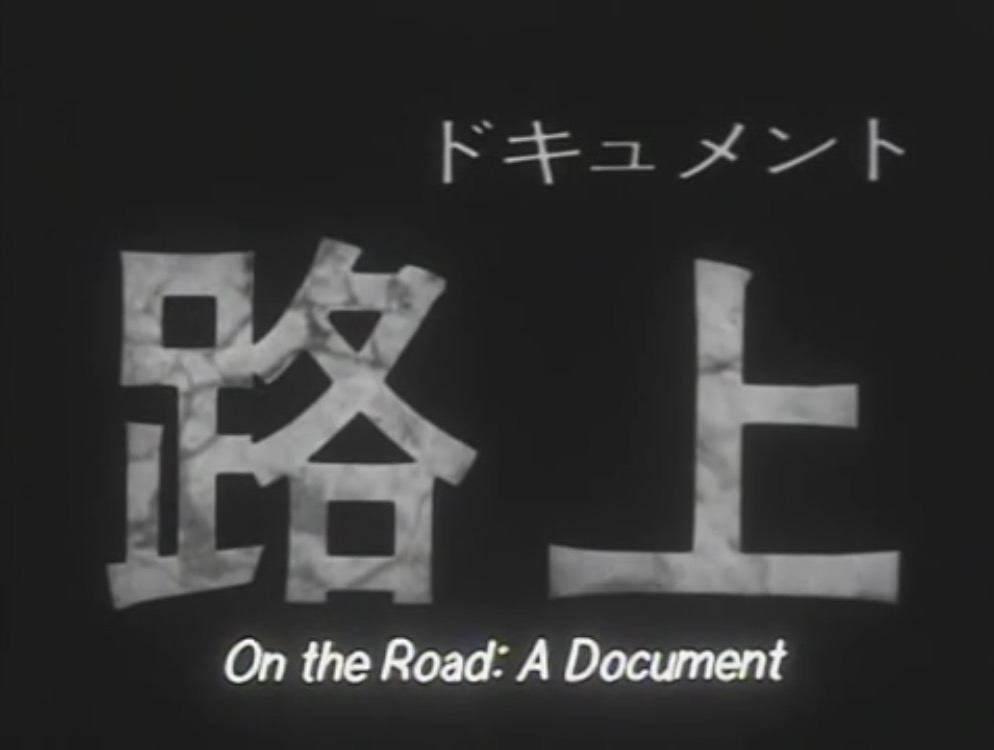
On the Road: A Document ドキュメント 路上(Tsuchimoto Noriaki, 1964)

One of the towering figures in Japanese documentary, Tsuchimoto Noriaki began his career as a documentarist, like many of his generation, at Iwanami Production in 1956. Tsuchimoto was since his university years a very active student, involved in the establishment of Zengakuren, member of the Japanese Communist Party and eventually expelled from Waseda University in 1953 for political activities. Mostly known in Japan and in the rest of the world, and rightly so, for his life-long series on Minamata and the mercury poisoning caused by Chisso Corporation, a total of 15 films in more than 40 years, Tsuchimoto in his long career tackled with his movies many different issues. Another Afghanistan: Kabul Diary 1985 and Traces: the Kabul Museum 1988, two movies set and about Afghanistan in a crucial time for the country, Nuclear Scrapbook (1982) on the danger of Japan’s nuclear policies, and On the Road: A Document, are some of his best non-Minamata works. It’s on this last one that I’d like to focus my attention today.
At the Beginning of the 60s Tokyo, and Japan in general, was in turmoil and experiencing huge changes, on the one hand the country was trying to leave behind and “forget” the tragedies of war, the consequent American occupation and more than 20 years of militarization and nationalism, on the other hand Japan was projecting itself and its people at maximum speed towards the future and a new phase. This “double” movement implied, among other things, starting a series of infrastructure projects that would completely alter the landscape of urban and suburban areas of the country, especially in preparation for the big international showcase of 1964, the Tokyo Olympics: streets, highways, the launch of the Shinkansen (the famous bullet train), and the devil’s pact with atomic energy. All changes that would shape, for better or for worse, the country’s future and made it what it is today.
On the Road was made in this whirl of structural, social and political changes, let’s not forget the huge demonstrations against the ANPO treaty in 1960 and those that would shake the country in the following years, a period of turmoil that is reflected in the film’s production history, as Zakka Films site puts it:

On the Road was originally commissioned as a traffic safety film with the Metropolitan Police as one of the sponsors. But it actually had a double existence: in reality Tsuchimoto was also working with the drivers’ union. When a police official finally saw the film, he dismissed it as “useless—the plaything of a cinephile,” and so it was never used for its original purpose. While winning numerous awards abroad, including at Venice, it was shelved in Japan for nearly 40 years.

The production is also a strong statement of Tsuchimoto’s artistic independence and creativity as a filmmaker, “The film was conceived as an experimental dramatized documentary” and “Tsuchimoto had amateur actors play the principal roles and, because the sound and image were recorder separately, asked drivers to reenact their duties, meeting and conversations”*. For all these reasons On the Road turned into a formally and highly creative documentary and a very different one, in style and concept, from those of the Minamata series that would follow in five years. Alienating music, fast editing and a cacophonic cityscape rendered through a jazz-like rhythm bring to mind the city symphony movies of the beginning of the 20th century, reimagined for and in the 60s. A snap-shot of an era of change for Japanese society framing a mutating urbanscape with a free-style touch that makes it highly watchable and fresh even for today’s viewers.

While it’s important to praise and introduce all the movies of the Minamata series to the broadest audience possible, it’s also vital not to overlook some of Tsuchimoto’s works made outside of his life-long series and by doing so affirming his importance and role in the history of Japanese documentary.

On the Road: A Document is available on DVD (with English subtitles) at Zakka Films, of course!

* from the DVD booklet

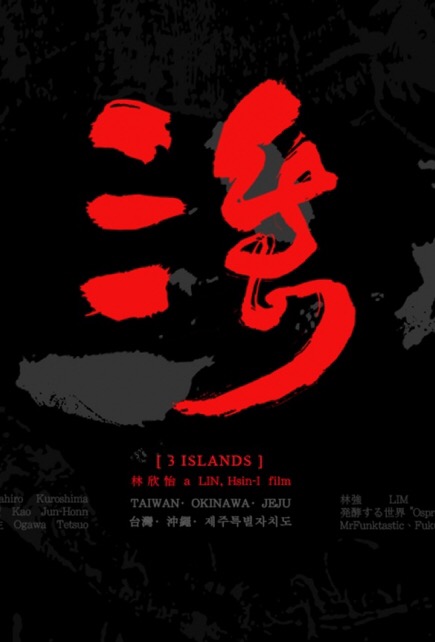
Some thoughts on 3 Islands (Lin Hsin-I, 2015)


I finally had the time to rewatch 3 Islands, an experimental documentary directed in 2015 by Lin Hsin-I, a work I enjoyed on my first viewing a month or so ago, but one that, because of its complexity and all the historical references, I really wanted to watch it again before trying to write down a “proper” review.
The movie is a blending of experimental cinema and non-fiction, a “genre” that has recently become more and more the main field of my interest*, but at the same time an exploration of the historical resonances that tragically bind together three different territories, Okinawa, Taiwan, and the Jeju island in South Korea.
3 Islands is a complex and multilayered work punctuated by literary quotes (Marguerite Duras, Kenzaburō Ōe and T.S. Eliot among others**), archival footage, contemporary art, beautiful digital shots of jungle and ruins, fictional memories and a minimalist and eerie music to wrap up everything.

img_2371

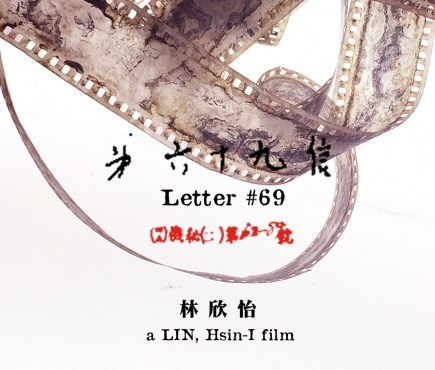
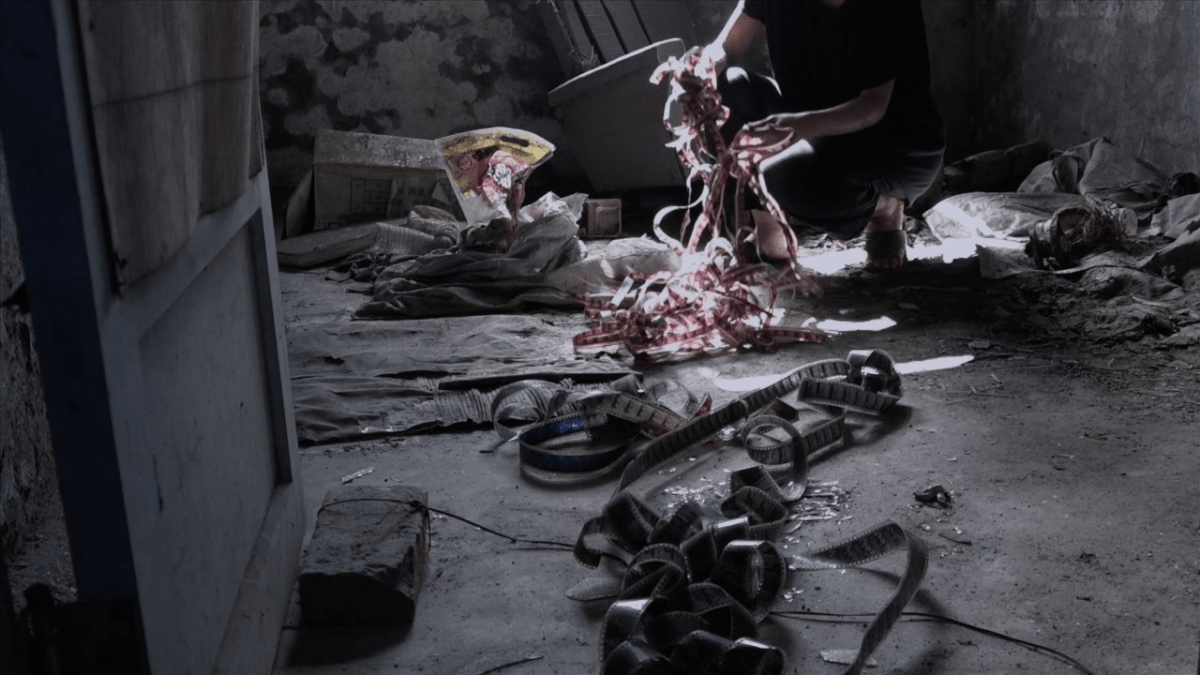
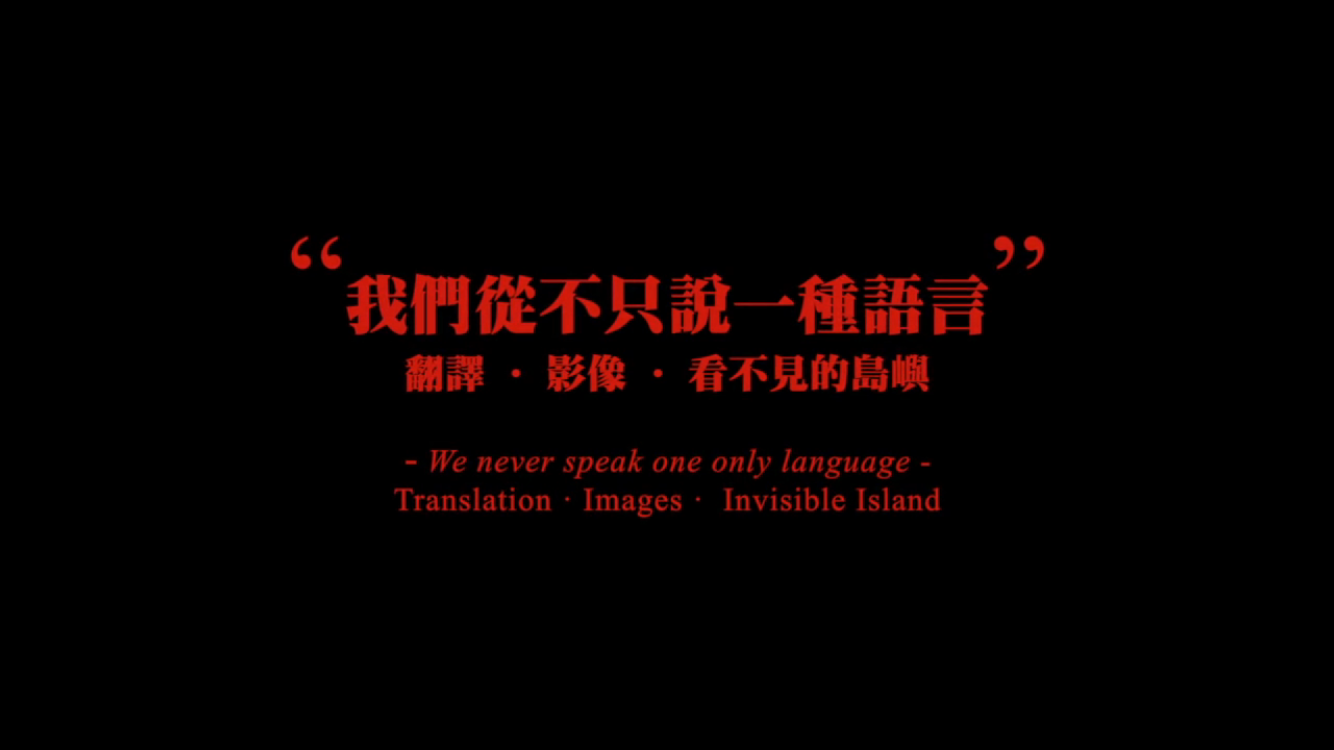
The movie’s very first image is a close up of an old strip of celluloid in what appears to be a destroyed building, later on we’ll discover is probably an abandoned theater in Tainan, Taiwan. The shots of the strip and those of the hands that pull it, are superimposed with quotes from Marguerite Duras and those from a Taiwanese artist, dealing with personal and historical memory, the differences in language(s) and the impossibility to convey a truth of any sort through them. It is thus clear from the very beginning that what interests the director is also, if not mainly, an exploration of the aesthetic limits of non-fiction and those of representation more in general.
In the following scenes, written messages of a young kamikaze who died in the battle of Okinawa are intertwined with images of mural art in Taiwan and connected with footage of kamikaze attacks on American ships. Moments of battles as experienced during II World War by Zhang Zheng Guan, presumably a Taiwanese pilot who fought the Pacific War with the Japanese Imperial Army, are narrated (in Japanese) over a split screen, one side showing the places where the carnage and horrors of war took place as they are today, the other showing the act of filming and photographing the very same spots. The gimmick of the split screen has here its raison d’être because, as written above, the film gives equal importance to the facts, stories and histories narrated in it, but also to the problem of representation itself, without, and this is one of Lin Hsin-I big achievements, becoming just an empty and self-absorbing aesthetic show-off. Archival war images and scenes from the Taiwanese jungle are then linked to those of the protests in Okinawa against the American base in Futenma, and everything is connected by the memories narrated, one of the more dense and horrifying passages of this account is when it describes scenes of mutilated and headless body still moving, and other where men are walking and singing with their hands on the belly holding their own intestines and livers.

img_2355

In the central part of the movie Lin Hsin-I  moves her focus on the island of Jeiju, a very small territory located between Japan and South Korea, also a place of geopolitical importance due to its proximity to Chinese waters. Again we are presented with images from today and photos and archival footage from the colonial past of the area, and more importantly from the Jeju uprising in 1948, a revolt where people were raped, tortured and brutally murdered by the Korean government’s militia. Talking or writing about the massacre was taboo for more than 50 years and was only in 2005 that an official apology from the South Korean president was issued.
As often happen to me when I watch works that are also about Japan, the least interesting parts are those that take place, or are about, the archipelago, not because they’re less compelling or thought-provoking, but more because they usually look like a déjà-vu to me. The same happened with 3 Islands and its final part about Ichimura Misako, a woman who decided to live like a homeless at Yoyoji Park in Tokyo, to whom the director felt deeply connected.
That being said, 3 Islands remains nonetheless one of the best work of non-fiction cinema I’ve had the chance to see this year, a multitude of images and words colliding and clashing together to create a polyphonic narrative.
From the aesthetic point of view, the work feels perhaps more akin to installation art than a movie, but because of this quality it works as a unique intellectual and visual experience: fragmentation, peripherality and the centrifugal complexity of its images, give 3 Islands a very peculiar rhythm and style, allowing the film to be challenging and compelling in every single minute of its duration.

https://youtu.be/iQ6yan9YKOI

3 Islands’ documentary images try to shift from literary writings to the actual fixing of body-scene. Adopting literatures as well as the personal research and practices of artists as scripts, parallel with reversible movements of the flesh, the work recounts the unknown history and the symptomatic interpretations of the 3 islands of East Asia—Taiwan, Okinawa, and Jeju Island.

Notes

* And apparently in Taiwanese documentary as well “The 15 nominees for the Taiwanese Competition at this year’s Taiwan International Documentary Festival (TIDF) signal a reversal from the previous social issue-driven, journalistic documentaries, with many entries crossing over into the domain of contemporary art. More here)

** Not really a quote, but there’s a very brief moment towards the end of the film when the director herself pronounces the words “Ogawa Shinsuke”. An homage to one of her inspirations?

Memories of Agano (阿賀の記憶 Satō Makoto, 2004)

This is an unfinished draft for an essay on Satō Makoto’s Memories of Agano 「阿賀の記憶」, a work in progress, at this stage no more than a series of random thoughts about one of my favorite movies.


last update: 26 September 2017


“…the habit of imposing a meaning to every single sign”

Trinh Minh-Ha


Satō Makoto’s documentaries seem to be (again) part of the filmic discourse in Japan, or at least on the rise in some cinematic circles, and deservedly so. Nine years have passed since his death, this year (2016) a book titled「日常と不在を見つめて ドキュメンタリー映画作家 佐藤真の哲学」(roughly rendered “Gazing at everyday and absence, the philosophy of documentarist Satō Makoto”) was published and a screening of all his documentaries, followed by discussions and talks, was held in Tokyo in March and later at the Kobe Planet Film Archive. I haven’t read the book yet, but the title summarizes and conveys perfectly the themes embodied in Satō’s last works: the dicothomy absence/presence and the presence of absence, that is to say the phantasmatic presence of cinema.

Sato’s final works, Self And Others, Memories of Agano and Out of Place: Memories of Edward Said witness and embody a shift in Satō’s approach, movies through which he was attacking and partly deconstructing the documentary form, to be fair with his works though, it’s a touch that was partly present in his films since the beginning, but in these three documentaries it becomes a very prominent characteristic. This publication seems to be timely and enlightening because is tackling Sato’s oeuvre not necessarily from a purely cinematic point of view, the book’s curator is by her own admission not a cinema expert, but it’s expanding the connections of Satō’s movies and writings towards the philosophical.

I hope the book will kindle and revive a new interest on his works, Satō is in my opinion one of the most important Japanese directors of the last 30 years, and sadly one of the most unknown in the West, I don’t really think there’s much out there in the internet or on paper about Satō, nor in English nor in other non-Japanese languages, and it’s a pity and a missed occasion because his movies, again, are more than “just” documentaries, or even better, are documentaries that have the power to question their own form and stretch in many differents areas. If you’re not familiar with his works, you can get a glimpse of Satō and his touch reading this beautiful and long interview, or you can buy them on DVD thanks to Siglo, it’s a rarity in Japan, but they come with English subtitles.

This year (2017) Yamagata International Documentary Film Festival will also hold a retrospective for the 10th anniversary of Satō’s death, commemorating and celebrating his works, his influence and his reception abroad.

One of Satō’s documentaries that resonates with me more than others, even after many viewings, is Memories of Agano (阿賀の記憶, 2004). As the YIDFF describes it:

Ten years after the acclaimed film Living on the River Agano, the film crew returns to Niigata. Personal memories reflect upon remnants of those who passed away as the camera observes abandoned rice fields and hearths that have lost their masters.

It is a relatively short but complex movie running only 55 minutes, an experiment in the form of a non-fiction film, splendidly shot on 16mm by cameraman Kobayashi Shigeru, the same cameraman who worked and lived together with Satō in Niigata for more than three years during the shooting of Living on the River Agano. The film is a poem on the passing of time and consequently on the objects that will outlive us, the persistence of things in time, including cinema itself. The original idea was in fact to make a film about the remnants of Meiji, that is “the glass photographic plates of the Niigata landscape from the late Meiji to early Taisho era (1910s) left behind by photographer Ishizuka Saburo. Using those old black and white photographs as a motif, we started out making the film with the same concept as Gocho Shigeo in Self and Others”. This quasi-obsession with objects is the thread that waves through the film’s fabric: boiling tea pots, old wooden houses, tools…

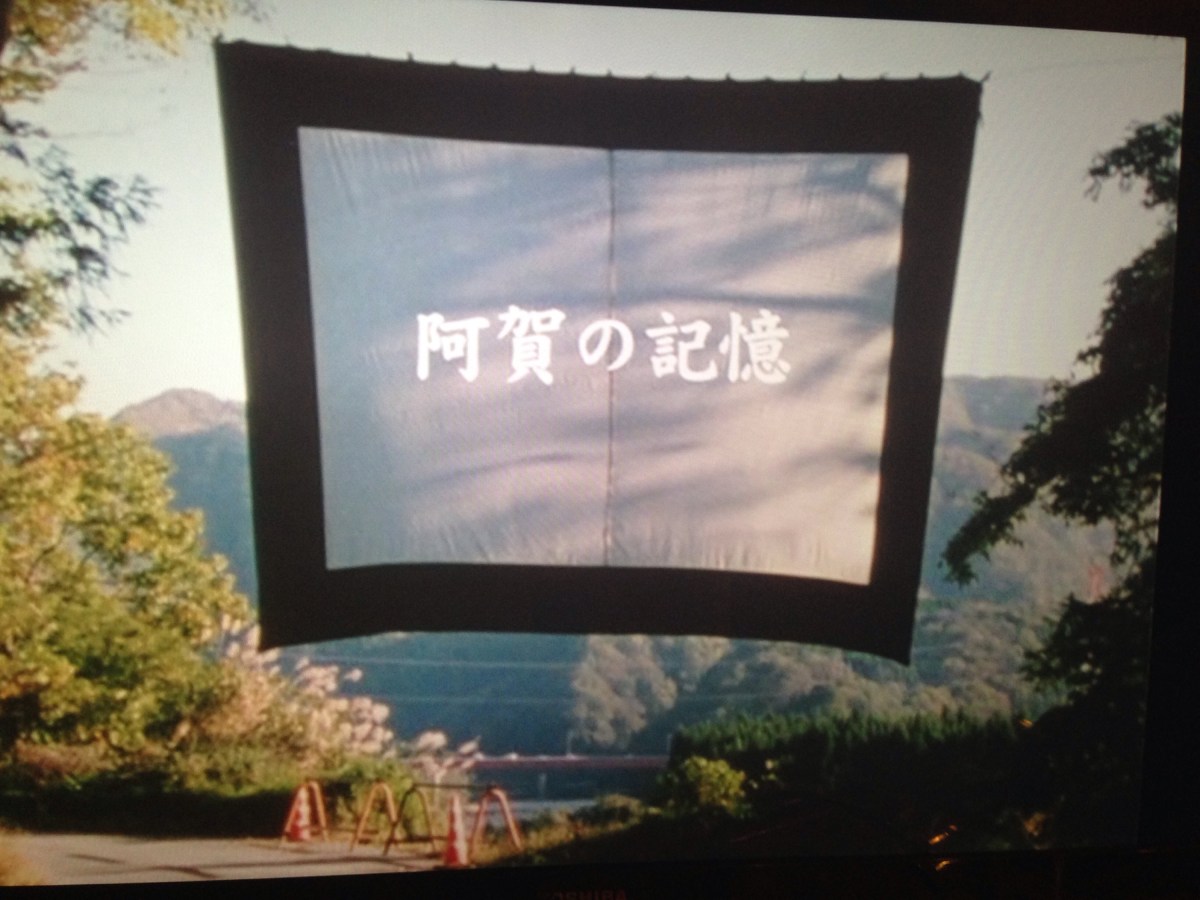
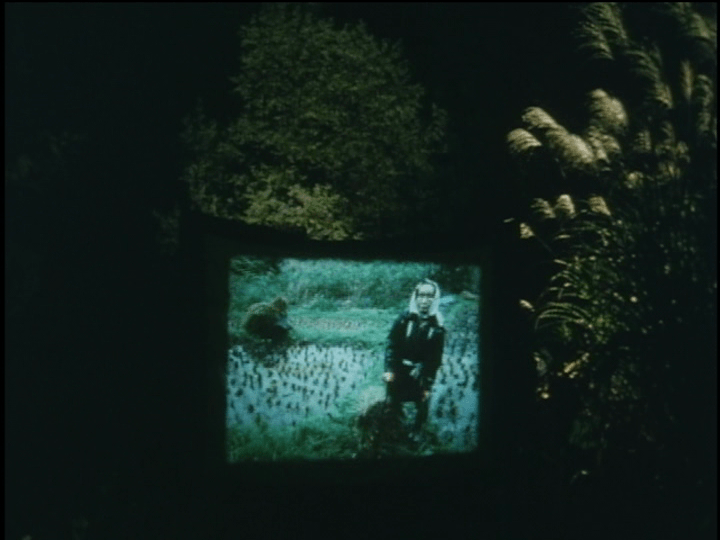
One of the most stunning scene of the movie and one that defines Memories of Agano is placed at the very beginning, when Satō and Kobayashi after returning to the area where the first movie was shot hang a big canvas tarp in the middle of a wood projecting on it the documentary they made 10 years before. The effect is profoundly disturbing and touching at the same time, images and thus memories are suddenly like tangible spectres.

On another level, Memories of Agano with its intertwining of past, present and landscapes ー the external ones with mountains, fields, rivers, and the interior landscapes of old and almost empty houses ー could also be read as an attempt to approach and partly re-elaborate the fūkeiron-cinema, the theory-of-landscape-oriented-cinema, 「footnote: “launched” almost five decades ago with A.K.A. Serial Killer (1969),  The Man Who Left His Will on Film (1970), Red Army/PLFP: Declaration of World War (1971) and The First Emperor (1973)」

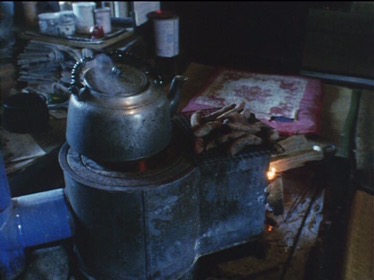
As for its aesthetics, one of the quality that strikes me every time I rewatch it, is the slow pace and the use of long takes that give the movie a dreamlike quality of lethargic torpor. The scene that embodies at most this aesthetic idea is an almost static shot of a teapot boiling on an old stove lasting about 10 minutes, on the background, sort of white noise, the words of an old lady spoken with a thick Niigata accent. She talks sparsly with Satō himself also about the fact she doesn’t wanna be filmed, half jokingly half seriously, a breaking of the fourth wall so to speak, a dialogue between camera and object filmed that was prominently present in Living on River Agano as well (“Are you filming me?” “Don’t shoot me!” are sentences that punctuate the course of this movie and the one made in 1992).

Memories of Agano also present itself as a documentary of opacity rather than one of transparency, the choice of not using the subtitles when people speak with their thick Niigata accent, a Japanese citizen from another area of the archipelago would probably understand 50% or 60% of what is said, a technical option that was used in Living on the River Agano – signals a major change in Satō’s approach to documentary and cinema in general. Feeding the viewer with limpid and clear messages and making a “comprehensible” movie is not what interests Satō here, but rather placing obstacles, visual riddles so to speak – the aforementioned tarp for instance, but also visually striking moments of pure experimentation – and thus presenting the opacity of the cinematic language seems to be the goals he had in mind when he conceived Memories of Agano. The images are thus escaping the organizing discourse tipical of so many Japanese documentaries, in contrast they open to new (cinematic) discoveries and keep resonating with the viewers and engage us on many different levels.

NDU and Asia is One (アジアはひとつ)

NDU (Nihon Documentary Union) was a Japanese collective established in 1968 by a group of Waseda University students, who would eventually drop out, one of the most prestigious universities in Japan. From 1968 to 1973, the year the group dismantled, this group of activists, they considered themselves first of all as a collective of activists,  made four documentaries, moving from the street of Tokyo – the first work was Onikko – A Record of the Struggle of Youth Laborers – to the far away islands in Micronesia passing through Okinawa, the archipelago where they shot two of the their most significant documentaries. Motoshinkakarannu (1971) was made and is about Okinawa before the reversion to Japan, the group went to the island in 1971 and captured on film a society in flux and in the middle of a shifting passage. The film show and focuses on the margins of society with illegal prostitution and life in the red districts, at the same time highlighting the historical and social fractures that were traversing the area: anti-establishment and anti-American riots, the Black Panthers visiting Okinawa, pollution of water and much more. I listed Motoshinkakarannu as one of my favorite Japanese documentaries in the poll I’ve organised a year ago, but today I want to shift my attention on the second movie made by the collective in Okinawa (and beyond): Asia is One (アジアはひとつ),  a work that I hadn’t seen at the time of the poll, and that would have certainly figured in my list paired with Motoshinkakarannu.

Asia is One was screened on June 26th at Kyoto Kambaikan, as part of the AAS in Asia, and it was screen with English subtitles for the first time, the movie was shelved for many many years, forgotten, and was (re)discovered only in 2005 when was screened at the Yamagata International Documentary Film Festival. The screening in Kyoto was followed by a fascinating Q&A with the only surviving member of NDU, Inoue Osamu, Nunokawa Tetsurō, who after the dismantling of the collective made other interesting solo documentaries in Palestine and US, passed away in 2012. As described by Roland Domenig (1), with Asia is One

NDU further explored the margins of Okinawan society and continued to break through borders by focusing on the Taiwanese minority. The film portrays Taiwanese migrant workers on the main island of Okinawa who substitute the Okinawa laborers who in turn are employed as migrant workers on Japan’s main islands. It traces the history of Taiwanese coal miners on Iriomote Island, follows legal and illegal workers to the westernmost island of Yonaguni and finally lands in Taiwan in a village of he Atayal tribe of Taiwanese aborigines, where still the Japanese naval anthem is played every noon.

Formally the documentary is composed of  landscapes and interviews, all of them out of sync, possibly due to the equipment used or maybe the lack of it. The uncanny space created by this displacement, but also by the use of music from radio broadcasts and kids voices, thrown here and there during the movie, gives the work  a peculiar aesthetic tone, a type of non-fiction cinema that I like to call “chaos cinema”. (2)
To explain and understand the “chaotic” trait of Asia is One, and Motoshinkakarannu, we have to delve deeper in the philosophy that laid behind NDU. What the collective has tried to convey through their cinema is extremely fascinating, in their writings (3), mainly published in the magazine Eiga Hihyo, the group was explicitly pushing towards a cinema/activism of anonymity, trying to reach an “impersonal space” and rejecting even the term “work” (sakuhin) because it was seen as the product of a single person in command and as a result of a dominating power structure. In this regard famous was their criticism of Ogawa Production, a collective that bore the name of a single person and that was basically structured hierarchically (4). To this kind of collectivism NDU tried to oppose a more fluid idea of group activism, where the structure was a flat and horizontal one,  and in doing so promoting a cinema made by amateurs (5) and not by professionals. “Everybody can push the button and shoot with a 16mm camera” said Inoue, and this is even more true today since the advent of the digital revolution. Whether this approach was successful or not, and more importantly, whether this horizontal structure and “amateur cinema” is possible at all, are questions without answers that are haunting scholars to this day.
Going back to Asia is One, the part of the movie the resonates more with me is the last one, when the film moves to the Atayal village in Taiwan. There’s a quality in the close-ups of the tribe people, beautiful and ancient faces, that is very fascinating, also because it is in these scenes that the political discourse on identity, or the negation of it, reach its peak. From the 17th Century onward The Atayal people, like the rest of the tribes inhabiting the island,  had to face the colonization of the Dutch, the Spanish, the Chinese and later of the Japanese (1895 – 1945). Calling them “barbarians” the Japanese Empire tried to assimilate and annihilate their culture (6), the words from the tribe people in the movie add layers of complexity to the situation  : “Japan conquered us and abolished many of our ancient traditions and customs”, but at the same time “we were drafted and went to war with pride and ready to die” and “luckily the Japanese abolished some of our ancestral traditions like beheading”.
Asia is One ends with the militaristic song If I Go to Sea against an everyday scene with the aboriginal Taiwanese people isolated in the mountains singing “We want to go to war again.” Of course there is oppression and violence, physical and cultural, in every colonization, but things here are very layered. It seems to me that in this process of cultural and historical coring that the movie conveys, from Okinawa to Taiwan, two very significant points emerge. The first is the crisis of the identity concept, often a forced cultural and national superstructure imposed by the stronger part on a “highly fluid space of human life” (6), as Inoue explained “identity was one of the most hated words inside the NDU, identity is a choking concept”. The second point that struck me is the recurrence of a power and social structure that exploits the margins and the outsiders, in mainland Okinawa the illegal prostitutes and worst jobs are done from people from Miyako island, and in Miyako and other small islands the lower part of society is occupied by Koreans, Taiwanese and aboriginal people.
A final note on the title, the movie as a product of a collective that was thriving towards anonymity, has not film credits, nor it had originally a title, Asia is One was attached to it only later, and it’s a kind of a joke because as Inoue himself said “we all know that Asia is not one!”

notes:

1 Faraway, yet so close by Roland Domenig, in The Legendary Filmmaking Collective NDU and Nunokawa Tetsurō ed. Yasui Yoshio, Tanaka Noriko, Kobe Documentary Film Festival Committee, 2012.

2 This might not be the best way to describe the movie, but aesthetically it reminded me, maybe because of the out of sync, of Imamura Shōhei’s documentaries shot in South East Asia during the 70s.

3 Some of the writings are translated in The Legendary Filmmaking Collective NDU and Nunokawa Tetsurō, op. cit.

4 You can find more in  Forest of Pressure: Ogawa Shinsuke and Postwar Japanese Documentary, Abé Markus Nornes, Visible Evidence 2007.

5 Some interesting insights on amateurism in cinema can be found in The Flash of Capital: Film and Geopolitics in Japan, Eric Cazdyn, Duke University Press 2002.

6 In 1930 the village was the site of an anti-Japanese uprising, the so called Musha Incident, an event portrayed in Warriors of the Rainbow: Seediq Bale (Wei Te-Sheng, 2011)

7 Nunokawa Tetsurō in YIDFF 2005 Special Program, Borders Within – What it means to live in Japan.

Land of the Dawn 「夜明けの国」(Tokieda Toshie, 1967)

The Chinese Cultural Revolution began 50 years ago, and newspapers, websites, magazines, blogs and books have recently taken the opportunity of this anniversary to write about, discuss and analyse the huge and still controversial historical event that shaped the Asian country and whose ripples were felt all over the world.
In 1966, a group of filmmakers from Japan were allowed to enter the country, or rather, they were lucky enough, almost by chance, to be in China just after the revolution was proclaimed (in August 1966) to film and record, almost without knowing what was happening, the changes brought about by the event. This was something of a “miracle”, as there were no formal diplomatic relations between the two countries at the time. The documentary is by no means a critical view of the revolution, as it was still in its infancy, and also because there were areas the group was not allowed to film, but it works as a visual and unique document of the early period of the revolution. The group spent seven months filming landscapes, factories, cities, farms and people across China, and the resulting documentary was compiled the following year under the title Land of the Dawn 夜明けの国.

The film was directed by Tokieda Toshie, a filmmaker who worked for and was associated with Iwanami Production for over 30 years. Among her extensive filmography, at least worth mentioning is Town Politics-Mothers Who Study 町の政治 – 勉強するおかあさん」 (1957), a depiction of a group of mothers-turned-activists in the town of Kunitachi, Tokyo (the short documentary is part of the films featured in this edition box set).

There’s an interesting interview with Tokieda on the Yamagata International Documentary Film Festival website, in which she recalls her experiences of filming in China. The film is also discussed in a chapter of Nakajima Takahirō’s The Chinese Turn in Philosophy (2007):

「The film」opens with a scene showing young Red Guards arriving from throughout China and gathering in Tian’an men Square. In the following scene a train appears with a plate indicating “Wansui Maozhuxi [long live Chairman Mao];” it is an express train traveling from Beijing to Shanhai Guan. The narrator of the film tells us that the young people clustering around Shanhai Guan station are tourists going to see the Great Wall. However, Tsuchiya Masaaki suggests that
these young people teeming around the station are not tourists, but are going to Tian’an men Square to see Mao Zedong.
It must be easy to reach such an understanding if we could comprehend the meaning of August 1966, or at least if we could grasp the meaning of the opening scene of the young Red Guards gathering in Tian’an men Square. However, the film presents the opening scene like a picnic or a school excursion, when they take souvenir photos and write their names in Mao notebooks and exchange them. It is “daily life” in the New China, which is regarded as being similar to daily life in Japan where people enjoy having fun. Following this line, the second scene at Shanghai Guan station is to be understood as showing tourists going to the Great Wall. Likewise, if we go to the third scene, it shows people bathing in the Songhua River in Ha’erbin City. In short, “Country of the Dawn” is edited to make the unusual event of the Cultural Revolution become normal and understandable to a Japanese audience.

This is just an excerpt from a chapter in which the author analyses the documentary in relation to Soseki Natsume’s Travels in Manchuria and Korea (here if you want to read more).
A final note on the availability of the film. In 2008 the movie was released on DVD, together with a book about the Cultural Revolution, it’s in Japanese without English subtitles, but if you’re interested you can buy it here.