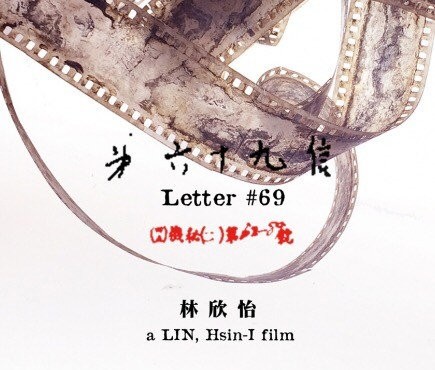
I’ve written at length, here and elsewhere, about 3 Islands, an experimental documentary by Taiwanese filmmaker and artist Lin Hsin-i. Recently I had the chance to watch another of the artist and filmmaker’s works, Letter #69. The short film (19′) was screened at this year Visions du Réel and in 2016 at the Women Make Waves Film Festival, where it received the Excellence Award.
Here is the synopsis from Visions du Réel:
In the White Terror period in Taiwan, Shui-Huan SHI was imprisoned for hiding her brother, and was soon executed later. In the prison, she wrote 69 letters for her family. Simulating the life in the prison, this film silently criticizes the history. The “photographic film image” in the video, Letter #69, is an old photographic film from an abandoned old Taiwanese theater. After cleaning the film, Shi Shui-Huan’s letters were printed on it to construct a stop motion. The reproduction of old film serves as a response to the esoteric, dark history of Shi Shui-Huan and her brother Shi Zhi-Cheng in their last escape where they hid in the ceiling. It is also a response to the historical violence of Taiwan that cannot be cleared and is difficult to look back at.
In 1954, Shi Sui Huan was imprisoned for hiding her brother, who was resisting the regime of Chiang Kai-shek. During the period spent in prison (she will eventually be executed), she wrote a series of letters to her family. The last one, the letter number 69, was left blank.
The blankness of the last letter is the canvas where Lin starts her investigation into the White Terror, a period of purges when political dissidents, who were protesting or resisting against the Kuomintang-led Republic of China government, were persecuted, incarcerated and killed. While the period started in 1947 and ended in 1987 when the martial law was officially lifted, I think the director is referring here to a more specific time and place, the first years of the White Terror and a corner of the Liuzhangli Cemetery in Taipei where Shi Sui Huan and other 201 people are buried.
Most of them were leftist thinkers or activists but also, like Shi Sui herself, people who just protected their relatives. The graves were forgotten and basically untouched in fear of repercussions till the end of the martial law, when slowly the country started to breath again, a “rebirth” that is well reflected in cinema (Taiwanese new wave, Hou Hsiao-hsien, Edward Yang, Tsai Ming-liang, etc.)
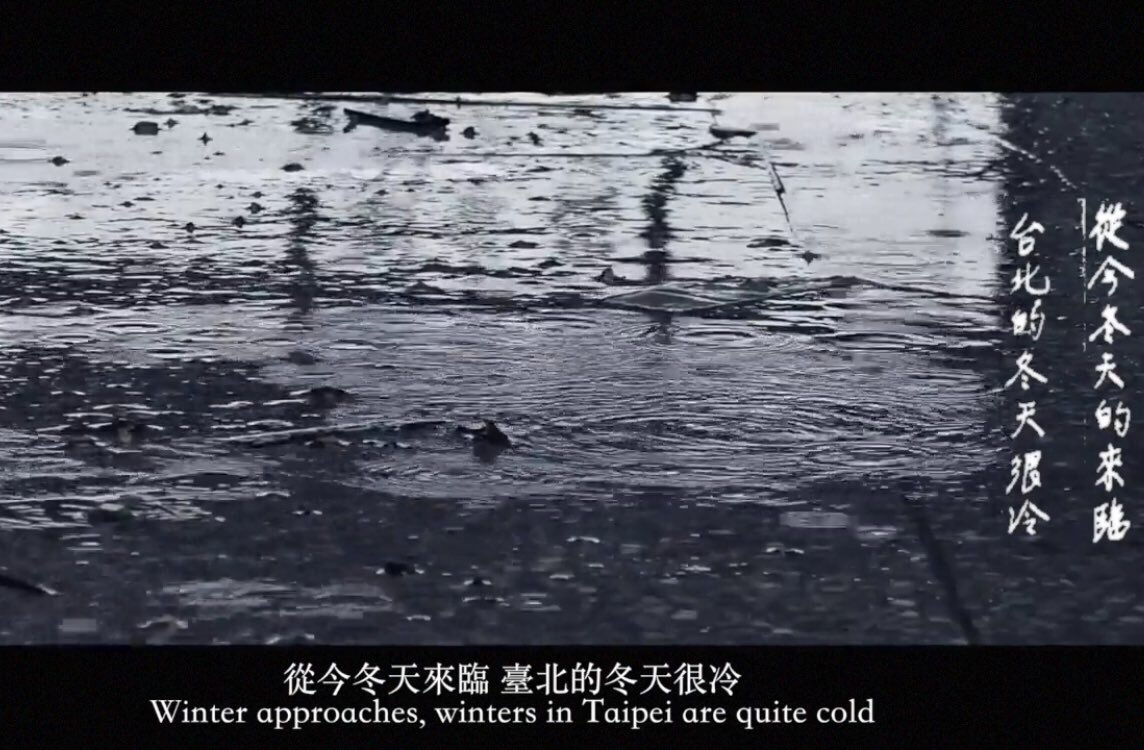
The absence of written words in the last letter embodies the impossibility of directly connecting with the tragic period and its remnants, yet the blankness also represents the white noise resulting from the accumulation of all the spectral memories that in one way or another, while denied for so many years, are still alive and present.
Sowing together all these fragments of scattered memories in an heterogeneous piece of cinematic patchwork, Lin Hsin-i’s work is an attempt to discover and create images and sounds of and for a lost and tragic period. The letters of Shi Sui Huan are juxtaposed with the narration in the present (done by family members of the victims), and images of ruins are overlapped with performative actions that recreate some of the gestures that the prisoner might have done.
Not only Letter #69 brings to the surface a forgotten past and guides its gaze towards a crucial point in Taiwanese history, but the filmmaking style that made 3 Islands so powerful and fascinating is here in full display again. Aesthetically Letter #69 is a fragmented and kaleidoscopic work that blends the beauty and clearness of the digital image with the grain and the roughness of overused celluloid film—an old strip of film where the director printed the woman’s letters—, sound manipulation and voice distortion with reenactment, and read and written passages from letters with the constant sound of a running film projector in the background.


3 thoughts on “Letter #69 (Lin Hsin-i, 2016) ”