
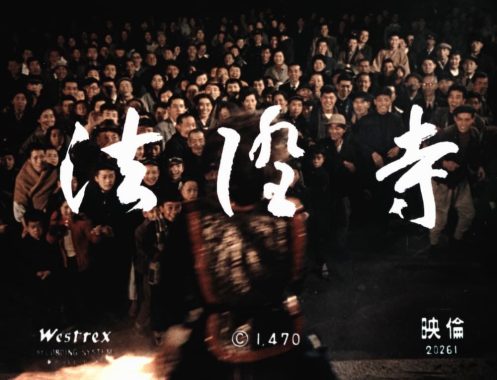
Last February in Osaka, I had the chance to attend some screenings of the special program Cinematographer Segawa Jun’ichi: Tracing Japanese Documentary Cinema through His Works. One of the films I had not seen before, and the one that left the deepest impression on me, was Hōryū-ji (also tautologically known as Hōryū-ji Temple), a 23-minute short directed by Hani Susumu in 1958, and probably one of the peaks of the period the filmmaker spent at Iwanami Productions — alongside, at least from the perspective of documentary history, Children in the Classroom (1954) and Children Who Draw (1956).
The temple, located in Nara, is said to house some of the oldest surviving wooden structures in the world, dating back to the Asuka period (538–710), and remains one of the most celebrated and visited sacred sites in Japan. The complex became a UNESCO World Heritage Site in 1993, and it is worth noting that many of the statues depicted by Hani and Segawa were not normally accessible to the general public. In this sense, the documentary also offered a rare opportunity to see these magnificent sculptures in all their beauty — and in colour (an Agfa negative was used).
Hōryū-ji, screened in Osaka in a vibrant — and, I believe, restored — 35mm colour print, is a transitional work in Hani’s career and occupies a significant place within it, being one of the last films he made for Iwanami Productions. As scholar Marcos Centeno-Martin has pointed out, “the film keeps great consistency with Hani’s method developed in his earlier works, including shooting on location, non-professional actors, rejection of scriptwriting, and adaptation to the changing circumstances of the environment; for example, Hani and his cameraman Segawa Jun’ichi took advantage of changes in natural light to capture different tints on the coloured wood as well as the reddish walls.”
At the same time, Hōryū-ji announces and foreshadows the next phase of Hani’s filmmaking path — a career that, especially during the following decade, would profoundly influence the evolution of Japanese cinema through milestones such as Bad Boys (1961), She and He (1963), the influential Nanami: The Inferno of First Love (1969), and one of my personal favourites, Mio (1971).
Although commissioned by the National Committee for Protection of Cultural Properties, the film is almost expressionistic and experimental in style, representing a further step in the evolution of avant-garde documentary in Japan. While the film could recall — both stylistically and thematically — Les Statues meurent aussi (1953) by Chris Marker and Alain Resnais, or even Matsumoto Toshio’s seminal The Song of Stone (1963) in its engagement with inanimate objects vivified through experimental music, at the time Hani was developing an alternative path to Matsumoto Toshio’s theory of avant-garde documentary. Instead of a cinema grounded primarily in the filmmaker’s subjectivity, “Hani’s interest shifted from the filmmaker’s inner world to the inner world as it manifested in the external world. In other words, Hani reflected on the possibilities of capturing subjectivities unfamiliar to the author. According to him, this could be achieved by working with subjects on whom one’s biases could not be imposed: children, animals, or even the figures found in the Hōryū-ji Temple.” (Centeno-Martin and Fortes-Guerrero 2026).
Hōryū-ji fully embodies this search for new subjectivities in the outside world. It is constructed through human faces, masks, and near-abstract shots of sculptures and architectural details, woven together through editing, lighting, and music. Screaming statues are paired with almost dodecaphonic sounds — Hani would later rework portions of the soundtrack, composed by Yashiro Akio, in Nanami: The Inferno of First Love — while more austere and hieratic figures are accompanied by solemn chants. Glimpses of the Buddhist paradise unfold alongside lighter musical passages, and the ripples of a pond carved in bas-relief are matched with delicate guitar arpeggios.
The result is a truly magnificent work, both visually and conceptually.





You must be logged in to post a comment.