Indigenous with a Capital ‘I’: Indigenous Documentaries from 1994 to 2000 – TIDF 2021

This is a translation and a partial rewriting of a piece I wrote for Alias (Saturday supplement of the Italian newspaper Il Manifesto) in 2021.

In 2003, Māori director and theorist Barry Barclay proposed the idea of a “Fourth Cinema.” Building on and expanding the concept of “Third Cinema” as theorized by Fernando Solanas and Octavio Getino in the late 1960s, Fourth Cinema designates a practice centered on the Indigenous gaze and Indigenous viewers. Rooted in Barclay’s background in documentary, the concept was initially conceived as an audiovisual practice in non-fiction—works created by Indigenous authors, within Indigenous communities, and for Indigenous audiences.

Paying homage to Barclay’s reflections, the twelfth edition of the Taiwan International Documentary Festival devoted a section of its official program to works by Indigenous filmmakers from the island, produced in the final years of the twentieth century (1994-2000). This was a period when long-standing questions of indigenous identity, resistance, and decolonisation converged with—and were amplified by—the revolutionary arrival of small, portable digital video cameras.

This technological shift, coupled with a transformed socio-political landscape, opened new avenues of self-expression for ethnic groups who, until then, had been confined to the roles of mere actors or spectators in their own representation.
It is worth noting that this followed the profound transformations of the last two decades of the 20th century—a period of seismic historical change for Taiwan, beginning with the lifting of martial law in 1987 and the subsequent democratisation of the country. On a cinematic level, this era also witnessed the rise of the Taiwanese New Wave and, on a smaller scale, the emergence of a grassroots documentary movement exemplified by the Green Team.

The history of Taiwan is one of centuries-long colonial domination. Its arts, customs, traditions, land, language, and landscape all bear traces of the successive layers of a history that, accumulating over time, have shaped the island as we know it today. The various Indigenous peoples who inhabited Taiwan for millennia first faced invasions by the Dutch and the Spanish, followed by the arrival of Han Chinese settlers from the mainland, and later domination under the Qing dynasty and the Japanese Empire.

Today, the island officially recognizes sixteen Indigenous groups, each with its own language and distinct culture. In most cases, these communities—despite enduring countless challenges—continue to strive to keep their rituals, languages, and traditions alive and meaningful, upholding alternative ways of life in resistance to the cultural homogenization brought by modernity.

By the late 1990s, the advent of digital cinema and the spread of small, affordable video cameras—“a theology of liberation,” to borrow a striking expression from Filipino director Lav Diaz—offered Taiwan’s Indigenous groups the possibility, finally and for the first time, of becoming active agents in their own visual representation, adding their voices to the island’s rich mediascape.

C’roh Is Our Name

Indigenous with a Capital ‘I’: Indigenous Documentaries from 1994 to 2000 brings together seventeen works—each between thirty and fifty minutes in length—made by Indigenous filmmakers, focusing on the lives, struggles, and resilience of their communities in contemporary Taiwan.
In New Paradise (1999) by Laway Talay, members of the Pangcah ethnic group leave their ancestral lands to seek work in other parts of the island, only to encounter exploitation and a profound sense of non-belonging—perhaps the most recurrent theme running through the works featured in this special program. This feeling of displacement is often subtle, but at times it emerges openly and even defiantly, as in C’roh Is Our Name (1997) by Mayaw Biho, a short documentary that follows a regatta annually organized by Taiwan’s Han population—the ethnic majority of Chinese origin that constitutes most of the island’s inhabitants. For the first time in the competition’s history, a group of Pangcah—who had traditionally lent their nautical skills to other teams—chose instead to form a team composed entirely of their own members.

For members of these communities, holding a camera also means gaining the ability to recount and preserve ancestral traditions and forms of knowledge that might otherwise vanish with the passing of time. This is the case in several works devoted to capturing the memories of elders—such as former tribal chiefs or weavers—who embody the living memory of their people.

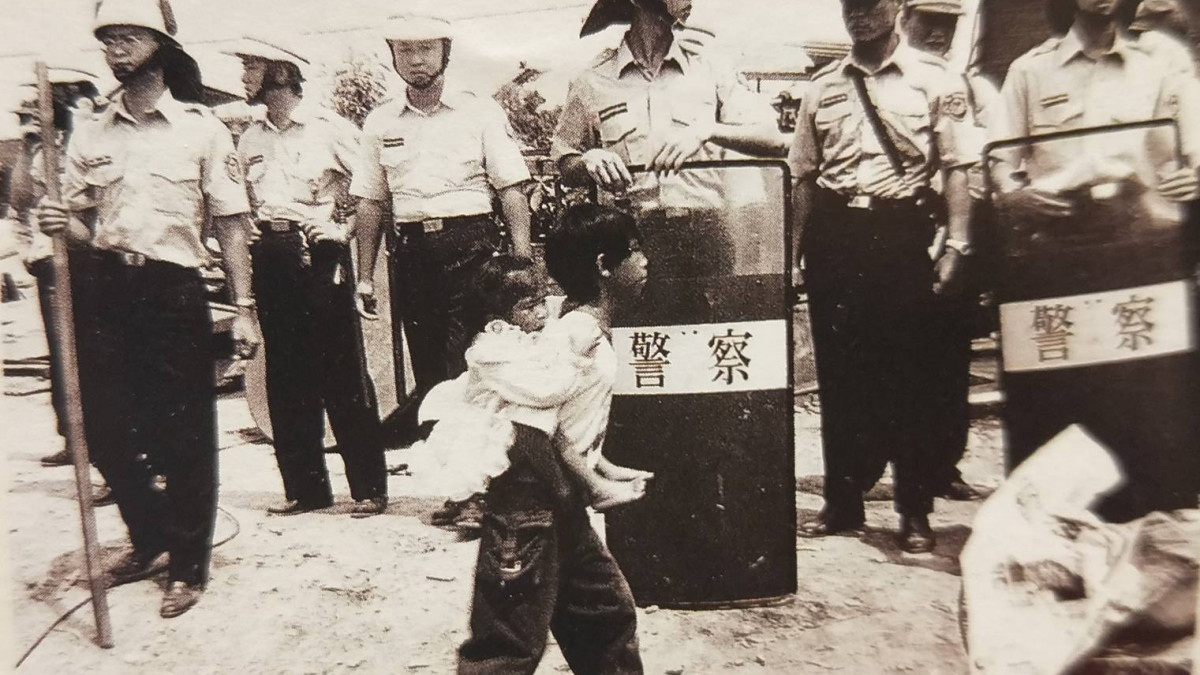
One of the most compelling works presented at the festival is Children in Heaven (1997), also by Mayaw Biho. Although it focuses on a specific ethnic group, the situation it portrays is, sadly, all too familiar in contexts marked by stark economic inequality. For a time, a small Pangcah community was forced to watch, year after year, as the government demolished the shacks they called home, deemed illegal structures. Surrounded by garbage and ruins, the children who grew up amid this Sisyphean cycle of demolition and rebuilding came to transform the recurring tragedy into a kind of game.

In this film, as in all the others in the program, the camera’s perspective is never detached or neutral. Aesthetically and narratively, it knows—and shows—from the very first scenes where it stands. The images are often low-resolution and deliberately anti-spectacular—what Hito Steyerl would call a “poor image.” It is a gaze that, precisely because it comes from within, does not judge—even when, as in Song of the Wanderer (1996) by Yang Ming-hui, it exposes the problems, contradictions, and even the violence that many of these communities face. Instead, it offers both a perspective and a means of expression to those who, until now, have had none.

Yamagata International Documentary Film Festival 2025 – preview

It’s that time of year again: autumn arrives, bringing with it a cascade of film festivals around the globe. Just to name a few of the major ones in Asia, we have Busan and Tokyo, along with the Image Forum Festival, the biggest event dedicated to experimental cinema in Japan. December will also see the debut of the newly established Aichi Nagoya International Animation Film Festival in Nagoya. But I digress.

One of the oldest and most prestigious festivals in Japan is without doubt the Yamagata International Documentary Film Festival, an event I’ve been attending for more than a decade now (and about which I’ve written various reports and reflections on this very website).

I plan to attend this year’s edition (October 9–16) as well, though life is unpredictable and you never know what might happen in the “real” world. Below are some of the screenings and programs that have caught my eye and that I’m especially looking forward to.

Being a biennial festival, YIDFF is not the place to see world premieres, but rather a chance to catch up with significant films already screened elsewhere or to discover under-the-radar documentaries, often from the Asian continent. This year’s International Competition will showcase Park by So Yo-Hen, which won the Grand Prize at the Taiwan International Documentary Festival last year, and With Hasan in Gaza by Kamal Aljafari, presented at Locarno a couple of months ago. Aljafari will also present his more experimental A Fidai Film in the program Palestine – Memory of the Land, a work I am eager to revisit on the big screen, this time with more information and conext to help decipher it.

Returning to the competition lineup, Letters to My Dead Parents by Ignacio Agüero weaves together personal stories with the history of the labor movement in Chile, while I Was, I Am, and I Will Be! by Itakura Yoshiyuki promises an exploration of Kamagasaki, a town of day laborers, at a moment when the city was preparing for Expo 2025.

New Asian Currents has usually been the section where I’ve made the most discoveries over my years of attending Yamagata. While many of these came from last-minute decisions or suggestions by friends and fellow critics on site, this time there are a couple of titles I’m especially eager to check out. Collective Dreams Stitched into December by Bappadittya Sarkar—a patchwork of interconnected stories set in the Indian city of Jaipur—promises to satiate my appetite for more documentaries from this vast country. Meanwhile, The Tales of the Tale by Song Cheng-ying and Hu Chin-ya captures the stories and dreams of an old mining town of Houtong in Taiwan.

In Perspective Japan, The Yoshida-ryo Dormitory by Fujikawa Keizō documents the ongoing battle to keep the country’s oldest student dormitory open—a struggle deeply intertwined with the social fabric of the city and the political activism of Japan at large (you can read more here). In the same section, Spring, On the Shores of Aga by Komori Haruka carries a special resonance for me, as it is connected to Satō Makoto, his cinematic legacy and the Agano area.

Every edition of the festival offers audiences a major retrospective, and this year it is Unscripted: The Art of Direct Cinema—32 works spanning five decades of a documentary mode that revolutionized the way non-fiction films are conceived, produced, and filmed. Although I have already seen most of these documentaries – but not all!- this is a perfect opportunity to revisit some “classics” and to gain deeper insights through the accompanying discussions.

Among the peripheral screenings and events, one that stands out is Feb 11, 1990 Rough Cut Screening: The Other Version—four and a half hours of material documenting the very first YIDFF in 1989, footage not included in Iizuka Toshio’s A Movie Capital (1991).
For those, like me, fascinated by Sanrizuka, the resistance against the construction of Narita Airport, and the legacy of Ogawa Pro, the special presentation Sanrizuka: Disappearing Landscapes – The Heta Project Screening is not to be missed. Another highlight is the invitation of Voices of the Silenced, this year’s closing film—a reflection on counter-archives and the suppression of minorities in Japan (particularly the Korean minority) by Park Soo-nam and Park Maeui. The documentary screened in Berlin two years ago, but YIDFF lists it as 2025, so I wonder whether the film has been reworked.

All of these films, however, feel like just planets orbiting around the central sun: Palestinian cinema, and Palestine itself—the true core of this year’s festival, even if the number of works is not overwhelming. At least, that is how I perceive it. Palestine, its culture, and the struggle of its people have always held a special place at YIDFF. This year, while the dedicated program Palestine—Memory of the Land features only eight films, additional Palestinian works will appear across other sections, and I expect that conversations at nearly every venue will inevitably turn toward the ongoing genocide of the Palestinian people.

As it is the case for the Direct Cinema section, I’ve already seen most of the films in the Palestinian program, but here more than ever I’m eager for the post-screening discussions, and for the chance to share on the big screen—together with other viewers—some true masterpieces of political cinema.

The documentary I’d like to highlight in these closing lines is Fertile Memory (1980) by Michel Khleifi. When I first encountered it, the film was a revelation. It reflects a culture and a society oppressed and dispossessed by the Israeli state from the outside, while at the same time telling the story of two women struggling to navigate the shifts and tensions within Palestinian society itself.

What is equally striking is how the film unfolds as a meditation on landscapes: the geographical terrain, where human history and geological time are layered, and the human landscape of faces—faces that reveal emotions, hopes, regrets, and anger. In this sense, the breathtaking images of the Palestinian land, with its warm colors and sinuous contours, both contrast with and converse with the more intimate shots of the two women moving and working inside their homes. Particularly moving are the images of food and its preparation, as well as those moments when one of the protagonists is framed between a door left ajar and the jamb. We should keep the door open and continue to talk and discuss about Palestine, its people and memories.

See the full line-up here

See you in Yamagata!


Personal documentary, diary films, first-person cinema and “Self documentary” in Japan

Originally published in 2018, edited with some minor changes on September 2022, in remembrance of Suzuki Shiroyasu (1935-2022)

Cinephiles and film buffs on the internet, and specifically those active on social media, are often times obsessed by lists. Although I’m not a big fan of them when used to rank movies, it is nonetheless unquestionable that lists are one of the best tools, when properly used that is, to discover new movies and explore novel cinematic landscapes.

In the past month I’ve asked on Twitter to list some of the most significant or favourite personal documentaries/diary films made in Japan. Some friends were kind enough to reply and share some titles, some of which I wasn’t aware of.

With this feedback in mind, I started to collect my thoughts and compile a list of what I consider the most important personal documentaries made in Japan since the advent of cinema. I’ve also included some titles I have not seen yet, don’t kill me for this, but I’ve trusted what has been written and discussed by people I trust and respect.

Before starting to explore what the list has to offer, let me clarify what we mean when we talk about “personal documentary”. Keeping in mind that the definition is always vague, in flux and susceptible to change, and so is the term documentary, I think we can approach a sort of truthfulness by stating that personal documentaries are works often made, but not always, in the first person and about the life of the director/cameraman. For these reasons often they are also called, or more precisely they overlap with, diary films and first-person cinema.

In Japan the term often used to define this kind of works is “Self Documentary” セルフ ドキュメンタリー. Illuminating in this respect is this piece written by Nada Hisashi for the Yamagata International Documentary Film Festival in 2005. Also available on the YIDFF site, an interview with Matsumoto Toshio conducted by Aaron Gerow, in it the theoretician and director criticized some trends in the Japanese self documentary scene of the 1990s, a take that, for what is worth, I agree with:

there are problems with an “I” which doesn’t doubt its “self” and the so-called “I-films” (watakushi eiga) share those: they never put their “I” in question. Since they don’t attempt to relativize themselves through a relationship with the external world, they gradually become self-complete–a pre-established harmony.

With this in mind, let’s start:

Extreme Private Eros: Love Song 1974 (Hara Kazuo, 1974)

My favourite film by Hara Kazuo, at the moment, maybe together with Minamata Mandala, one of the cinematic highlights of the second part of his career. The movie is one of the first and finest examples of diary cinema and personal documentary in Japan, and contrary to what many films made in the following decades did, Extreme Private Eros is a sublime embodiment of the famous artistic motto of the 1960s and 1970s “the personal is political”.

Impressions of a Sunset (Suzuki Shiroyasu, 1975)

If Extreme Private Eros is where the Japanese personal documentary started, Impression of a Sunset is where the diary film à la Mekas emerged in the Japanese archipelago. Mostly unknown outside Japan, it’s in every way a diary composed by images where Suzuki, after buying a CineKodak 16 (a pre-war 16mm camera) at a second hand camera shop, starts filming his wife, his newborn baby and his workplace. With Impressions of a Sunset and other works such as 15 Days (1980), Suzuki is more a poet with a camera than a documentarian in the sense we give the term today.

Embracing (1992) and Katatsumori (1994)

Probably the most known personal documentarian from Japan, Kawase started her career with short home movies about the search for her father, who abandoned her as a child, in Embracing, and about the strong bond with her grandmother, who became de facto her adopted mother, in Katatsumori.

Memories of Agano (Satō Makoto, 2004)

I’ve written extensively about the movie and its hybrid and experimental qualities, clearly it’s much more than a personal documentary, but director Satō and his cameraman returning to the locations and the people filmed more than 10 years before in Niigata, make it a movie perfect for this list.

Dear Pyongyang (2006) and Sona, the Other Myself (2009) by Yang Yong-hi

A documentary by zainichi Korean director Yang Yong-hi about her own family. It was shot in Osaka (Yang’s hometown) and Pyongyang, North Korea. In the 1970s, Yang’s father, an ardent communist and leader of the pro-North movement in Japan, sent his three sons from Japan to North Korea under a repatriation campaign sponsored by ethnic activist organisation and de facto North Korean embassy Chongryon; as the only daughter, Yang herself remained in Japan. However, as the economic situation in the North deteriorated, the brothers became increasingly dependent for survival on the care packages sent by their parents. The film shows Yang’s visits to her brothers in Pyongyang, as well as conversations with her father about his ideological faith and his regrets over breaking up his family. In Sona, the Other Myself the director continues the exploration of her family, Sona is the daughter of her brother who moved to North Korea from Japan in the early 1970s. Narrating her story, the film shows the struggles of a generation that migrated from Japan to North Korea, and the life of their offspring, who were born and raised in North Korea. (from Letterboxd).

Ending Note: Death of a Japanese Salesman (Sunada Mami, 2011)

Recently retired from a company after some 40 years of service, Sunada Tomoaki, father of filmmaker Sunada Mami, is diagnosed with terminal cancer and only has a few months left to live. True to his pragmatic core, Sunada sets out to accomplish a list of tasks before his final departure: playing with his grandchildren, planning his own funeral, saying “I love you” to his wife, among others. (from Letterboxd)

Everyday is Alzheimer’s (2012), Everyday Is Alzheimer’s 2 – The Filmmaker Goes to Britain (2014) Everyday Is Alzheimer’s the Final: Death Becomes Us (2018) by Sekiguchi Yūka

Director Sekiguchi Yūka documents and depicts the daily life of her dementia-diagnosed mother and how this changed her family’s life.

Yongwanggung : Memories from Across the Water ( Kim Im-man, 2016)

Statement from the director: “Yongwangung was a Gutdang (shaman’s shrine) where first generation Korean women who crossed the seas from Jeju to Japan use to go before the Second World War. In 2009, I heard that the shrine was about to be demolished by the Osaka city government. My childhood memory of my mother praying in the kitchen came back when I was filming elderly women in Jeju. I felt the urge to have a shamanistic ritual for my mother who had been hospitalized.”

Home Sweet Home (Ise Shinichi, 2017)

This was one of the movies I was more eager to see last year, but unfortunately I couldn’t catch it. The film covers 35 years in the life of filmmaker Ise Shinichi’s family, documenting his disabled niece Nao since 1983.

Special mentions

Toward a Common Tenderness (Oda Kaori, 2017)

It’s one of my favourite viewings of the year, but it has just come out and I need to rewatch it, that’s why it’s not included in the list. The balance between the personal and the poetic is what makes it special.

Magino Village – A Tale (Ogawa Shinsuke, 1986)

As the mysterious object of Japanese documentary per excellence, Magino Village goes of course far beyond the realm of personal films, but somehow this sprawling movie is, among other things, the result and the partial documentation of more than a decade spent in Yamagata by the Ogawa collective.

Yamagata International Documentary Film Festival 2017

The Yamagata International Documentary Film Festival, one of the most awaited film-related events of the Japanese archipelago, will kick off its fifteenth edition next week on October 5th. For eight days the city of Yamagata will be the capital of documentary cinema, hosting not only an international competition with movies from all over the globe, but also a plethora of  more or less known documentaries presented in other sections, special screenings and retrospectives. For the cinephiles and the film lovers visiting the northern Japanese city, the festival will be an occasion to discover hidden gems of historical importance and an unmissable chance to meet directors, scholars and documentary-obsessed people.
Festival opens on the 5th with a special screening commemorating the passing of Matsumoto Toshio, one of the true giants of Japanese cinema. Two of his best known documentaries, Nishijin (1961) and Ginrin / Bicycle in Dreams (1955) will be presented for the occasion in their original format (35mm), while For My Crushed Right Eye (1968) will be screened as it was originally conceived, that is in 16mm and with 3 projectors. Funeral Parade of Roses (1969) and other experimental works made by Matsumoto during the 1970s and 1980s will also be shown during the festival, including one of my favourite, Atman (1975), a kaleidoscopic trip to the philosophical source of movement and image.
Among the titles presented in the International Competition a must-see for me is Ex Libris—The New York Public Library, the latest work by Frederick Wiseman, but I’m also looking forward to I Am Not Your Negro by Raoul Peck and the long-awaited new work by Hara Kazuo, Sennan Asbestos Disaster, the first feature documentary the director of The Emperor’s Naked Army Marches On made in more than a decade. The movie follows the victims who suffered asbestos-related damages in the city of Sennan in Osaka, during their eight years fight for compensation.
Also in competition the beautiful Machines by Rahul Jain (I wrote about it here), Donkeyote, a subtle reflection on dreams and hopes through the eyes of a donkey and its ageing owner, directed by Chico Pereira, and Another Year by Zhu Shengze, a movie that has received much praise in the international festival circuit. Wake (Subic) by John Gianvito, about the pollution afflicting the residents of a former US naval base in Luzon Island, the Philippines, looks interesting and so does Tremoring of Hope, the difficult recovery of the people of Hadenya in Miyagi, six years after the Great East Japan Earthquake.
Here the complete line-up.
A promising section that will probably sparkle heated post-screening debates is Politics and Film: Palestine and Lebanon 70s–80s, a selection of films made in Palestine and Lebanon during the Lebanon civil war (1975-1990) and in recent years, movies that show and reflect on the struggles and politics of the area. Among them the (in)famous Red Army / PFLP: Declaration of World War, filmed by Wakamatsu Koji and Adachi Masao in 1971, and Genet in Shatila (1999), about the French writer and his relation with the Palestinian revolution as he witnessed the aftermath of the Shatila’s massacre in September of 1982.

Introducing Asian documentary filmmakers, New Asian Currents is usually one of my favorite section for its scope and the variety of films shown, this year 21 works from the continent will be presented, giving us a glimpse of the life, difficulties and struggles the people inhabiting the huge and diversified area have to cope with in their daily life. A Yangtze Landscape by Xu Xin is an interesting movie (more here) that deserves to be seen on the big screen, exploring the geographical and social landscape surrounding the Yangtze River in its long course of more than thousands kilometers. While the works of Yamashiro Chikako are a rare example, rare in Japan at least, of how to tackle a series of thorny historical issues, Okinawa and its relation with mainland Japan and with its past, merging documentary with the experimental.
Here the section’s complete line-up.
I’m ashamed to admit, but I know almost nothing of African documentary. Africa Views will thus be my entrance gate to it, “a program that introduces over 20 films created since the year 2000—with a particular focus on the Sub-Saharan region—depicting a contemporary Africa that lets off a considerable racket as it creaks toward progress, and introducing us to the people who live there.” What caught my attention in Perspective Japan are the new films by Murakami Kenji and Onishi Kenji, two short experiments in 8mm whose screening promises to be, like two years ago, a real cinema-event.
The Festival will also hold a retrospective on Fredi M. Murer, a Swiss director that the program describes as “a leader of the internationally-acclaimed Swiss Nouveau Cinema movement that was active from the late 1960s through the 1980s, together with Daniel Schmid and Alain Tanner. (…) Depending on the period in which they were made, Murer’s works may be classified variously as experimental film, documentary, or narrative film.” The retrospective that interest me the most though is Ten Trips Around the Sun: Sato Makoto’s Documentary Horizon Today, a tribute to Sato Makoto on the 10th anniversary of his death, that will include screenings of his major works accompanied by discussions and panels.

North Korean missiles permitting, I’ll be in Yamagata from October 6 to 11, and, as I did two years ago, I will try to keep a diary of my viewings experiences, here or more likely on my Twitter account.

P.S. I’ve also created a list on Letterboxd with most of the movies that will be in Yamagata.

This slideshow requires JavaScript.

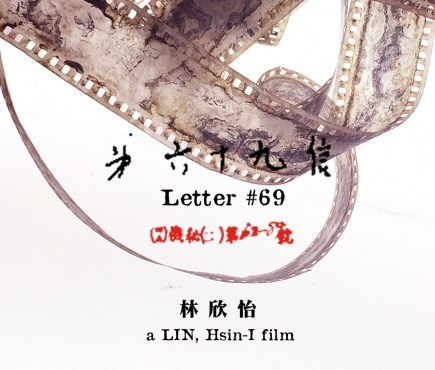
Letter #69 (Lin Hsin-i, 2016) 

I’ve written at length, here and elsewhere, about 3 Islands, an experimental documentary by Taiwanese female filmmaker and artist Lin Hsin-i, one of my favorite nonfiction movies of last year. Yesterday I had the chance to watch another of her works, Letter #69, a short film (19 min) that was screened at this year Visions du Réel and in 2016 at the Women Make Waves Film Festival where it received the Excellence Award.

Here is the synopsis from Visions du Réel:

In the White Terror period in Taiwan, Shui-Huan SHI was imprisoned for hiding her brother, and was soon executed later. In the prison, she wrote 69 letters for her family. Simulating the life in the prison, this film silently criticizes the history. The “photographic film image” in the video, Letter #69, is an old photographic film from an abandoned old Taiwanese theater. After cleaning the film, Shi Shui-Huan’s letters were printed on it to construct a stop motion. The reproduction of old film serves as a response to the esoteric, dark history of Shi Shui-Huan and her brother Shi Zhi-Cheng in their last escape where they hid in the ceiling. It is also a response to the historical violence of Taiwan that cannot be cleared and is difficult to look back at.

In 1954 Shi Sui Huan was imprisoned for hiding her brother who was resisting the regime of Chiang Kai-shek. During the period spent in prison, she will eventually be executed, she wrote letters to her family and her last one, the letter number 69, was left blank.
The blankness of the last letter is the canvas from which the director starts her investigation into the so called White Terror, a period of purges when political dissidents who were protesting or resisting against the Kuomintang-led Republic of China government, were persecuted, incarcerated and killed. While the period started in 1947 and ended in 1987 when the martial law was officially lifted, I think the director is referring here to a more specific time and place, the first years of the White Terror and a corner of the Liuzhangli Cemetery in Taipei where Shi Sui Huan and other 201 people are buried. Most of them were leftist thinkers or activists but also, like Shi Sui herself, people who just protected their relatives. The graves were forgotten and basically untouched in fear of repercussions till the end of the martial law, when slowly the country started to breath again, a “rebirth” that is well reflected in cinema (the so called Taiwanese new wave of Hou Hsiao-hsien,  Edward Yang, Tsai Ming-liang, etc.)

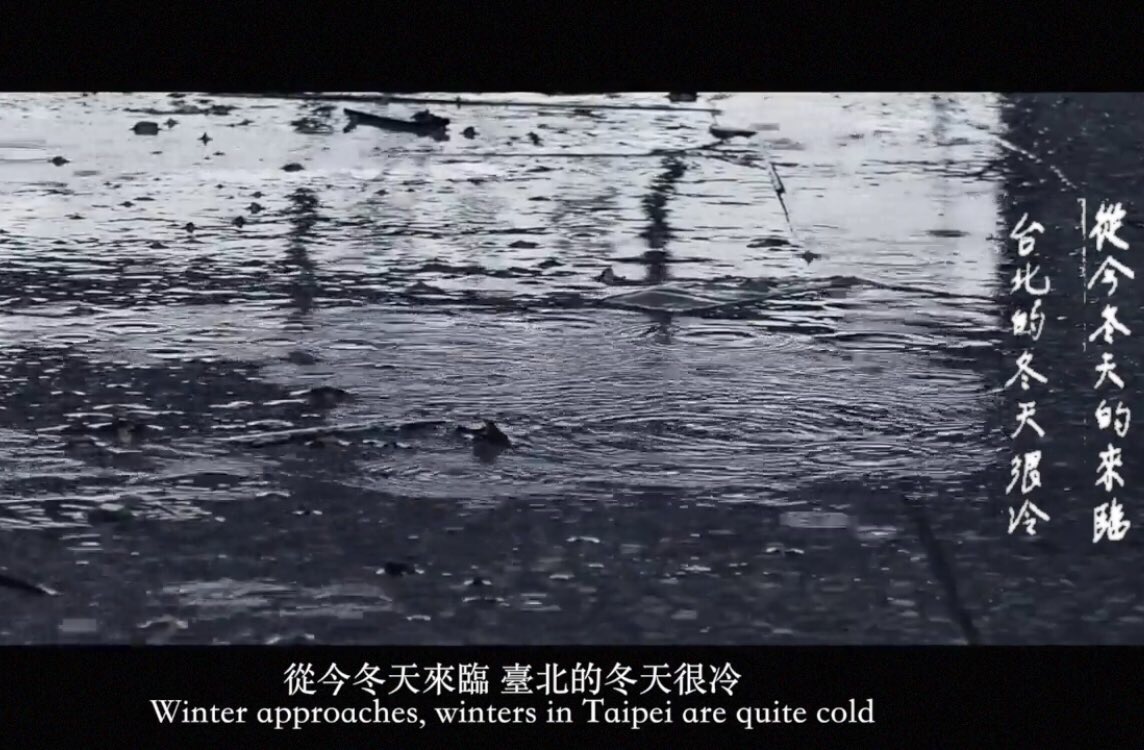
The absence of written words in the last letter embodies the impossibility of directly connecting with the tragic period and its remnants, yet the blankness also represents the white noise resulting from the accumulation of all the phantasmic memories that in one way or another, while denied for so many years, are still alive and present. Sowing together all these fragments of scattered memories in an heterogeneous piece of cinematic patchwork, Lin Hsin-i’s short movie is an attempt to discover and create images and sounds of a lost and tragic period. The letters of Shi Sui Huan are juxtaposed with the narration in the present (done by family members of the victims), and images of ruins are overlapped with performative actions that recreate some of the gestures that the prisoner might have done.
Not only Letter #69 brings to the surface an obliviated past and directs its gaze towards a crucial spot in Taiwanese history, but the filmmaking style that made 3 Islands so powerful and fascinating for me is here in full display again. Aesthetically Letter #69 is a fragmented and kaleidoscopic work that blends the beauty and clearness of the digital image with the grain and the roughness of overused celluloid film ー an old strip of film where the director printed the woman’s letters ー sound manipulation and voice distortion with reenactment, and read and written passages from letters with the constant sound of a running film projector.

I might be partial because my cinematic taste tends definitely towards hybrid documentaries, but 3 Islands and now this Letter #69 are so fascinating and challenging that make Lin Hsin-i one of the most interesting filmmakers working in experimental nonfiction today.

Fighting Soldiers 「戦ふ兵隊」(Kamei Fumio, 1939) 

Kamei Fumio’s Fighting Soldiers is a defining work in the history of Japanese documentary, possibly one of the first non-fiction works made in the archipelago to have a very distinctive authorial touch, to the extent that it is often referred to as the “first Japanese documentary”.

In 1939, on behalf of Toho (PCL had changed its name to Toho just three years earlier), Kamei and cameraman Miki Shigeru went to China to make a propaganda documentary, or rather a war record, about the Japanese Imperial troops involved in the ongoing invasion of Manchuria. However, Kamei made something very different from what the government and the army expected, and the film was immediately banned from release. What the authorities particularly disliked was the portrayal of the soldiers, and also the depiction of Chinese casualties. As the head of the Japanese Metropolitan Police Board famously remarked at an advance screening: “These aren’t fighting soldiers, they’re tired soldiers!” .

I’m going to focus on the first 5 minutes of the film, one of my favourite openings in Japanese cinema and a powerful example of Kamei’s use of montage, a “method of philosophical expression” that the Japanese director so beautifully explained in his book Takakau eiga:

I think documentary film must be like haiku. If the viewer observes something with shot A, then shot B must produce the space for the viewers to freely develop their own creative possibilities. Shot B, therefore, demands a new observation by the viewer. Shot B is what i call the MA of documentary film.
(quote from “The Flash of Capital” Eric Cazdyn, pag. 64)

Kamei was obviously and directly influenced by Soviet cinema and, in particular, Soviet montage theory, a technique he mastered while studying film in Leningrad (now St Petersburg) in the early 1930s.

You can watch the opening here:

All the following stills are taken from the first five minutes of Fighting Soldiers and are here displayed in chronological order:

(1)

vlcsnap-2015-01-23-09h07m34s210

(2)

vlcsnap-2015-01-23-09h13m01s252

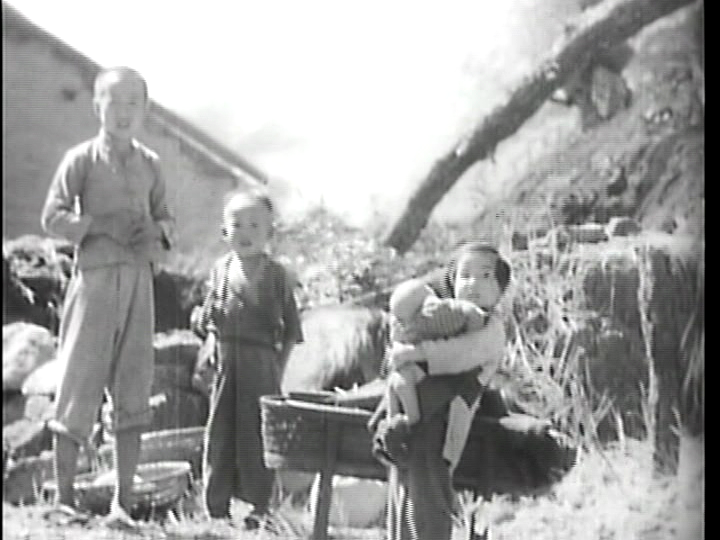
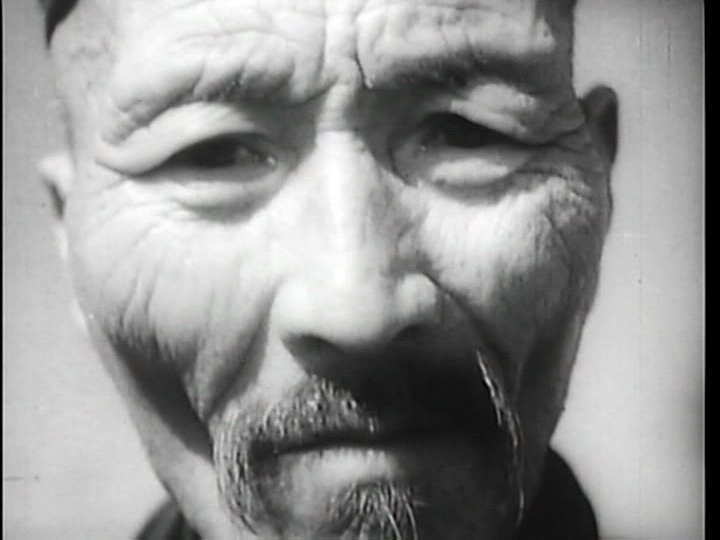
After the opening credits, the film begins with an old man praying in front of a shrine, images of destroyed houses, shots of children staring at the camera (1) and a powerful close-up of the same old man (2).

(3)

vlcsnap-2015-01-23-09h08m29s106

(4)

vlcsnap-2015-01-23-09h08m46s24

(5)

vlcsnap-2015-01-23-09h09m42s79

(6)

vlcsnap-2015-01-23-09h09m53s194

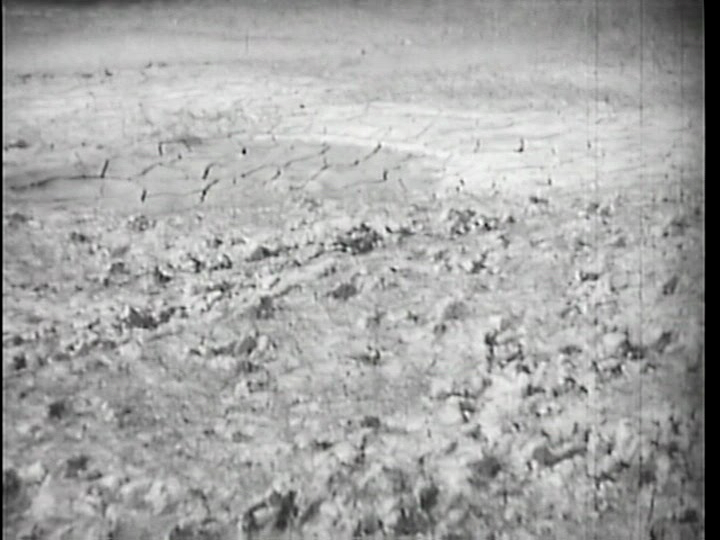
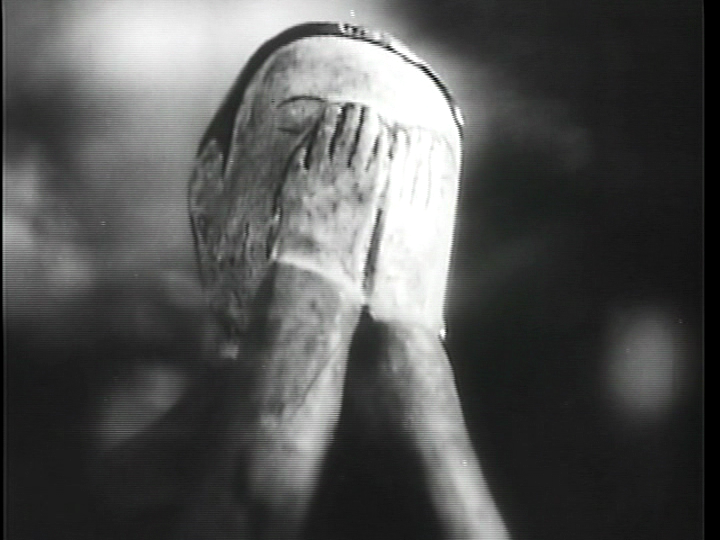
In the next scene, a group of people carrying all their belongings, walk away from the destroyed town (3) through a barren land (4), soon after, the movie cuts to a close-up of a small statue hands on its face, almost frozen in a scream of despair (5). Next we see the same statue from a different perspective with the expanse of dry land on its background (6).

(7)

vlcsnap-2015-01-23-09h10m52s1

(8)

vlcsnap-2015-01-23-09h11m10s188

In the next shot we see the departure (or arrival) of Japanese tanks (7) from the land they conquered and destroyed, these war vehicles are seen from a medium distance. Next, in one of the most stunning shots and cuts in the history of Japanese documentary, the point of view shifts and we are now on a tank moving through the ruins of the bombed city. It’s a short tracking shot, and there’s also an amazing close-up of a Japanese flag flapping from the tank, but what we see in the background of the flag is the village reduced to rubble (8).

As a filmmaker, Kamei had the philosophical necessity, paradoxically even though he was making what is still considered a propaganda documentary, to bring to the fore what is usually relegated to the background: the suffering, the grief, the destruction and the loss that every military conflict brings. Because of this inner conflict/dichotomy, Fighting Soldiers is still hated or loved by many viewers and critics, and the film is considered by many critics and scholars to be both a cinematic miracle and an enigma. To make matters worse, in the years that followed, Kamei himself would often repeat and write that what he had made was in no way an anti-war film.
Problematic films, more than perfect ones, encourage us to think about and engage with their themes, they do not offer easy and ready-made points of view or solutions, they keep coming back to us, view after view, challenging our vision. Fighting Soldiers is one of these films, and one of the best to come out of the world of Japanese non-fiction cinema.

It’s a real shame that the film isn’t as well known in the West and that, apart from a cheap Japanese DVD, we don’t have a proper DVD or BD release.

Further readings:

Japanese Documentary Film – The Meiji Era Through Hiroshima, Abe Mark Nornes, University of Minnesota Press, 2003.

The Flash of Capital, Eric Cazdyn, Duke University Press, 2002.
Net

A Talk by Kamei Fumio
The typical genius of Kamei Fumio