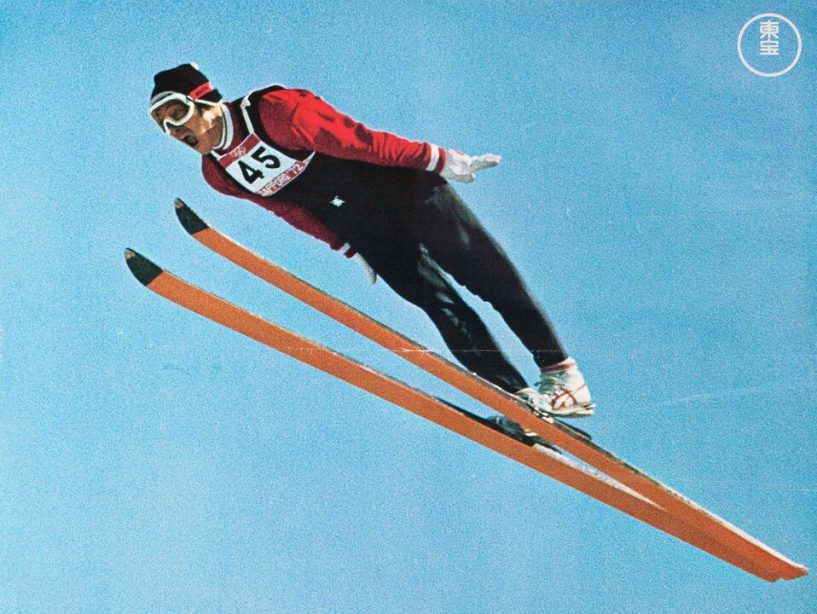
The summer special on sport and cinema I’m working on with my friends at Sonatine gave me the chance to revisit Ichikawa Kon’s Tokyo Olympiad (1965) last week, and today I turned to Shinoda Masahiro’s Sapporo Winter Olympics, a fascinating documentary in its own right.
I’m posting here the English version. Please keep in mind that, while slightly modified, this is a more traditional review in style, so to speak, and it might read differently from the pieces I usually publish here.
After two landmark events in Japan’s postwar history, the 1964 Olympics and the 1970 Osaka Expo, another major international event took place on the Japanese archipelago just a few years later. The 1972 Winter Olympics shifted attention northward, introducing Sapporo and Hokkaidō to the world. To document the event, the organisers called upon Shinoda Masahiro, at the time one of the leading figures of the so-called New Wave, directors who had revolutionised Japanese cinema from the 1960s onward.
In Shinoda’s documentary, the solemnity and formality of the Tokyo Games and Ichikawa’s film give way to an international atmosphere with an almost provincial charm—one shaped by the director and his staff primarily through a fascinating approach to sound. Downhill skiing, ski jumping, figure skating, speed skating, and luge are among the winter sports featured in the film, which also lingers on snow-covered landscapes, mountains, lakes, and snow—lots of snow.
Inevitably, Sapporo Winter Olympics is often compared to Kon Ichikawa’s 1965 documentary. The comparison stems not only from the fact that both films were directed by major auteur filmmakers—Ichikawa representing the old guard, while Shinoda the new wave—but also because they document two landmark international sporting events held in Japan less than a decade apart.
The two films, however, take markedly different approaches, largely because they portray very different sporting events. While today the Winter Olympics have grown into a massive international spectacle, fifty years ago they still retained a relatively modest scale. Shinoda emphasizes this almost provincial quality from the opening sequences, recalling the controversy surrounding Austrian skier Karl Schranz and his sponsorship deals. At the time, athletes were not allowed to wear clothing displaying commercial logos, and the incident became one of the defining disputes of the Games. The film’s more relaxed and informal atmosphere is also shaped by Shinoda’s stylistic choices, many of them suggested by the very nature of the winter sports themselves. His compositions consistently highlight the surrounding mountains, while the athletes compete against the snow-covered landscapes of Hokkaidō, turning the natural environment into a constant presence and almos a character throughout the documentary.
This almost matsuri-like atmosphere is already evident during the opening ceremony, where the diegetic music is performed by a brass band, but it emerges most clearly through Shinoda’s editing and directorial choices in the rest of the film. A telling example is the way he portrays Emperor Hirohito, who had also opened the Tokyo Games eight years earlier. His brief speech is presented here almost in its entirety, including its pauses and hesitations, details that render him surprisingly human, stripping away much of the institutional solemnity that typically surrounds his public image.
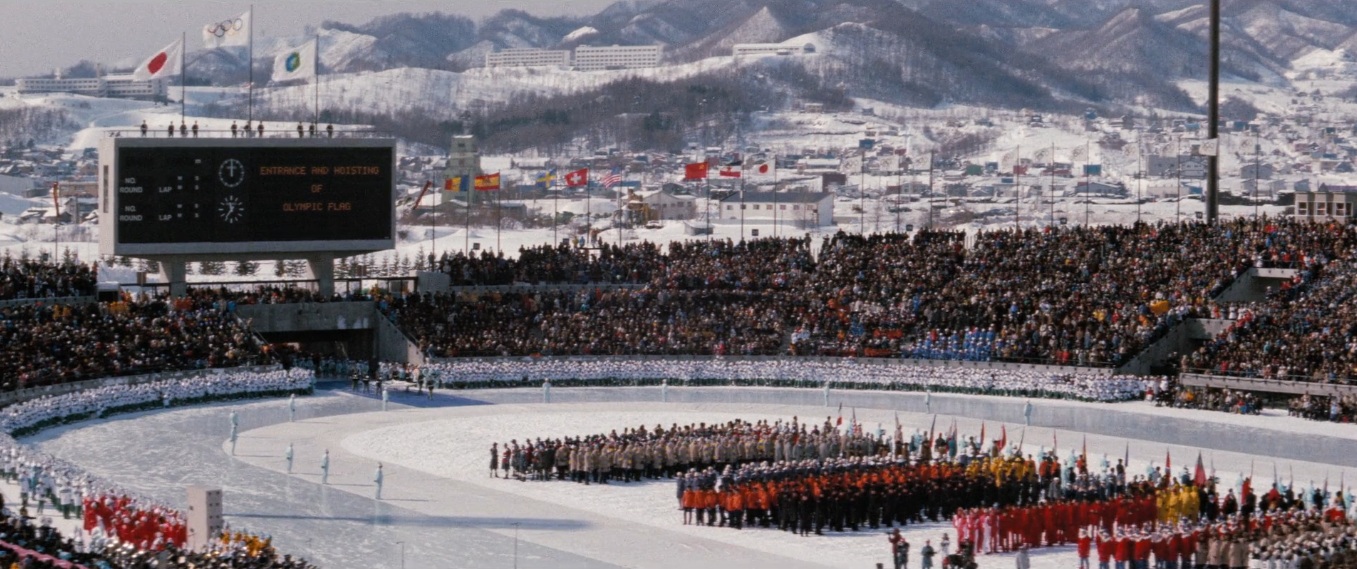
Watching the documentary, one has the impression of witnessing an international event that still retains an accessible, almost intimate quality at times. A good example is the men’s ski jumping competition, which ended in a historic Japanese clean sweep. Shinoda shows the athletes walking back up the long slope on foot, and, during a brief lull, one of the skiers is casually seen smoking a cigarette, an image almost unimaginable in contemporary sport. It not only reinforces the film’s relaxed tone but also highlights how profoundly the world of elite sport has changed over the past fiftyfive years.
One of the documentary’s greatest strengths is the way its form continually adapts to the sports it depicts, not only through its images but also, as we have mentioned, through its remarkable sound design. Downhill skiing, slalom, biathlon, speed skating, luge, and ice hockey are accompanied by a richly layered soundscape in which the murmur of spectators and officials, conversations in different languages, and, at times, even the voices of the athletes themselves merge with the scrape of skate blades on ice, the hiss of skis cutting through fresh snow, or the luge hurtling down the track with a missile-like whistle. Rather than simply documenting the competitions—which are shown only in fragments—Shinoda immerses the viewer in their sonic environment.
Another interesting choice is the decision to use two voices for the narration: a male voice, more informative in tone, and that of actress Kishida Kyōko, whose delivery moves between descriptive passages and moments of almost poetic intensity. The music, composed by Masaru Satō, further contributes to the film’s distinctive identity. At several points, it evokes the soundtracks of 1960s spy films (James Bond!), while the theme accompanying the opening title recalls the famous fanfares associated with Tōei films.
On a musical level, Shinoda also incorporates the sound of the mukkuri, a traditional Ainu instrument similar to a jaw’s harp, in several sequences of the documentary. This is a significant detail, recalling that Sapporo and Hokkaidō as a whole are territories that were inhabited by the Ainu people for thousands of years before being colonized and incorporated into the Japanese state in relatively recent history. Without explicitly dwelling on this past, the film allows a memory of the place to emerge through music, silently surfacing alongside the narrative of the sporting event.
Evocative and perfectly in tune with the documentary’s overall tone in its idiosyncrasy is the ending. While images of the closing ceremony appear on screen, a conversation with ski jumper Kasaya Yukio is heard. Asked, “Do you feel anxious about returning to normal society?”, he replies, “I feel fear.” The film responds to these words with a succession of still frames dedicated to the various Olympic disciplines, accompanied by a harsh, experimental musical score. The images then give way to an aerial shot of the Olympic facilities, slowly receding into the distance, as an orchestral composition replaces the earlier abrasive sounds.

