It’s always fascinating when a filmmaker engages with a specific place and a group of people over a long period of time and the history of documentary cinema provides many stunning examples: the Up series, naturally, comes to mind, but there are also the films made by Ogawa Production and those of Tsuchimoto Noriaki, for instance.
In recent years, a newer addition to this approach has been 47 Km series, ten documentaries made by artist and filmmaker Zhang Mengqi over the course of a decade in the rural village of Diaoyutai. Zhang nicknamed the village “47 km,” after its distance from the nearest town, Yindian, in Suizhou, Hubei. Besides being a filmmaker, Zhang is also active as a choreographer, her works have been performed in France, Austria, Croatia, and Germany, and this background is evident in many of the documentaries in the series, particularly the earlier ones.
PolePole Higashi-Nakano, a small cinema in Tokyo specializing in documentary films, will be screening the complete 47 km series starting on November 7. It’s a preliminary event related to the Yamagata International Documentary Film Festival 2027, a perfect excuse for me to revisit some of the films I’ve already seen and discover others for the first time.
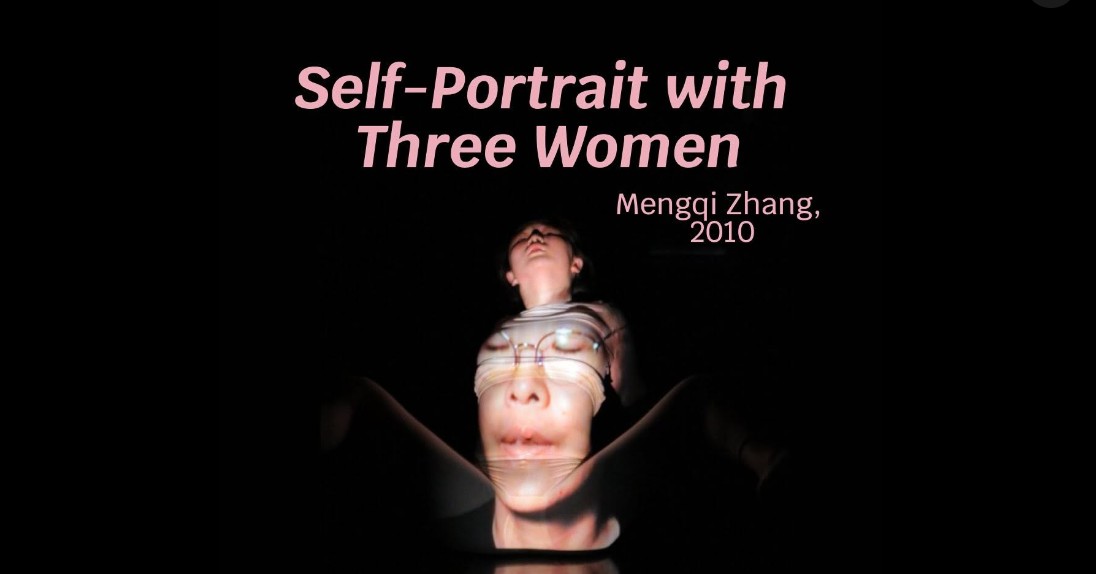
Self-Portrait with Three Women (2010) is not included in the retrospective at PolePole (it’s not part of the 47 Km series) but it marks Zhang’s beginnings as a filmmaker, so I thought it was fitting to start from this work.
Formally, the documentary is constructed by interweaving footage of Zhang speaking with her mother and grandmother (some of it filmed by her mother herself) with old photographs, and recordings of Zhang’s own dance performances. At times, Zhang uses her body as a screen onto which images are projected, showing her mother recalling moments from her life or responding to her daughter’s questions. The narration, structured as a kind of spoken diary in which Zhang reflects on the lives of the three women, often overlaps with the dialogue taking place diegetically on screen. The filmmaker’s words also become an act of self-analysis, particularly in relation to her identity as a daughter: “more and more, I found myself to be my mother’s body double, her way of reliving her failures and missed opportunities.”
The relationship between Zhang and her grandmother is particularly strong. When Zhang was six, her mother left home to look for work in the cities, and it was her grandmother who raised her until she went to university. One of the documentary’s most touching scenes occurs when Zhang finds and reads letters she wrote to her mother as an elementary school student. It’s this experience of absence and distance from her mother that probably propels her inquiry into their relationship through the camera and her performances: “I want to search inside my body to see the connection between me and her [mother].”
Chaotic in its construction yet highly visceral in the way the filmmaker confronts fundamental questions about womanhood, daughterhood, and her relationship with her grandmother, Self-Portrait with Three Women reveals a strong feminist perspective on both intimate life and Chinese rural society in the latter part of the 20th century. Particularly revealing, in this sense, are the video calls in which Zhang asks her grandmother about how sex was discussed and taught in the Chinese countryside in the past, as well as those in which her grandmother speaks about her difficult relationship with her husband. In one scene, the two can be heard yelling at each other; in another, the grandmother recalls how badly she was treated by her husband’s family.
What emerges through these candid conversations is the extent to which both Zhang’s grandmother and mother experienced unhappy marriages, but also how, despite their different generations (one growing up in the 1950s, the other in the 1970s) both held relatively progressive aspirations, including the desire to join the Communist Youth League of China.
While some of the filmed performances are very powerful—in one, for instance, Zhang recalls how, as a young teenager, she explored her sexuality by discovering her own breasts—they become somewhat repetitive as the film progresses, and Zhang’s reflections occasionally verge on the trite. Given that she was only 22 or 23 and had just graduated from university when she made the film, this is perhaps understandable. Nevertheless, Self-Portrait with Three Women remains a fascinating experiment in personal documentary, gaining particular interest when viewed in the context of how Zhang’s filming practice evolved through the documentaries that followed in the 47 Km series.

