First part of this special can be read here
Self Portrait: At 47 KM is the first film Zhang shot in Diaoyutai, her father’s hometown, thus marking the first official entry in the 47 series. The documentary is also the first made in collaboration with the Folk Memory Documentary Project.
After my first documentary Self-portrait with Three Women, my second self-portrait was painted in a village named 47 KM. This village, located 47 kilometers from Suizhou, Hubei Province, is where my father was born. He left the village when he was 20, but his father, my grandfather, still lives there. In the summer and winter of 2010, through my participation in the Folk Memory Project, I went back to the village, which seems disconnected from my current life, and re-discovered and came to better understand my grandfather, the old villagers who underwent the disaster of the famine 50 years ago, as well as the village, which always perplexed and embarrassed me. What does 47 KM really mean to me? It seems to be like a mirror, I see myself in front of it.
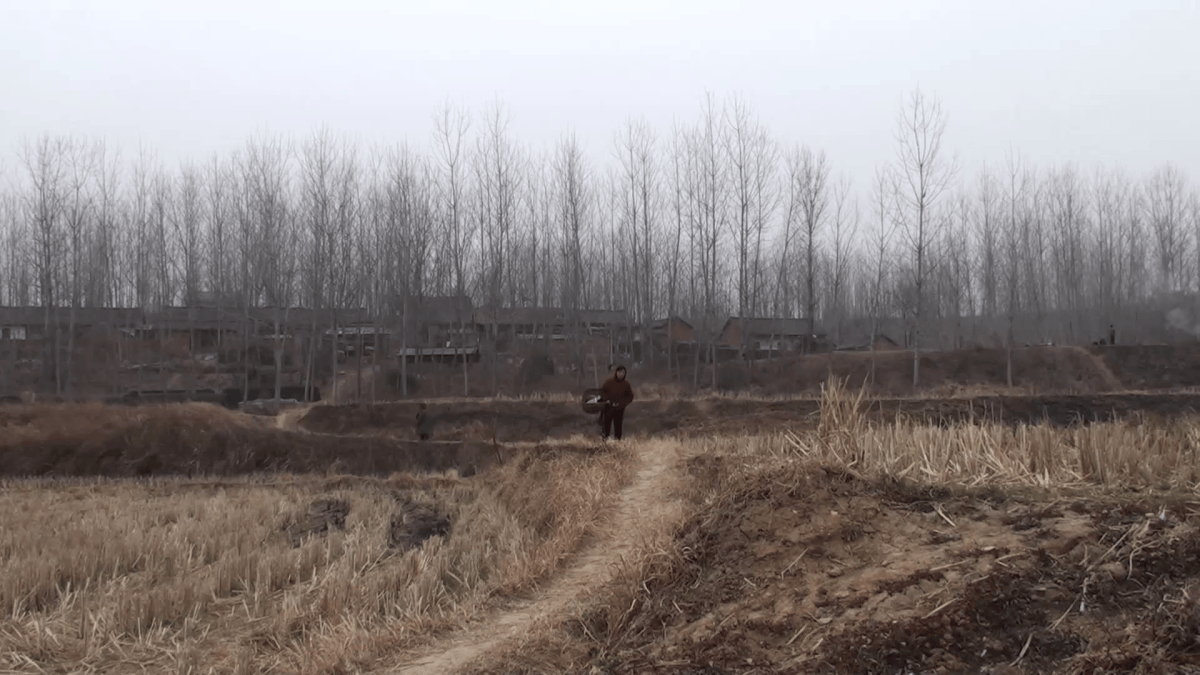
From one of the very first scenes, a road in the countryside and the sign 47 Km on the side of it, it’s quite clear that the focus of the film has shifted from the interior spaces prevalent in the previous documentary, to the large expanse of land of the Hubei province. This movement from the interior to the exterior is also reflected in the themes explored. If in the previous film the personal stories of her mother and grandmother formed the main structure of the project, here the backbone is the famine that killed thousands of people in the Chinese countryside between 1958-1960. Yet, as often in the documentaries by Zhang, the historical shifts and the personal stories intermingles and cross their path: In Self Portrait: At 47 KM, by moving her focus to Diaoyutai, the filmmaker is also reorienting her gaze from the women of her family (mother and grandmother) to her (absent) father.
The documentary is structured with interviews to the elderly people who still remember the man-made tragedy of the famine, interwoven with scenes where the filmmaker is wandering the barren landscape, walking along the river, occasionally encountering people passing by. There are also scenes filmed on stage like in the previous entry, but they are far less frequent.
One of the first person she interviews for the project is her grandfather, who has hearing problems. Zhang shouting her questions at him and the old man not catching the meaning of what she is trying to say is sweet and funny at the same time. Various other testimonies of the famine, some of them framed with an old poster of Mao Zedong on the background, reveal the harshness of the tragedy. Particularly harrowing are the accounts of a woman who describes the unbearable pain and constipation caused by surviving on nothing but weeds for an extended period, and a man who recounts being the sole survivor in his family after all of his siblings died of hunger.
Each interview is preceded by a big photo of the interviewee placed in a dark room, a visual device that works as an introduction of sorts. These conversations are alternated with others in which Zhang chats with father’s friends and relatives about the absent man.
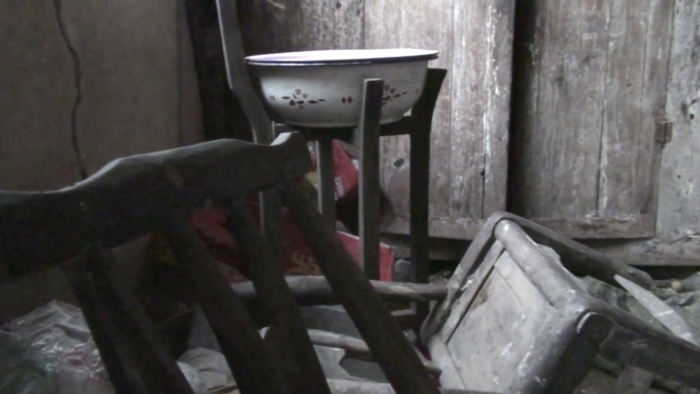
One of the central scenes of the documentary is the meeting and chat with an old lady, her name is Yu Xiantang, who seems to take a like on Zhang. A beautiful shot of the interiors of the woman house shows a bowl of ceramic placed on a wooden structure. The camera lingers a few seconds on it and then slowly pans to the left revealing other objects in the room and the old lady standing up and closing the window.
This scene could be read as an aesthetic shift of sorts in Zhang ‘s style. In the previous film and in many parts of this one as well, the camera is often moving and walking with her or still on a tripod capturing the landscape.
Here, on the contrary, there is an intention of staying with the subject and her surroundings, a will to capture and to hint at the life of a person through her house and the objects she surrounds herself with.
The subtle and slow swaying of the camera is also a hint at the passing of time and at the marks left by time on people and objects alike. The centrality of the encounter with Yu Xiantang for the movie and the Folk Memory Documentary Project is revealed in the following scene, when we learn that the lady has passed away after the filming.
In the final 20 minutes of the documentary, Zhang’s gaze shifts first to a child surrounded by chickens and then to two young children; while walking with them she asks about their dreams and aspirations for the future. A change of topic that creates a gap between what was on screen just few scenes before. These segments foreshadow the interest in the younger generations growing up in the village that will become more prominent in many following entries in the series, notably in Self-Portrait: Fairy Tale in 47KM (2021).
As mentioned at the beginning, the documentary continually interweaves the large movements of history, the famine, with the more personal stories. Zhang returns to her relationship with the father in one scene towards the end, when she makes a scarecrow with his old clothes, and after sitting beside it addresses the camera talking about his absent figure. A parallel “memory project” in itself, a very personal one.

