Continuing my articles about the exhibition, Part 4 (Part 1 here, Part 2 here, Part 3 here)
The retrospective Idemitsu Mako What a Woman Made, currently on view at the Tokyo Photographic Art Museum (July-September 2026), is one of the most comprehensive exhibitions ever devoted to the pioneering video artist and filmmaker. Bringing together films, video works, installations, and archival materials, it offers an unprecedented overview of more than five decades of Idemitsu’s artistic practice, tracing the evolution of a body of work that has consistently explored gender, domesticity, motherhood, and the mediated construction of female identity, especially in Japan.
I visited the exhibition, which also featured special screenings of Idemitsu’s works, over two days in July, immersing myself completely in her world. It was one of the most extraordinary artistic experiences I’ve had in 2026, an aesthetic revelation that continues to resonate within me.
From the museum’s homepage:
Idemitsu Mako (b. 1940) is a pioneering artist in the fields of experimental film and video art in Japan. After spending time in the United States during the 1960s, she began creating works that explored themes such as the lives of women, family, and the relationship between media and society, using film and early video as her mediums. Her video works from the 1970s onwards in
particular incorporate the narrative techniques of television melodramas to depict themes such as mother-child relationships, the dynamics of marriage, and women’s social roles from a unique perspective. In recent years, as the global conversation surrounding gender and the body continues
to grow, her practice has received renewed attention.
The Tokyo Photographic Art Museum acquired Idemitsu Mako’s complete film and video works, as well as her major installation pieces, between 2017 and 2018. This large-scale retrospective offers a comprehensive overview of Idemitsu’s artistic practice, including works that are being exhibited for
the first time since their acquisition by the museum. A total of 45 works, including those in the museum’s collection, will be presented through exhibitions and screenings.
As a future reference for myself and for anyone who might stumble upon this page, I’ll be publishing my notes on every work I saw during my two-day stay in Tokyo. They’re rough impressions rather than finished reviews, but I hope they’ll prove useful, whether as a personal archive or for readers interested in Idemitsu remarkable body of work.
Hopefully I longer piece will eventually emerge from this work in progress.(Works are listed in the order I saw them)
Part 4
“My 16 mm works are about creating another world to escape the rigid routine of daily life. Even now, film retains something of that quality, whereas video is a reflection of everyday reality. These two mediums exist as completely distinct entities. When I shoot on film, I want to detach myself from daily life and capture images that are incredibly beautiful. I actually love these kinds of films. For me, film and video stand clearly apart from each other.”
Interview with Idemitsu Mako The Complete Works of Idemitsu Mako, 1970-1996, Pandora, 1996, p. 21
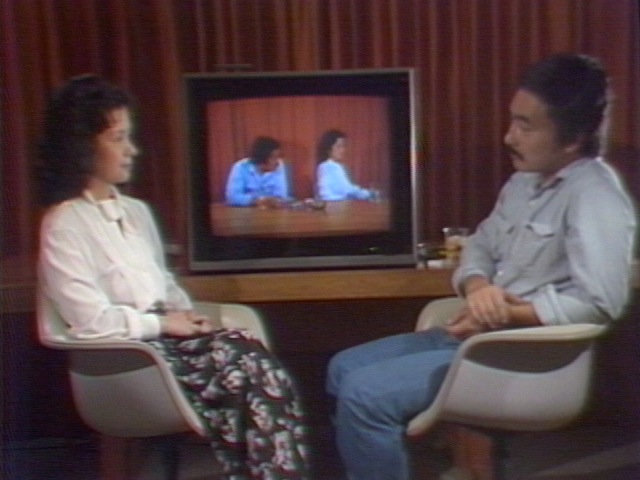
Shodows Part 1 (1980) video
This work marks a pivotal moment in Mako Idemitsu’s career, as it was the first collaboration with Michael Goldberg, a Canadian videomaker based in Japan who would serve as cinematographer on many of her video works throughout the 1980s and beyond.
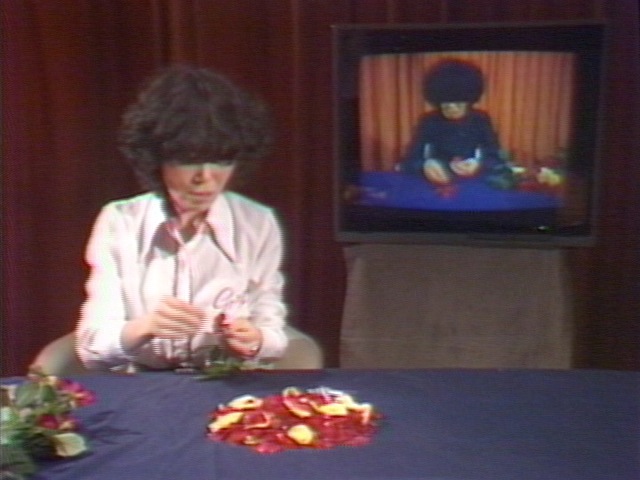
We are in the world of fashion, and a woman is seen discussing her latest work with a male journalist, while a monitor display other conversations unfolding simultaneously. The sound moves freely from one reality to the other.
As in many of Idemitsu’s videos, the work draws on a Jungian concept—in this case, the shadow, the hidden and often repressed dimension of female subjectivity.
Perhaps more explicitly than in her other works, it becomes clear how the stories in the monitors and those outside (but the is no really inside and outside!) are different realities, different temporalities/fluxes. But there’s no real temporality vs fake temporality, or borrowing from the language of perspectivism, each monitor does not offer a point of view on reality; instead, it constitutes a real point of view. As the exhibition catalogue notes, the work was also strongly influenced by the pervasive presence of television in the daily lives of Japanese housewives.
Kiyoko’s Situation (1989) video
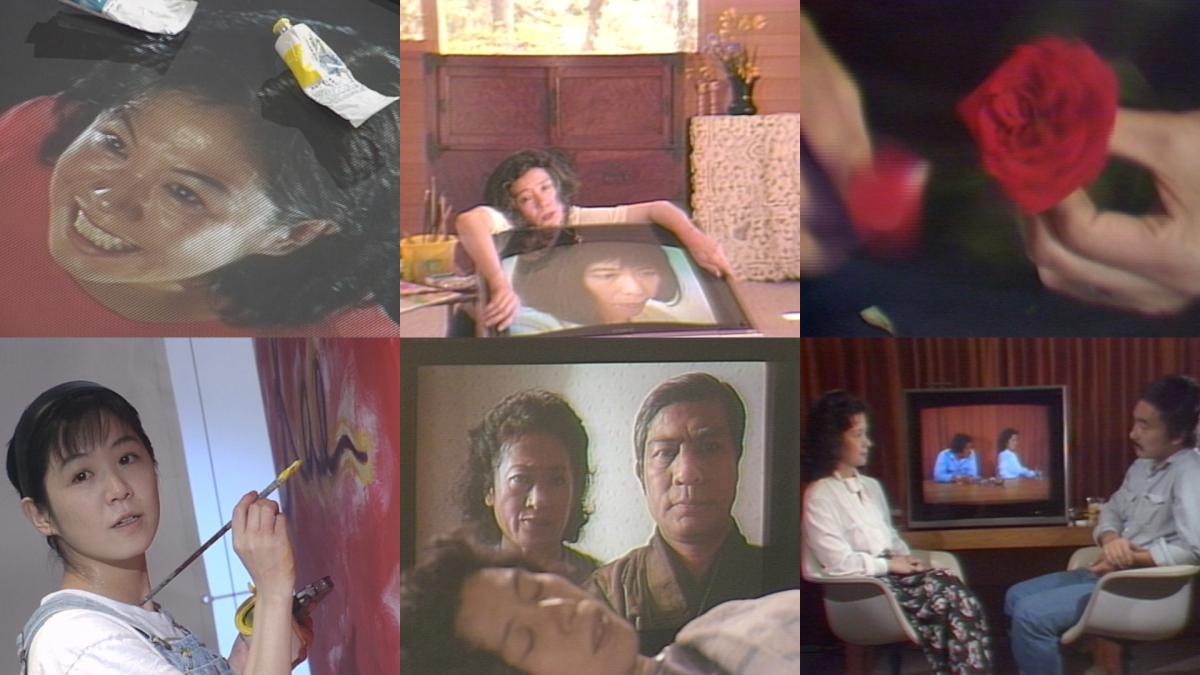
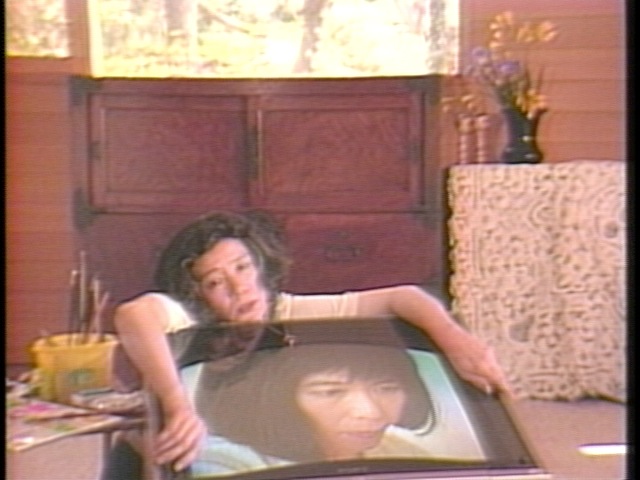
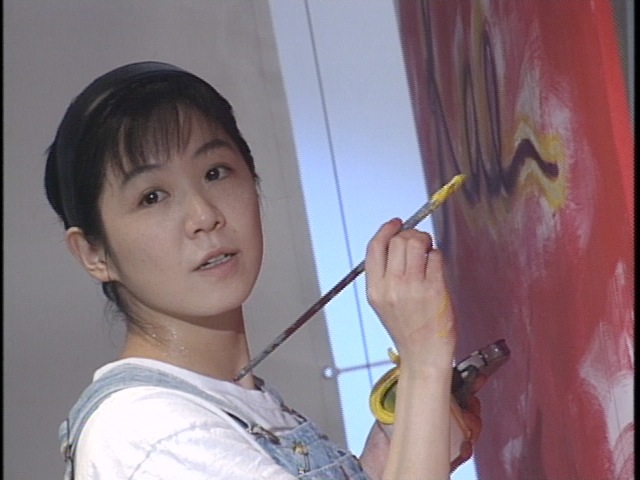
Almost a decade after Shadows Part 1, Kiyoko’s Situation returns to Idemitsu’s exploration of women artists in contemporary Japanese society. The protagonist is a woman who aspires to become a painter, but after marrying under pressure from her parents, her ambitions are gradually crushed by the domestic role she is expected to fulfill as a housewife.
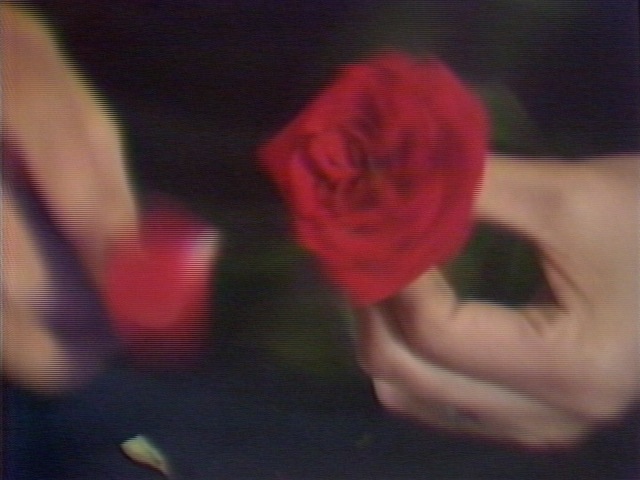
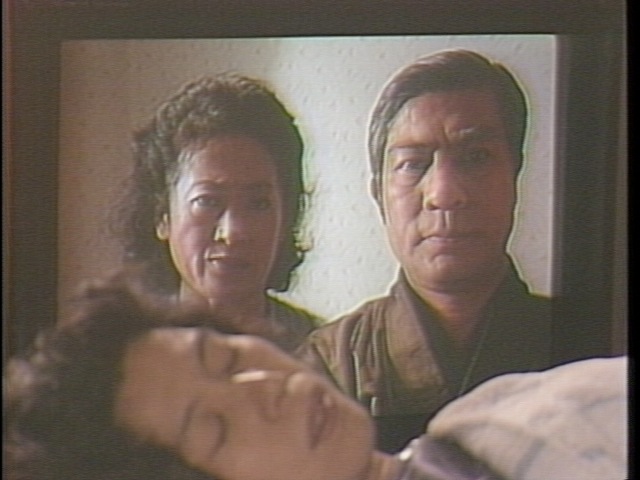
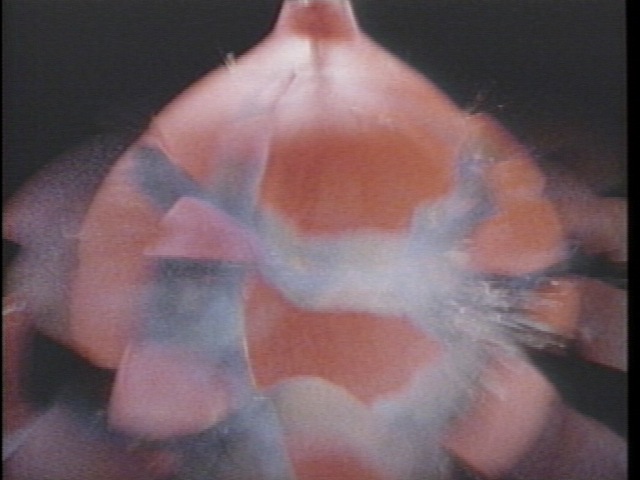
The scenes unfolding inside the monitors are more imposing and menacing than in Idemitsu’s earlier videos, particularly when Kiyoko’s parents perform their self-appointed “duty” as guardians of her life. Her husband is equally violent and insensitive, “You are half a woman if you don’t give birth.” Kiyoko, in turn, confesses, “Inside me there’s another me who becomes repressed by me becoming a mother and wife.” At one point, a vase is shattered, and Kiyoko desperately attempts to piece it back together: a metaphor for her effort to reconstruct both her dreams and the self she had hoped to become. The work culminates in a devastating ending, with Kiyoko hanging herself, using a television monitor as a footstool. Undoubtedly one of Idemitsu’s darkest reflections on the limited freedom afforded to women, especially women artists, within Japanese society and the traditional family structure.
Formally, the texture of the images appears more refined and polished than in the earlier works, possibly reflecting improvements in the video equipment used. Once again, television monitors are employed horizontally as tables, an especially effective visual device. The interplay between multiple monitors is more sophisticated, while both the set design and the interaction between performers and monitors are more elaborate than in Idemitsu’s previous works. The voices and overall soundscape are more carefully constructed.
According to the exhibition catalogue, Kiyoko’s Situation was inspired not only by Idemitsu’s own experiences but also by the lives of the artists Takamura Kōtarō and Takamura Chieko. The work is dedicated to Idemitsu’s older sister, who died young in Paris while pursuing her own dream of becoming a painter.
Kae, Act Like a Girl! (1996) video
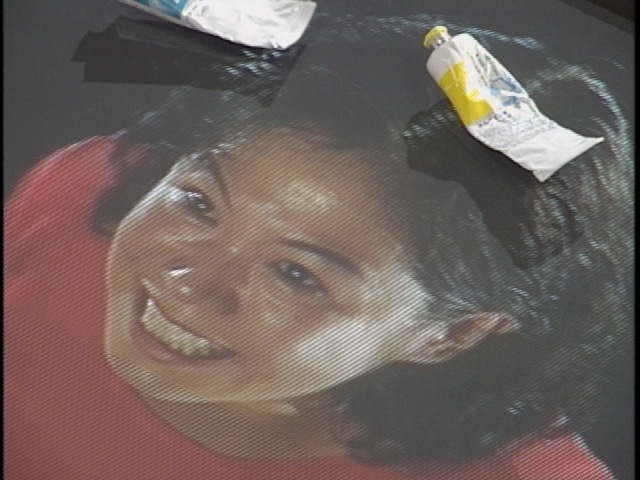
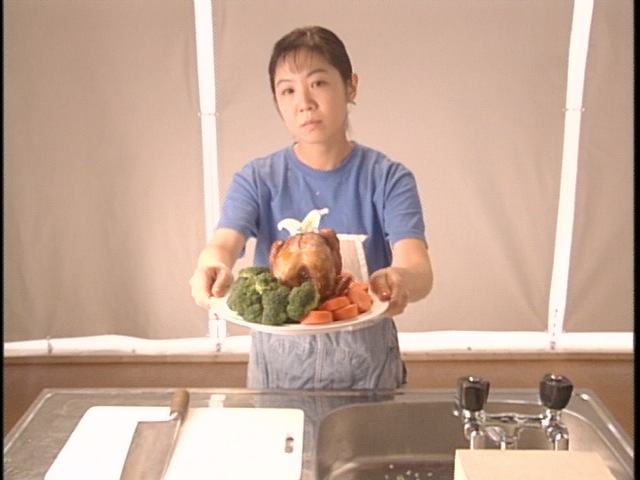
The preoccupation with the place of women artists in society reaches its culmination in this work. In many ways, it is Idemitsu’s most accomplished video: it is longer, makes use of projections as well as television monitors, features more professional acting, and has more elaborate sets. Its narrative follows a woman artist who gradually frees herself from social pressures and the web of expectations surrounding her, with the crucial support of her mother.
Yet, for me, it is less impactful than her earlier works from the 1980s that deal with similar themes. Gone, for the most part, is the satirical, almost surreal quality that permeates those videos, while the greater aesthetic refinement of this work, in my opinion, slightly weakens its overall impact. Maybe it was just fatigue after two days of immersion in her video-world.
On the other hand, I found the work’s performative quality and the inclusion of installations refreshing, and it probably marks a turning point in Idemitsu’s career, as new technologies and artistic possibilities opened up fresh path of exploration.


One thought on “Idemitsu Mako What a Woman Made (2026)/part 4”