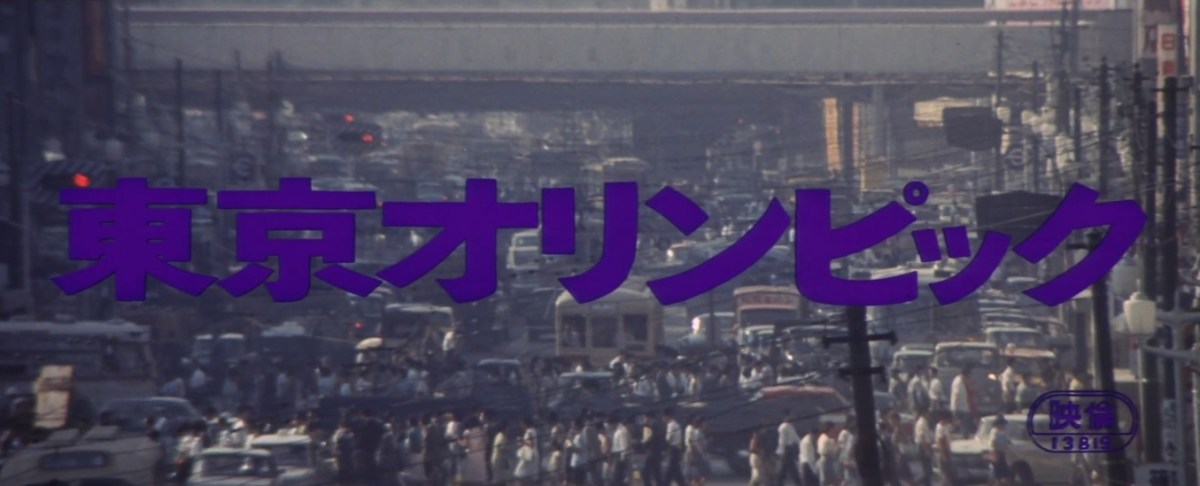
The summer special on sport and cinema I’m working on with my friends at Sonatine gave me the chance to revisit Ichikawa Kon’s Tokyo Olympiad (1965), a spectacle-documentary that revolutionised the way sports films were made, though not without its issues—especially those linked to the production context behind the film.
I’m posting here the English version. Please keep in mind that, while slightly modified, this is a more traditional review in style, so to speak, and it might read differently from the pieces I usually publish here.
The Historical Context
The Tokyo Summer Olympics of 1964—held, it is worth remembering, in October rather than during Japan’s sweltering summer—are generally considered one of the defining symbolic moments in modern Japanese history. They were the first Olympic Games ever hosted by an Asian nation; the Games originally awarded to Tokyo in 1940 had been cancelled because of the outbreak of the Second Sino-Japanese War. More importantly, they symbolically marked Japan’s definitive transition from postwar reconstruction to the period of rapid economic growth that would later become known as the Japanese economic miracle.
The Games also brought about lasting material transformations in the country. The construction of the Shinkansen high-speed rail line was justified in part by the need to accommodate the Olympics, giving rise to a technological innovation that would profoundly reshape Japan’s territory, patterns of mobility, and urban development over the following decades. At the same time, the Olympics accelerated the spread of television sets into Japanese households. The rapid adoption of television, driven in no small part by the Games, contributed to a fundamental shift in entertainment habits and became one of the factors behind the decline of the Japanese film industry in the early 1970s, bringing to an end the era of the big studios.
It is against this broader historical backdrop that Ichikawa’s sprawling documentary should be (re)considered. Released just five months after the conclusion of the Games, Tokyo Olympiad went on to become one of the biggest box-office successes in Japanese history, a distinction it still holds today, ranking as the country’s fifth most-watched film with more than 23 million tickets sold. A curiosity, to this day the first place with allegedly 100 million tickets sold belong to The War at Sea from Hawaii to Malaya (1942) a propaganda war film by Yamamoto Kajirō and with special effects by Tsuburaya Eiji.
The Opening Ceremony and the Emperor
Tokyo Olympiad unfolds chronologically, following the progression of the Olympic Games from beginning to end. It opens with images of a building being demolished to make way for the construction of new Olympic facilities. This act of destruction can be read in several ways. On one level, it symbolizes a nation in transition, leaving its past behind as it enters a new era. On another, it hints at the darker side of economic growth and “progress”: the inevitable reality that someone or something is always left behind, forgotten, or quite literally destroyed.
This part maudite of postwar modernization has been a recurring concern in Japanese cinema, particularly in the work of filmmakers who emerged during the 1960s, such as Ōshima Nagisa, Imamura Shōhei, Masumura Yasuzō, Yoshida Kijū, and Shinoda Masahiro. Staying within the realm of non-fiction, and in close dialogue with the Olympics themselves, it is also worth recalling Tsuchimoto Noriaki’s On the Road: A Document (Dokyumento rojō, 1964), another film that captures the less celebrated realities hidden beneath the triumphant narrative of Japan’s rapid modernization.
The demolition scenes soon give way to more spectacular imagery, accompanied by a concise narration recounting the history of the modern Olympic Games and tracing the Olympic torch’s journey from Greece to Japan. Aerial shots, street-level footage, and brisk, often lyrical editing follow the relay across continents, frequently lingering on the faces of the people it encounters. Significantly, the film places particular emphasis on Asian countries and their populations, an appropriate choice given that these were the first Olympic Games ever held on the continent.
This opening section culminates in a montage of the opening ceremony, with athletes from the participating nations parading into the stadium. The traditional sporting and geopolitical powers are, of course, present: the United States, the Soviet Union, and the two German states competing separately under a unified team. Yet Ichikawa and his collaborators devote considerable attention to smaller delegations that would have been almost unknown to Japanese audiences at the time, including countries such as Congo and Cameroon.
Within these first thirty minutes, the documentary’s guiding approach is already clearly established. While it provides a comprehensive portrait of the Games, its gaze is repeatedly drawn toward smaller, seemingly less significant stories. The spectators, officials, and the quiet moments of preparation or recovery before and after the competitions become just as important as the athletes themselves.
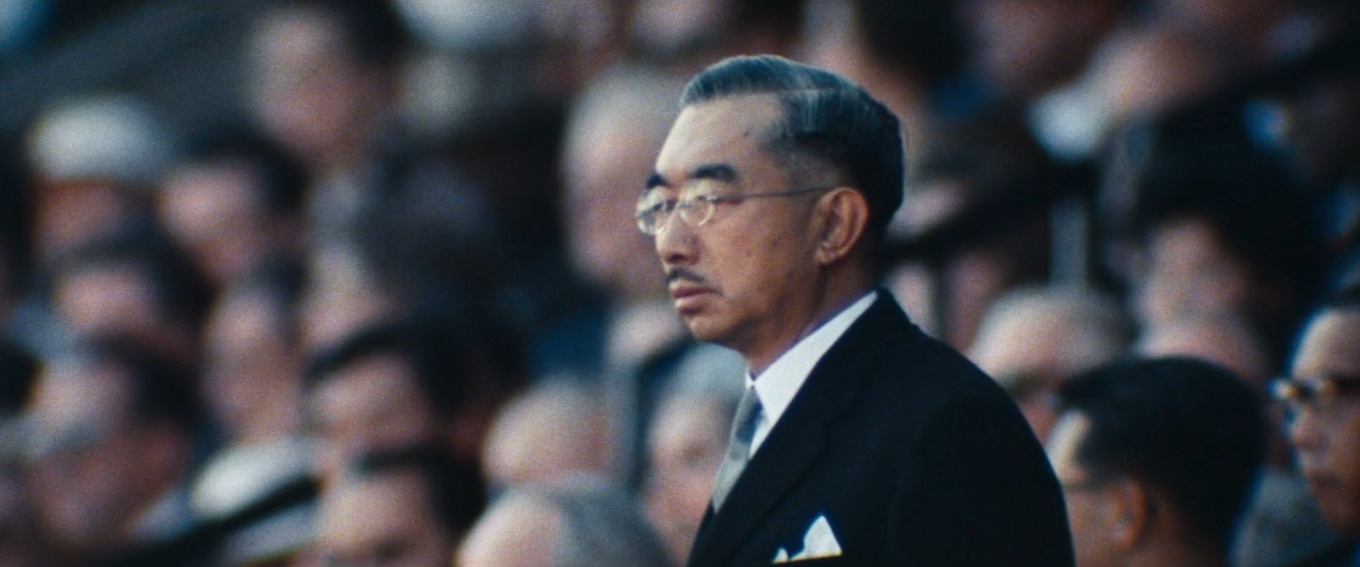
At the same time, this opening section reveals many of the contradictions embedded both in the Olympic Games and, inevitably, in the documentary itself. Emperor Hirohito (Emperor Shōwa), whom many historians regard as bearing responsibility for Japan’s imperial expansion and colonial violence across Asia during the first half of the twentieth century, appears repeatedly on screen. In an opening ceremony celebrating international unity and peace, the prominence given to the Emperor’s face and voice is difficult to ignore. For Japanese audiences in 1965, his voice would inevitably have recalled the radio broadcast announcing Japan’s surrender following the atomic bombings. His presence therefore introduces a tension into the film’s message of universal harmony. Yet this contradiction ultimately belongs perhaps less to Ichikawa’s documentary than to the Olympic games themselves.
A horizontal approach
The coverage of the competitions begins with the men’s 100 metres, the high jump, and the weight throw, perhaps the discipline that best exemplifies Ichikawa’s visual approach and the work of his six cinematographers. Through carefully orchestrated silences and a sound design that isolates the athletes’ breathing, footsteps, and physical exertion, the sequence conveys the profound solitude of athletic performance. The ambient sound was recorded by Ichikawa’s own crew, while the commentary appears to be taken from the original Japanese television broadcasts of the Games.
More than anything else, the documentary captures the poetry of athletic effort through its extensive use of slow motion and long telephoto lenses. Combined with the widescreen TohoScope format, these techniques lend the film a distinctive visual language that remains immediately recognizable more than sixty years after its release.
As mentioned earlier, however, Ichikawa is ultimately less interested in sporting triumphs than in the stories unfolding at their margins. Victories are presented with remarkable restraint. There is no easy mythologizing of champions: we see the event, hear the winner’s name announced, listen to the national anthem, and then the film moves on. What is celebrated instead is the athletic gesture itself—the beauty of movement, as in the slow-motion sequence of a gymnast suspended against a black background, one of the film’s most strikingly stylized images. Equally important is the determination simply to complete the contest, exemplified by the runner from Sri Lanka—then competing as Ceylon—who finishes last in the men’s 10,000 metres.
After the intermission, the documentary continues its search for these “minor” stories. It opens with Ahmed Issa, a middle-distance runner from Chad, a nation that had gained independence only four years earlier and had sent just three athletes to Tokyo. The film briefly follows his solitary training sessions in the Olympic Village before accompanying him to the 800 metres, where his journey ends in the semi-finals.
A multitude of sports, a multitude of styles
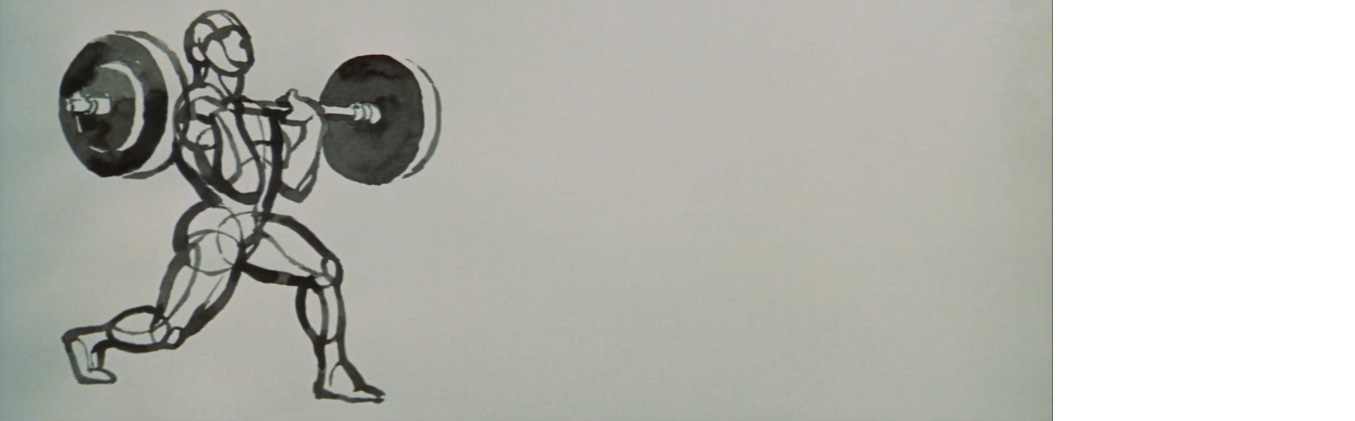
The documentary’s second half moves steadily through a wide range of sporting events, each distinguished by its own visual and sonic identity. Among the most memorable are the weightlifting sequences, introduced by a series of sketches, and filmed in extreme close-ups; the Greco-Roman wrestling, introduced through an almost Cubist montage of intertwined limbs and bodies; and the boxing matches. Boxing is presented entirely in black and white, a stylistic choice that seems to emphasize the sport’s timeless, almost archaic qualities. In striking contrast, the women’s foil competition unfolds as a rapid, almost subliminal montage of vivid colours, evoking the visual language of 1960s Pop Art.
Each discipline is therefore granted its own cinematic treatment. Cycling, for example, takes the viewer beyond the Olympic venues and into the Japanese countryside, accompanied by an uptempo jazz soundtrack that conveys both speed and exhilaration. Throughout the film, Ichikawa refuses to impose a single visual style upon the Games. Instead, he continually adapts his cinematic language to the rhythm, physicality, and emotional texture of each sport.
It is in moments like these that Ichikawa’s remarkable versatility as a filmmaker becomes particularly evident. Over the course of his long career, few Japanese directors demonstrated such an ability to reinvent their style according to the subject at hand. From his beginnings in animation to documentaries and experimental pop-inflected commercials, from the period dramas of the 1950s and 1960s to The Inugami Family (Inugami-ke no Ichizoku, 1976)—the mystery film that not only revitalized his career but also reshaped the Japanese film industry by paving the way for what would later become known as the media mix.
The final thirty minutes of the documentary are devoted to the marathon and the closing ceremony. Once again, alongside the leading athletes of the race—including Abebe Bikila—the film turns its attention to those who fail to complete the course: the runners who collapse on the road, exhausted, as well as the anonymous volunteers and refreshment stations offering drinks and wet sponges to the competitors.
Documentary vs militant documentaries
It is difficult not to consider Tokyo Olympiad a masterpiece of documentary cinema, almost a John Ford of non-fiction filmmaking, one might say. It is a work that remains technically breathtaking, thanks to its creative use of telephoto lenses, slow motion, large-format film, editing, camera angles, and frame composition. At the same time approaching the Olympic Games from a remarkably horizontal perspective, refusing to privilege certain athletes, nations, or sporting powers over others.
However, this vision and praise is only possible by understanding the documentary primarily as cinema-spectacle, one of the possible modes of non-fiction filmmaking, and by placing in parentheses everything that exists behind the Olympic machine: political rivalries and pressures, corruption, as well as the sacrifices imposed upon parts of the host population, usually those with the least social and economic power.
By accepting the project, Ichikawa had already chosen to stand with the Olympic Committee and the organisers, a position that was, in many ways, consistent with his long history of working within the major studio system (at least until the end of the 1960s). The members of “the other side” should already be familiar if you’ve been reading this space over the years: Ogawa, Tsuchimoto, and the many filmmakers, groups, and collectives who were resisting a particular way of producing, distributing, and exhibiting documentaries in Japan at the time.
And yet, in a way that recalls Ford once again, perhaps the images of Tokyo Olympiad ultimately resist and even contradict the very framework in which they were produced, or at least that is one of my more hopeful readings. The opening image of demolition is a perfect example. Reconsidered in light of what I have pointed out, it acquires an even greater complexity, becoming an unresolved and opaque symbol. Perhaps this is not enough to fundamentally alter our understanding of the documentary—we should get rid of our attachment to ‘spectacle’ and the ‘beautiful images’ once for all—but it remains a fascinating tension nonetheless.


One thought on “Tokyo Olympiad (Ichikawa Kon, 1965)”