Starting from last October, Planet +1 in Osaka is hosting a retrospective of most of the films made by NDU (Nihon Documentarist Union, 1968-1973), and by the works directed by one of its founding members, Nunokawa Tetsurō.
If you follow this space, you know that I have dedicated many articles to the collective over the years. Still, I believe that much more can, and should, be written about NDU, and in a much better form. The retrospective offers a perfect opportunity to revisit their films, and hopefully, a deeper knowledge of their activities, a better understanding of the sociopolitical context in which they operated, and a clearer picture of the evolution of Japanese documentary cinema will allow me to engage more deeply with works.
The retrospective will run for almost half a year, with each film screened twice a month. The final screening, scheduled for February, will be Asia Is One. I am not sure I will be able to attend every screening, but in any case, I intend to at least revisit and rewrite my older pieces. Each screening will be introduced by Nakamura Yōko, a scholar who will also offer a short analysis of the film afterwards and is currently writing a book on NDU and Nunokawa Tetsurō.
Motoshinkakarannu (沖縄エロス外伝 モトシンカカランヌー, 1971)
“…the development of the image and the sound strip each along a separate rhythmic course. They must not be tied to one another by naturalistic imitation but connected as the result of the interplay of action.”1
In Onikko, we saw how filming Tokyo from the freight train carrying jet fuel to the American military bases allowed the collective to cross an internal border and gaze at Japan from an outside, yet still internal, point of view. We also noted how spraying graffiti on the wall surrounding Shinjuku Station drew attention to state practices of dividing, concealing, and constructing borders.
For their next film, Motoshinkakarannu, NDU members decided to cross a different kind of border: this time a physical one, separating Okinawa, which was still under U.S. administration, from mainland Japan. In 1969, the group flew to the southern archipelago, intending to film a Union Labor rally. Their base was an apartment in the city of Koza. Some young yakuza lived in the same building, and and a sex worker named Akemi was often there and began talking to the filmmakers. This introduction to Koza’s nightlife and to the young women who worked there revealed another side of Okinawa and opened up a new direction for NDU’s political filmmaking: giving a voice to people marginalized or not usually involved in the political movements themselves. The focus thus shifted from the depiction of the overtly political engagement (struggles, marches, and protests) to the politics of everyday life2 , in this case, the lives of the motoshinkakarannu, the young prostitutes.
The film opens with Akemi speaking about her life, before moving to the arrival of labor-union members to the island. They are interviewed about the sex workers and their views on the subject, often giving awkward, patronizing or evasive answers. As in NDU’s other films, the voices of the people interviewed, whether sex workers or union members, are presented out of sync with the words floating over the images, as it were. Images showing clients visiting the Yoshiwara sex district, strip and dance clubs, the American bases, and other parts of the city.
When the camera captures the urban landscape, it pays particular attention to signs advertising American brands, highlighting the island’s double colonization by the United States, both military and cultural. In this whirl of images, almost lost, a small TV shows a visit to Okinawa by Japan’s prime minister at the time, Nakasone, hinting at the distance between “the Political,” with a capital P, and people’s everyday lives.
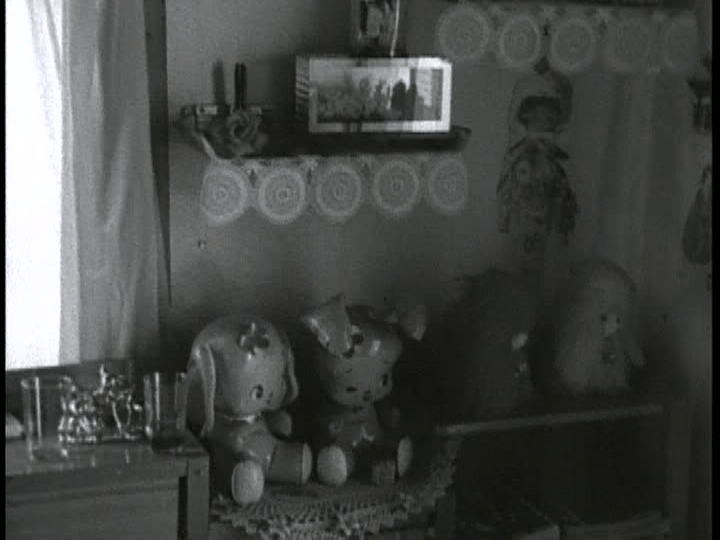
Like most of NDU’s other works, the film is fragmentary in style, alternating between street scenes depicting protests and labor-union gatherings and more intimate scenes of young women chatting and singing in their rooms. In one of the film’s most touching scenes, we are introduced to a young woman’s empty room. Before she appears, a curtain moves in the breeze as the camera slowly pans across the space, revealing Coca-Cola and Pepsi signs and dolls decorating the walls. We learn that she was raised by her single mother on Miyako Island, one of the southern islands of the Ryūkyū archipelago, and that she chose Kozo and this way of life as a means of survival.
In its third segment, the film turns to a group of African American U.S. soldiers affiliated with the Black Panther movement, although, unfortunately, the sound is missing from most of this footage. The final part of Motoshinkakarannu shifts to a refinery on the coast, hinting at the environmental problems that also burden the island.
As explained in the supplementary notes distributed at the screening by scholar Nakamura Yōko, the documentary was completed after the Koza Riot of December 1970, a violent uprising against the U.S. military presence in the city. Although the riot itself was not filmed, it had a significant influence on the editing of Motoshinkakarannu. The final scenes bring together footage of Eisa dancing at a festival, young sex workers, and Black people rioting during the August 1969 uprisings. Accompanied by cacophonous music and Akemi’s singing, this sequence weaves together disparate images and sounds, presenting the movements of reality in a kaleidoscopic, mosaic-like form, and different subjectivities converging in a united impulse of resistance.

