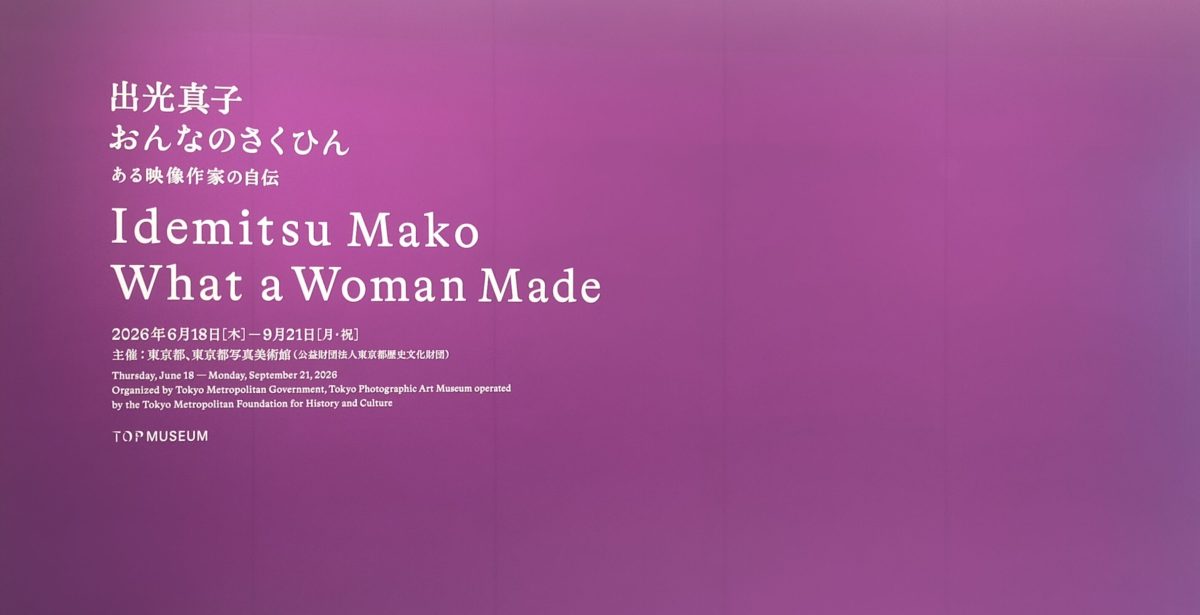
This is the last entry in my coverage of the exhibition (here Part 1, Part 2, Part 3, and Part 4)
The retrospective Idemitsu Mako What a Woman Made, currently on view at the Tokyo Photographic Art Museum (July-September 2026), is one of the most comprehensive exhibitions ever devoted to the pioneering video artist and filmmaker. Bringing together films, video works, installations, and archival materials, it offers an unprecedented overview of more than five decades of Idemitsu’s artistic practice, tracing the evolution of a body of work that has consistently explored gender, domesticity, motherhood, and the mediated construction of female identity, especially in Japan.
I visited the exhibition, which also featured special screenings of Idemitsu’s works, over two days in July, immersing myself completely in her world. It was one of the most extraordinary artistic experiences I’ve had in 2026, an aesthetic revelation that continues to resonate within me.
From the museum’s homepage:
Idemitsu Mako (b. 1940) is a pioneering artist in the fields of experimental film and video art in Japan. After spending time in the United States during the 1960s, she began creating works that explored themes such as the lives of women, family, and the relationship between media and society, using film and early video as her mediums. Her video works from the 1970s onwards in
particular incorporate the narrative techniques of television melodramas to depict themes such as mother-child relationships, the dynamics of marriage, and women’s social roles from a unique perspective. In recent years, as the global conversation surrounding gender and the body continues
to grow, her practice has received renewed attention.
The Tokyo Photographic Art Museum acquired Idemitsu Mako’s complete film and video works, as well as her major installation pieces, between 2017 and 2018. This large-scale retrospective offers a comprehensive overview of Idemitsu’s artistic practice, including works that are being exhibited for
the first time since their acquisition by the museum. A total of 45 works, including those in the museum’s collection, will be presented through exhibitions and screenings.
As a future reference for myself and for anyone who might stumble upon this page, I’ll be publishing my notes on every work I saw during my two-day stay in Tokyo. They’re rough impressions rather than finished reviews, but I hope they’ll prove useful, whether as a personal archive or for readers interested in Idemitsu remarkable body of work.
Hopefully I longer piece will eventually emerge from this work in progress.(Works are listed in the order I saw them)
The Past Ahead (2004)
I chose to end my coverage with this installation partly because it was located towards the end of the exhibition, but also because it was the work that resonated with me the most. Its compelling formal structure, the themes it explores, and the way it brings Idemitsu’s career full circle make it a fitting culmination of her artistic journey.
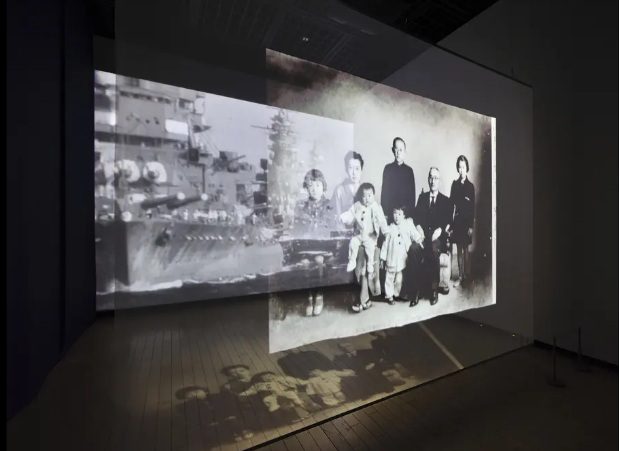
The Past Ahead consists of two screens positioned some distance from one another. The screen closest to the viewer is transparent, allowing the eye to see through it to the second screen in the background. The result is a double exposure effect done in a physical space, a kind of three-dimensional superimposition.
In addition to the two screens, the images projected onto the transparent screen are also cast onto the floor in the space between the two projections (see the photo above).
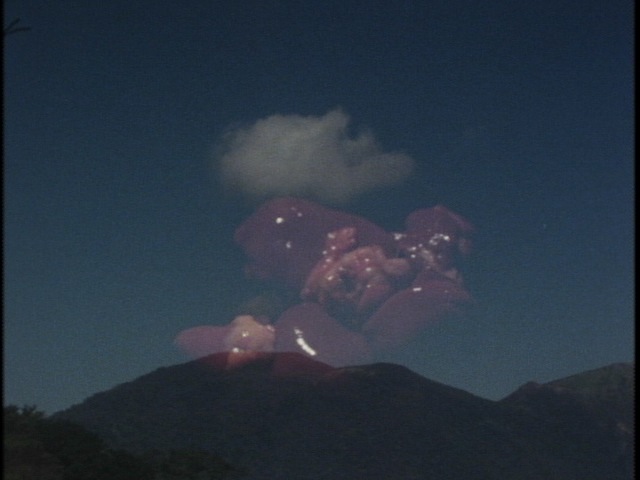
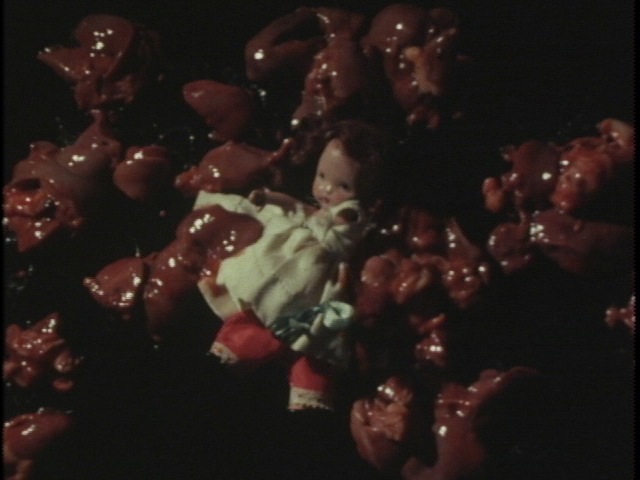
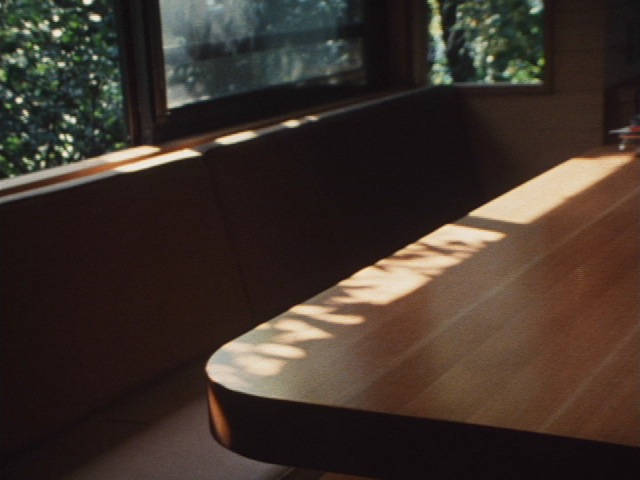
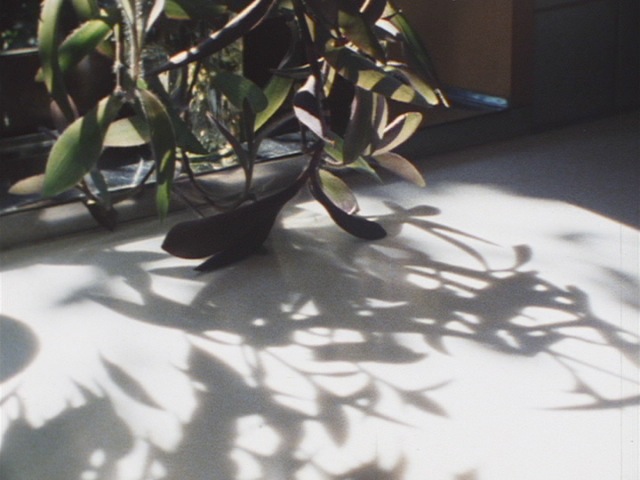
The screen in the foreground presents photographs and other images of Idemitsu’s family from the wartime years, during the early 1940s, while the screen behind it projects footage documenting the Japanese Empire’s military campaigns during the same period. Images of corpses, warships firing their guns, and aircraft carrying war across Asia are interwoven with excerpts from other films. Among them, I recognized scenes from Kami Fumio’s Fighting Soldiers, as well as clips from a documentary about the so-called “comfort women,” although I cannot recall the title.
If video and video art, as we have seen in the previous entries, possess the ability to capture and generate multiple temporalities, and if Idemitsu made full use of these possibilities throughout her works of the 1980s and 1990s, then this installation represents the culmination of her exploration of interweaving temporal flows.
The key innovation Idemitsu introduces here is the incorporation of personal material, although this was already present, to some extent, in her earlier installation Real? Motherhood. Above all, however, the work offers a fierce critique of what her family, and her father in particular, represented within a Japanese society structured around patriarchal authority. It is worth remembering that Mako’s father, Sazō, in 1911 founded Idemitsu Kōsan, currently the second-largest petroleum company in Japan. He was a dominating and controlling figure and when his daughter decided to pursue a career in the arts and marry in the United States, he disowned her.
The problematic relationship with her father runs throughout Idemitsu’s career, but what distinguishes The Past Ahead is the way his figure is elevated into a symbol of patriarchy, male supremacy, and its connection to the violence of war and imperialism. The horrors of war and the violence perpetrated by the state, the artist seems to suggest, have their origins in the familial nucleus itself, they are already embedded in the very structure of the “traditional” family.
The effect of these two worlds, these two temporalities, overlapping before our eyes is mesmerizing. On one screen, we see the peaceful lives of Idemitsu’s family; on the other, the horrors produced by the imperial machine operating at full force. The contrast speaks of class divide, privilege, sexism, oligarchic power, and the exploitation of the most vulnerable. It evokes a past that, as the title suggests, is very much still ahead of us.
This contrast is amplified by the zooms into the family photographs, but also by the subtle movement of the images themselves, as if the screen were a curtain stirred by the wind. In some sections, the photographs drift out of focus, almost guiding our gaze toward the second screen behind them.
The complex sonic landscape, composed of two channels, is another of the main reasons why The Past Ahead is such a powerful and affecting work. The images on the first screen are accompanied by soft, ambient-like music, while those projected on the second screen are paired with static noise and voices of military personnel, often distorted and slowed down to create an even more unsettling effect.
終


You must be logged in to post a comment.