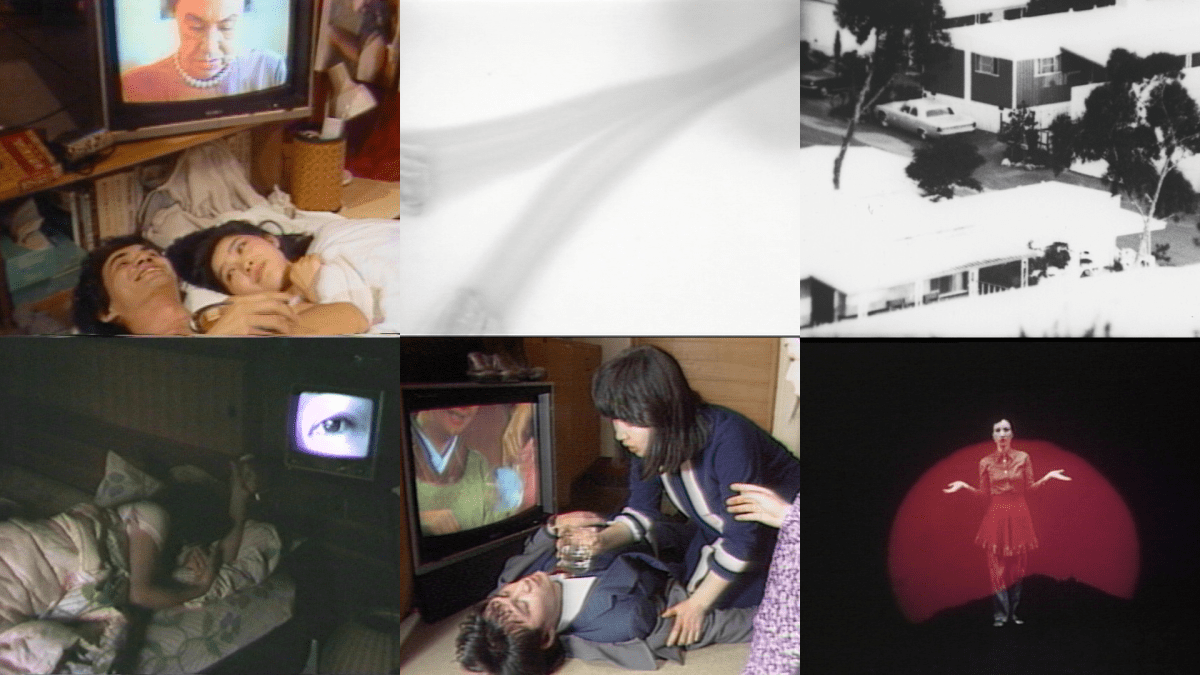
The retrospective Idemitsu Mako What a Woman Made, currently on view at the Tokyo Photographic Art Museum (July-September 2026), is one of the most comprehensive exhibitions ever devoted to the pioneering video artist and filmmaker. Bringing together films, video works, installations, and archival materials, it offers an unprecedented overview of more than five decades of Idemitsu’s artistic practice, tracing the evolution of a body of work that has consistently explored gender, domesticity, motherhood, and the mediated construction of female identity, especially in Japan.
I visited the exhibition, which also featured special screenings of Idemitsu’s works, over two days in July, immersing myself completely in her world. It was one of the most extraordinary artistic experiences I’ve had in 2026, an aesthetic revelation that continues to resonate within me.
From the museum’s homepage:
Idemitsu Mako (b. 1940) is a pioneering artist in the fields of experimental film and video art in Japan. After spending time in the United States during the 1960s, she began creating works that explored themes such as the lives of women, family, and the relationship between media and society, using film and early video as her mediums. Her video works from the 1970s onwards in
particular incorporate the narrative techniques of television melodramas to depict themes such as mother-child relationships, the dynamics of marriage, and women’s social roles from a unique perspective. In recent years, as the global conversation surrounding gender and the body continues
to grow, her practice has received renewed attention.
The Tokyo Photographic Art Museum acquired Idemitsu Mako’s complete film and video works, as well as her major installation pieces, between 2017 and 2018. This large-scale retrospective offers a comprehensive overview of Idemitsu’s artistic practice, including works that are being exhibited for
the first time since their acquisition by the museum. A total of 45 works, including those in the museum’s collection, will be presented through exhibitions and screenings.
As a future reference for myself and for anyone who might stumble upon this page, I’ll be publishing my notes on every work I saw during my two-day stay in Tokyo. They’re rough impressions rather than finished reviews, but I hope they’ll prove useful, whether as a personal archive or for readers interested in Idemitsu remarkable body of work.
Hopefully I longer piece will eventually emerge from this work in progress.
(Works are listed in the order I saw them)
Part 1
“My 16 mm works are about creating another world to escape the rigid routine of daily life. Even now, film retains something of that quality, whereas video is a reflection of everyday reality. These two mediums exist as completely distinct entities. When I shoot on film, I want to detach myself from daily life and capture images that are incredibly beautiful. I actually love these kinds of films. For me, film and video stand clearly apart from each other.”
Interview with Idemitsu Mako The Complete Works of Idemitsu Mako, 1970-1996, Pandora, 1996, p. 21
Another Day of a Housewife (1977) Video
Presented on a big television, this is the work that opens the exhibition.
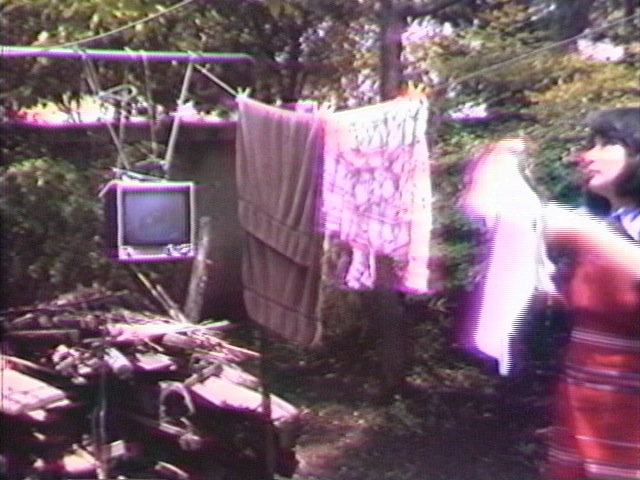
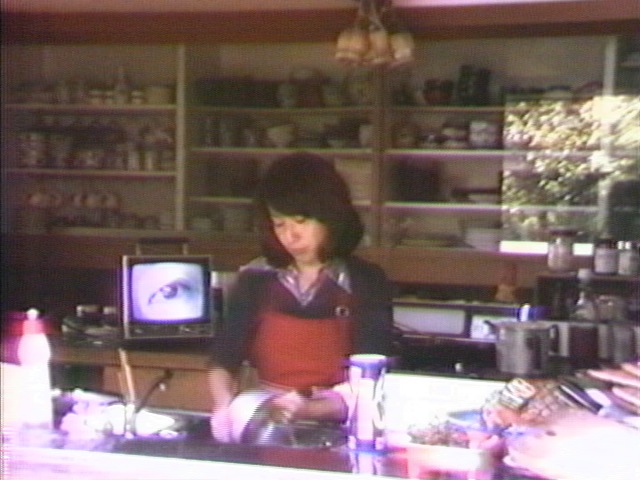
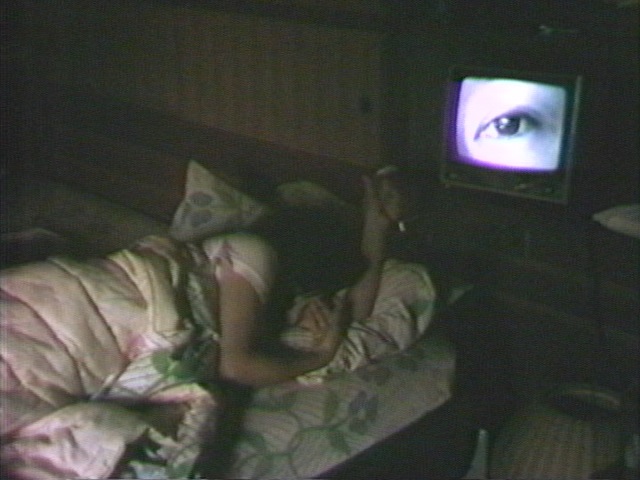
This early video observes the everyday routines of a housewife—played by Idemitsu herself—through a series of long, static takes. Waking up, cooking, washing the dishes, grocery shopping, hanging laundry, calling friends on the phone. Throughout the film, a giant eye—again, the filmmaker’s own—repeatedly appears on a television monitor, silently watching the protagonist.
The constant presence of this eye is deeply unsettling. It evokes the omnipresence of the media, but even more powerfully, especially in the film’s darker, more intimate scenes, it comes to embody the internalized gaze of society: an apparatus of self-surveillance through which the protagonist judges and disciplines herself. The eye is at once external and internal, suggesting that social expectations have become inseparable from the housewife’s own consciousness.
Although this is not the first work in which Idemitsu incorporates television monitors, Grandmother, Mother, Daughter (1976) is probably the one, it is perhaps the first in which they function as a channel and window to the protagonists’ inner world. This formal device would become increasingly central to her work throughout the 1980s, eventually evolving into one of the defining features of her visual language, often referred to as the “Mako Style.”
*
Woman’s House (1972) 16mm
First work in 16mm by Idemitsu, the film is the recording, a re-composition of Womanhouse, an exhibition conceived by Judy Chicago and Mirian Schapiro at the California Instutite of Arts in 1971.
Small objects, clothes, interiors of a room, curtains, dolls, everything bathed in bright light. The screen is saturated with white from the very first shot. Surreal: fake breast cover the ceiling and walls, later giving way to sunny-side-up eggs.
What a Woman Made (1973) video
Static white sceen with a voice talking on it, the topic is gender roles for children as expected and codified in Japanese society. The image on screen is out of focus, abstract-like, and only toward the end does it gradually come into focus, revealing a tampon swirling in a toilet bowl. Idemitsu’s first significant work, also from a feminist point of view.
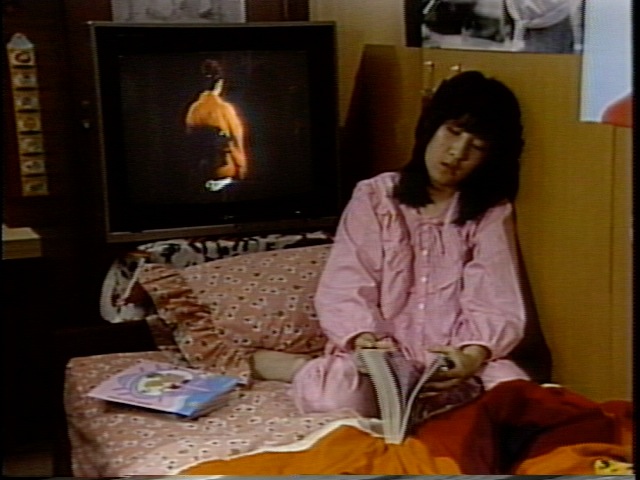
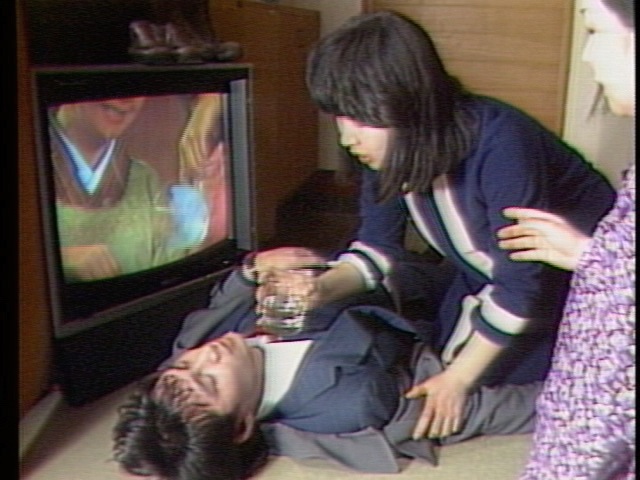
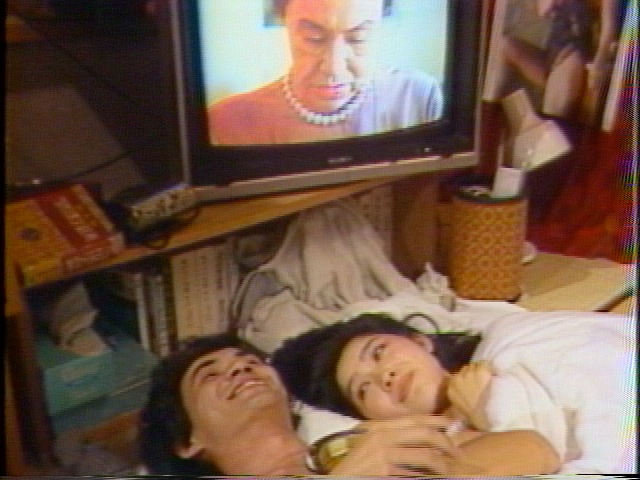
Great Mother (Harumi) (1983) video
Great Mother (YUMIKO) (1984) video
Great Mother (Sachiko) (1984)
Trilogy inspired by the Jungian concept of the “Great Mother”.
The relationship between mother and daughter varied in each work, but it’s alway excessive in hate or love.
The rebellious girl in the seond part seems to represent Idemitsu herself, who grew up in an affluent and powerful family.
In the last segment the mother/daughter relationship it’s not only very strong, but also a necessary shield, a safe space, against the violence, physical and mental, perpetrated daily by the husband (another vile male figure in the Idemitsu’s universe). Of the three the last is perhaps the nastiest in relation to the position and role played by the man, who is a representation of the alpha male/Japan/masculinity embedded in Japanese society.
Worth noting: in the last video, the television monitor is used also horizontally, as a table.
What is most astonishing here is the way the television monitors function not only as a means of materializing Jungian archetypes, but also of introducing multiple temporalities. They become windows onto the past or onto moments from another person’s life, collapsing different psychological and temporal dimensions into the same video space (“video is time” as Nam June Paik has stated and Maurizio Lazzarato expanded upon).
*
At Santa Monica 3 (1975) 16mm
Black-and-white silhouettes, the sun slowly setting, shifting patterns of light and shadow, reflections in constant motion. Accompanied by music by John Cage “String Quartet in Four Parts”, the film unfolds as an impressionistic vision of her house in Santa Monica and surroundings, where Idemitsu lived for many years. Probably the best work of her first period (in 16mm), at least amongst the ones I’ve seen.
Next (1973) 16mm
Single channel video form the original 16mm, Next collects together several works by artist CIBA: colorful geometrical shapes on white background, reds and yellows predominate.
At Any Place 4: From the Habanera of a Housewife by Yoneyama Mamako (1978) 16mm
Projected on a wall of the exhibition on single-channel video. Idemitsu continues her interest in shooting and re-elaborating on stage performances, here pantomime Yoneyama Mamako’s performance is overlayed with images of natural places she filmed. Visually and for its use of a wide range of music is a very fascinating work.
- images are from the artist’s official homepage


4 thoughts on “Idemitsu Mako What a Woman Made (2026)/part 1”